





Yes, focused bathroom remodeling SEO reliably produces higher-quality local leads once you fix your Google Business Profile and build service pages that actually convert. The fastest first move is a technical and GBP audit, not a blog calendar. Expect small visibility wins within a few months and a steady lead pipeline within about half a year to a year.
TL;DR:
- Focusing on Google Business Profile completeness and service page optimization delivers faster lead generation than generic content or blog posts.
- Prioritize technical site fixes and GBP setup within the first three months to establish a solid foundation for local SEO growth.
- Track phone calls and quote requests tied to specific pages and GBP insights to measure real lead conversion rather than rankings alone.
- Invest in phased SEO efforts: initial technical and profile fixes, followed by content and citations, then backlink building to support long-term growth.
- Use proven in-house or certified agency resources, avoiding promises of guaranteed rankings or reliance on link farms to ensure sustainable results.
Table of Contents
- What Does Bathroom Remodeling SEO Actually Do for Your Business?
- What Are the Core SEO Components Every Bathroom Remodeler Needs?
- A Phased SEO Roadmap for Bathroom Remodeling Companies
- How Do You Measure SEO Results for a Bathroom Remodeling Business?
- How Do You Choose the Right SEO Partner for Bathroom Remodeling?
- Why Certifications and In-House Execution Matter for Remodeler SEO
- What the Data Actually Supports for Remodelers
- Get Your Bathroom Remodeling SEO Roadmap Started
- Partner Resources and WWS Guides
- Sources
- FAQ
What Does Bathroom Remodeling SEO Actually Do for Your Business?
Search engine optimization for bathroom contractors works because it matches two very different buyer intents to two very different pages. Someone typing “bathroom remodel near me” or “walk in shower installation [city]” is close to hiring. Someone browsing “small bathroom remodel ideas before and after” is still shopping for inspiration but often converts weeks later after seeing your gallery.
Ranking for both means your service-area pages and your project galleries need to work together, not compete for the same keywords.
The KPIs that actually matter to a remodeler are not rankings. They’re:
- Phone calls tracked back to organic and map-pack visits
- Booked consults or estimate requests submitted through service pages
- Calls and direction requests logged inside your Google Business Profile insights
- Quote request form fills tied to specific project pages (walk-in showers, tub-to-shower conversions, full gutouts)
Local search carries outsized weight here because of how Google structures results for “near me” style queries. Google Partners certification exists precisely because agencies handling this kind of local intent need to direct access to Google’s own training and account support, not guesswork.
Pro Tip: If you only track one number this quarter, track the ratio of calls to GBP views. It tells you faster than rankings whether your profile is actually converting curiosity into phone calls.
The practical takeaway: a remodeler who ranks for “bathroom remodeling [city]” but has a thin, photo-free Google Business Profile is leaving calls on the table. The map pack and the website have to be optimized as one system, not two separate projects.
What Are the Core SEO Components Every Bathroom Remodeler Needs?
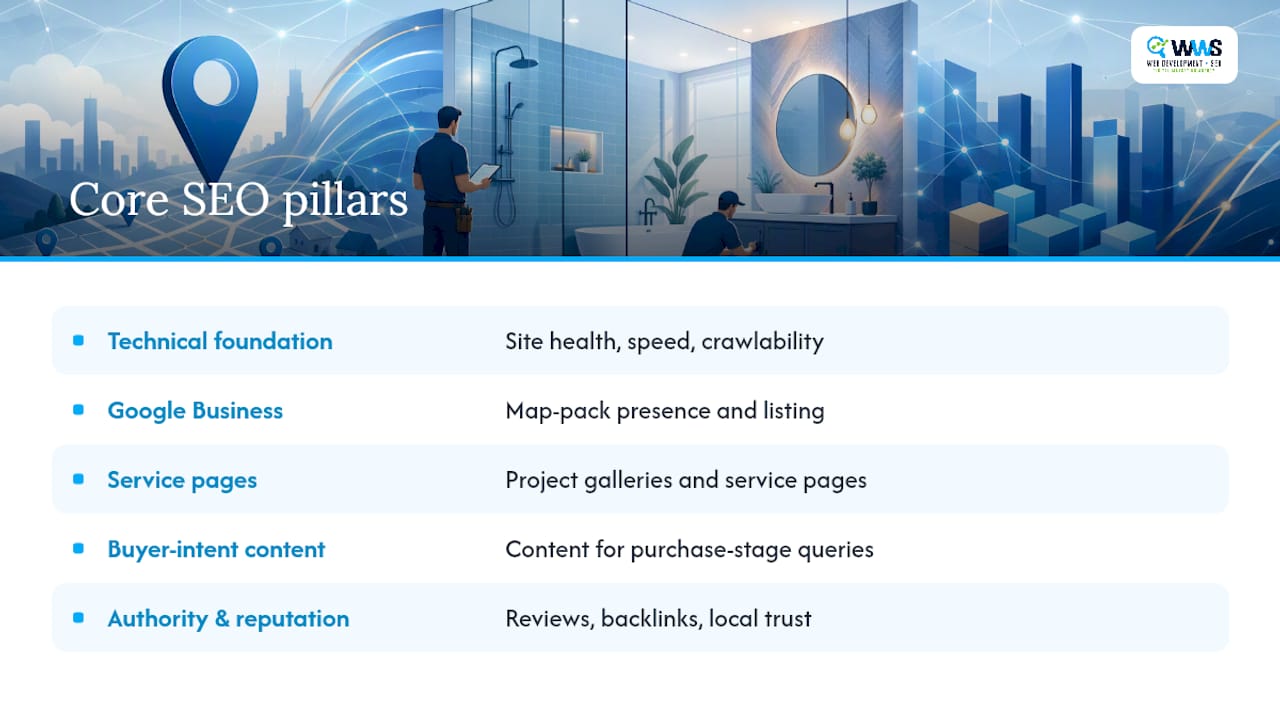
Five pillars carry almost all the weight in bathroom remodeling SEO. Skip one and the rest underperform, because Google and your prospective customers judge the whole experience, not isolated tactics.
Technical foundation
Site speed, mobile responsiveness, and clean crawlability come first because nothing else works if Google can’t index your pages or a homeowner bounces before your gallery loads. Schema markup matters more here than most contractors realize: LocalBusiness schema on your homepage, Service schema on individual offer pages, and structured data on project galleries help search engines understand exactly what you do and where. If a site rebuild is coming, a 4 to 8 week migration checklist can protect existing rankings during the switch instead of resetting your progress to zero.
Google Business Profile and map pack presence
Your GBP category selection, listed services, photo volume, weekly posts, and Q&A responses all feed the map pack algorithm. Review management belongs here too. A Google Business Profile optimization approach that treats reviews as an ongoing campaign, not an afterthought, tends to outperform a profile that gets updated once and ignored.
Service pages and project galleries
Generic “our services” pages rarely convert. Pages built around specific jobs (walk-in shower conversions, tub replacements, full bathroom gutouts) paired with real project photography and a visible phone number consistently pull more consult requests. A service page framework built around clear calls to action and local keyword targeting turns a static portfolio into a lead form.
Content strategy built on buyer intent
Project case studies, fixture-specific pages, and blog posts answering real questions (“how long does a bathroom remodel take,” “what does a mid-range bathroom remodel cost in [city]”) build the topical depth Google rewards. Structured, well-tagged content also matters as AI-driven discovery tools increasingly surface local businesses based on content clarity rather than keyword density alone.
Authority and reputation signals
Local citations, contractor association memberships, supplier partnerships, and steady review velocity build the trust signals Google weighs alongside the on-page content. A case study pattern from another local service business shows what this looks like in practice: GBP optimization and targeted local campaigns working together to surface contact-focused leads rather than passive traffic.
A Phased SEO Roadmap for Bathroom Remodeling Companies
Bathroom remodeling SEO rewards sequencing. Attacking every pillar at once spreads a limited budget too thin; a phased build compounds results instead.
- Phase A, months 0 to 3: Foundation. Run a full technical and GBP audit, fix crawl errors and page speed issues, complete every GBP field (categories, services, attributes, service area), and publish your three or four highest-intent service pages first (walk-in showers, tub-to-shower conversions, full remodels). This phase is where a small budget should concentrate entirely.
- Phase B, months 3 to 6: Growth. Build a repeatable project gallery system so every completed job becomes a new page with before-and-after photos and location tags. Launch a local citation cleanup and a structured review request campaign tied to project completion. Start publishing buyer-intent content addressing cost, timeline, and material questions.
- Phase C, months 6 to 12: Scale. Pursue backlinks through supplier and contractor partnerships, expand content into fixture and material comparison pages, and run conversion rate optimization tests on your highest-traffic service pages. This is also when ROI-first link building tactics pay off, since your foundation is stable enough to support outreach.
Pro Tip: If your monthly budget is tight, spend Phase A dollars on GBP completeness and one great service page before touching blog content. A perfectly optimized service page with three reviews outperforms ten mediocre blog posts with zero.
For remodelers who want faster testing during Phase A or B, running local paid ads alongside organic work lets you validate which service pages and offers convert before you invest months of content effort behind them. Retainer clients typically run all three phases concurrently at a lower intensity, while project-based budgets tend to front-load Phase A and revisit B and C later once early leads fund the next round.
How Do You Measure SEO Results for a Bathroom Remodeling Business?
Attribution starts with call tracking numbers on your website and GBP listing, UTM tagging on any paid or campaign links, and booking or form integrations that log where a lead originated. Without this, you’re guessing whether that spike in consults came from organic search or a referral.
Timelines follow a predictable pattern. First local ranking movement on lower-competition service terms typically shows up in the first 4 to 8 weeks. Map-pack entry for competitive “near me” terms usually takes longer, often several months depending on your existing review count and citation consistency. Steady, monthly-predictable inbound leads tend to arrive within about half a year to a year.
| Budget shape | What it typically covers | Best fit |
|---|---|---|
| One-time technical fix | Site speed, schema, crawl error cleanup, GBP setup | Newer sites or a pre-launch cleanup |
| Monthly retainer, lower tier | GBP management, one to two new service pages, basic citation building | Solo operators and small crews |
| Monthly retainer, higher tier | Full content calendar, gallery system, link outreach, review campaigns, CRO testing | Multi-crew remodelers scaling across service areas |
How Do You Choose the Right SEO Partner for Bathroom Remodeling?
Vetting an agency for bathroom remodeling online marketing comes down to proof, not promises. Ask to see a recent local case study with before-and-after ranking or lead data, a sample of GBP improvements they’ve made for a similar contractor, and one actual service page they built, not a template mockup.
Watch for these red flags before signing anything:
- Guaranteed rankings or a specific position promised on a timeline
- No in-house technical staff, meaning your work gets outsourced to unnamed subcontractors
- Vague monthly reports with no call tracking, ranking data, or GBP insights attached
- Reliance on link networks or bulk citation submissions instead of earned local authority
Prioritize agencies with direct home improvement or contractor experience, an in-house execution team you can actually talk to, and a written set of KPIs and timeline milestones before the contract starts. If an agency can’t tell you what “success in month three” looks like in specific numbers, that’s a scoping problem you’ll inherit later.
Why Certifications and In-House Execution Matter for Remodeler SEO
Google Partner and Meta Partner status isn’t a badge for decoration. It means the team executing your campaigns has been through Google’s own partner certification process and has direct lines into product training and support when something breaks on the ad or account side.
WWS – Web Development + SEO runs every part of this roadmap in-house: design, development, technical SEO, GBP management, and content, with no outsourced subcontractors touching your account. That structure, paired with over 200 client partnerships, is what makes the phased roadmap above executable rather than theoretical. Readers wanting a closer look at proof patterns can review the Kitchen and Bath Direct case study for how GBP and service-page work translate into local visibility for a remodeler-adjacent business.
What the Data Actually Supports for Remodelers
Most SEO advice aimed at contractors treats blog content as the centerpiece and GBP as an afterthought. That ordering is backwards for bathroom remodeling. The map pack, not the organic ten-blue-links section, is where a homeowner searching “bathroom remodel near me” makes their first decision, and a thin GBP profile undercuts even a technically excellent website.
The conventional advice also overrates volume. Twenty generic blog posts move the needle less than three sharp project pages with real photos and a phone number above the fold. Content earns its keep only when it’s built around actual buyer questions about cost, timeline, and process, not keyword density.
If you’re starting from zero, prioritize the boring work first: GBP completeness, review velocity, and one or two service pages built around your highest-margin job types. Everything else in the roadmap, content expansion, link outreach, CRO testing, compounds on top of that foundation. Skip it, and you’re building a content strategy on sand.
— Online Marketing Experts
Get Your Bathroom Remodeling SEO Roadmap Started
The audit, the GBP fixes, and the service page builds all come from one team, not passed among multiple subcontractors. That matters most for remodelers who’ve been burned by agencies promising rankings and delivering vague monthly PDFs.
As an official Google and Meta Partner serving Des Plaines and the greater Chicago Area, our certified team handles technical audits, Local SEO campaigns, and Google Business Profile management without outsourcing a single piece of the work. A typical first 30 to 60 days covers your technical and GBP audit, quick-win fixes, and your first two priority service pages, the same Phase A work outlined above. If you want full Website SEO built around your service area and project galleries from day one, start with a strategy call and we’ll map your first three months before you commit to anything longer.
Partner Resources and WWS Guides
For deeper implementation help alongside this roadmap:
- ROI-first link building tactics for the authority phase
- Google Business Profile optimization guide for map-pack tactics
- Service Page SEO framework for conversion-ready builds
- Local SEO checklist for citation cleanup
Sources
FAQ
What is a realistic budget for a bathroom remodel?
Realistic bathroom remodel budgets vary widely by scope, ranging from cosmetic refreshes to full gut renovations with structural changes. Most remodelers quote based on square footage, fixture quality, and whether plumbing or electrical work is involved, so exact figures depend on your local market and project scope.
What does a $10,000 bathroom remodel look like?
A bathroom remodel that covers cosmetic updates like new flooring, a vanity, fixtures, paint, and lighting typically does not include major structural or plumbing changes. Such a remodel rarely covers a full gut renovation, especially if the layout changes or new plumbing lines are needed.
Is $10,000 enough for a bathroom remodel?
A moderate refresh of an existing layout usually does not include a full renovation involving new plumbing, structural changes, or high-end fixtures. The final cost depends heavily on local labor costs and material choices.
What is an SEO contractor?
An SEO contractor or agency is a specialist who improves a business’s visibility in search engines and local map results through technical fixes, content, and Google Business Profile management. For bathroom remodelers specifically, this means building service pages and local citations that turn searchers into booked consults, which is the core focus of WWS’s Local SEO service.
How long does bathroom remodeling SEO take to show results?
Early ranking movement on lower-competition terms often appears within 4 to 8 weeks, while map-pack entry for competitive local terms and a steady lead flow typically take 6 to 12 months. Timelines depend on your existing review count, citation consistency, and how quickly technical fixes get implemented.