





Remodeling contractor SEO works when it prioritizes three things: project-specific service pages, a fully optimized Google Business Profile, and a steady stream of reviews and project photos tied to call tracking. Contractors should claim and verify their Google Business Profile, split generic service pages into individual project pages, add call tracking, request reviews from recent clients, and fix page speed issues before anything else. These five moves target homeowners who are already comparing bids, which converts faster than blog traffic ever will.
TL;DR:
- Prioritizing project-specific service pages and consistently updating Google Business Profile with fresh photos, posts, and reviews significantly boosts local visibility and lead quality.
- Building dedicated pages for each project type and neighborhood captures high-intent searches, with optimized images, descriptive alt text, and clear calls to action improving conversions.
- Implementing call tracking with unique GBP numbers and linking SEO efforts to booked jobs ensures measurable ROI and keeps contractor marketing efforts focused on revenue-generating activities.
- Maintaining a steady stream of detailed reviews and project photos on Google and your website enhances trust and reinforces search relevance in competitive local markets.
- Outsourcing SEO to an in-house, certified team provides faster, more consistent results through integrated management of GBP, website, content, and review programs.
Table of Contents
- Why Remodeling Contractor SEO Is Different From General SEO
- Google Business Profile and Map-Pack Priority: Setup and Maintenance
- Service Pages and Project Pages: The Structure That Converts
- How to Find Project Keywords That Actually Convert
- On-Page and Technical Fixes Contractor Sites Need
- Reviews and Project Photos as Ranking and Conversion Signals
- Local Citations, Partnerships, and Link Tactics Worth Your Time
- Tying SEO to Booked Projects and Revenue
- Should You Hire an Agency for Remodeling Contractor SEO?
- What an In-House Certified Agency Brings to Remodeler SEO
- How WWS – Web Development + SEO Builds SEO Systems for Remodelers
- Sources
- FAQ
Why Remodeling Contractor SEO Is Different From General SEO
Most SEO advice assumes you’re building an audience. Remodeling contractors aren’t building an audience. They’re trying to get twelve phone calls a month from homeowners who already know they want a bathroom gutted or a kitchen redone. That distinction changes everything about how the work should be prioritized.
Home remodeling SEO blends local SEO, dedicated project pages, reputation management, and conversion optimization into one system, rather than treating content volume as the goal. A remodeler ranking for “general contractor near me” but burying their bathroom remodel gallery three clicks deep is losing jobs to a competitor with a worse website but a clearer path from search result to phone call.
Results build gradually. Most contractors start seeing meaningful movement in the map pack and organic results within several months, and momentum compounds over time as reviews stack up and project galleries build authority that’s hard for new entrants to match quickly. A contractor with 80 Google reviews and 40 documented projects has a moat that a rival with a prettier website but no track record can’t cross overnight.
The metrics that matter aren’t rankings. They’re:
- Calls generated from the Google Business Profile listing
- Quote request form submissions tied to specific service pages
- Booked consultations, not just leads
- Revenue attributed back to specific pages or campaigns
If an SEO effort can’t connect to one of those four outcomes, it’s not worth the contractor’s time or budget. Ranking #1 for a keyword nobody searches with intent to hire is a vanity metric, not a business result.
Google Business Profile and Map-Pack Priority: Setup and Maintenance
For most remodelers, Google Business Profile is the single highest-leverage asset in the entire SEO strategy, ahead of the website itself. The map pack sits above organic results on most local searches, and it’s often the first thing a homeowner taps on their phone.
Category selection matters more than most contractors realize. Pick the most accurate primary category (General Contractor, Remodeler, or Kitchen Remodeler, depending on your actual focus) and add secondary categories only when they genuinely reflect services you perform regularly. Listing every possible category to “cast a wide net” dilutes relevance signals and can actually hurt placement for your core service.
Service area settings deserve the same discipline. List the specific cities and neighborhoods you actually serve well, not every town within an hour’s drive. Google rewards accurate, complete business information over inflated coverage claims, and homeowners searching from outside your real service radius won’t convert anyway.
A weekly GBP routine keeps the profile active, which Google treats as a freshness signal:
- Upload two to four new project photos with descriptive file names and captions.
- Publish a Google Post about a recent job, a seasonal offer, or a completed project.
- Check the Q&A tab and answer any new questions within 48 hours.
- Respond to every new review, positive or negative, promptly.
- Review the Insights tab for call and direction-request volume trends.
Keep the language on your GBP posts and descriptions consistent with your service pages. If your kitchen remodel page talks about “custom cabinetry” and “quartz countertops,” use those same terms in your GBP posts so the profile and the website reinforce each other.
Pro Tip: Tie a unique tracking phone number to your GBP listing specifically, separate from the number on your website. That’s the only reliable way to know how many actual calls come from the map pack versus organic search.
WWS – Web Development + SEO’s Google Business Profile optimization work follows this exact cadence for remodeling clients, because a dormant profile loses map-pack position within weeks.
Service Pages and Project Pages: The Structure That Converts
A single “Remodeling Services” page trying to rank for kitchens, bathrooms, basements, and additions all at once will lose to competitors who built one focused page for each. Search engines and homeowners both reward specificity. Someone searching “bathroom remodel [city]” wants a page about bathroom remodeling, not a paragraph buried in a general services list.
The fix is a repeatable template applied to every major project type and, ideally, to standout individual projects:
- A headline that names the service and the location together (e.g., “Kitchen Remodeling in Naperville, IL”)
- A scope section describing exactly what’s included (demo, plumbing, electrical, finishes)
- A plain-language process walkthrough, from consultation to final walkthrough
- Realistic timeline ranges, so homeowners can plan around the project
- Budget guidance, even as ranges, since “how much does this cost” is the question most homeowners actually have
- A gallery of real photos from completed jobs, not stock images
- A short testimonial pulled from an actual client review
- A focused FAQ answering three or four common objections
- One clear call to action, ideally a quote request form above the fold
Individual project (case) pages do even more work. A dedicated page for “Ranch Kitchen Remodel in Aurora” captures long-tail, neighborhood-specific searches that a generic service page never will, and it gives homeowners proof you’ve done this exact type of project before. A focused, single-purpose page structure also prevents your own pages from competing against each other for the same search terms, which happens more often than most contractors realize.
Photo optimization on these pages isn’t optional polish. Compress images, name files descriptively (kitchen-remodel-aurora-il-before-after.jpg, not IMG_4821.jpg), and write alt text that describes the actual work shown. WWS – Web Development + SEO’s approach to contractor website design treats every project page as a conversion tool first, not a portfolio piece second.
How to Find Project Keywords That Actually Convert
There’s a real difference between someone searching “how long does a kitchen remodel take” and someone searching “kitchen remodel contractor Schaumburg.” The first is researching. The second is hiring. Both matter, but they need different pages and different priorities.
Project keywords, the phrases that combine a service with intent to hire, tend to include location, project type, and sometimes urgency or cost language. Targeting these decision-stage phrases captures homeowners closer to picking a contractor, which is why they should get the strongest pages on the site.
A simple keyword-mapping matrix keeps this organized:
- Service pages target “[project type] contractor [city]” and “[project type] remodel [city]”
- Cost and timeline guides target “how much does [project] cost” and “how long does [project] take”
- Project galleries target neighborhood-specific and style-specific searches (“mid-century kitchen remodel,” “farmhouse bathroom [city]”)
- FAQ and blog posts target informational questions that support, but don’t replace, the service pages
For validation, Google Ads Keyword Planner gives a free, direct read on search volume and related terms straight from Google’s own data. A quick manual check works too: search the phrase yourself and look at what’s already ranking. If the results are all contractor websites with quote forms, that’s a buying-intent term worth a dedicated page. If the results are blog posts and Reddit threads, it’s informational, and belongs in supporting content instead.
On-Page and Technical Fixes Contractor Sites Need
A beautifully written service page that takes seven seconds to load on a phone won’t convert, and it likely won’t rank well either. Technical SEO for contractor sites isn’t complicated, but it’s easy to neglect.
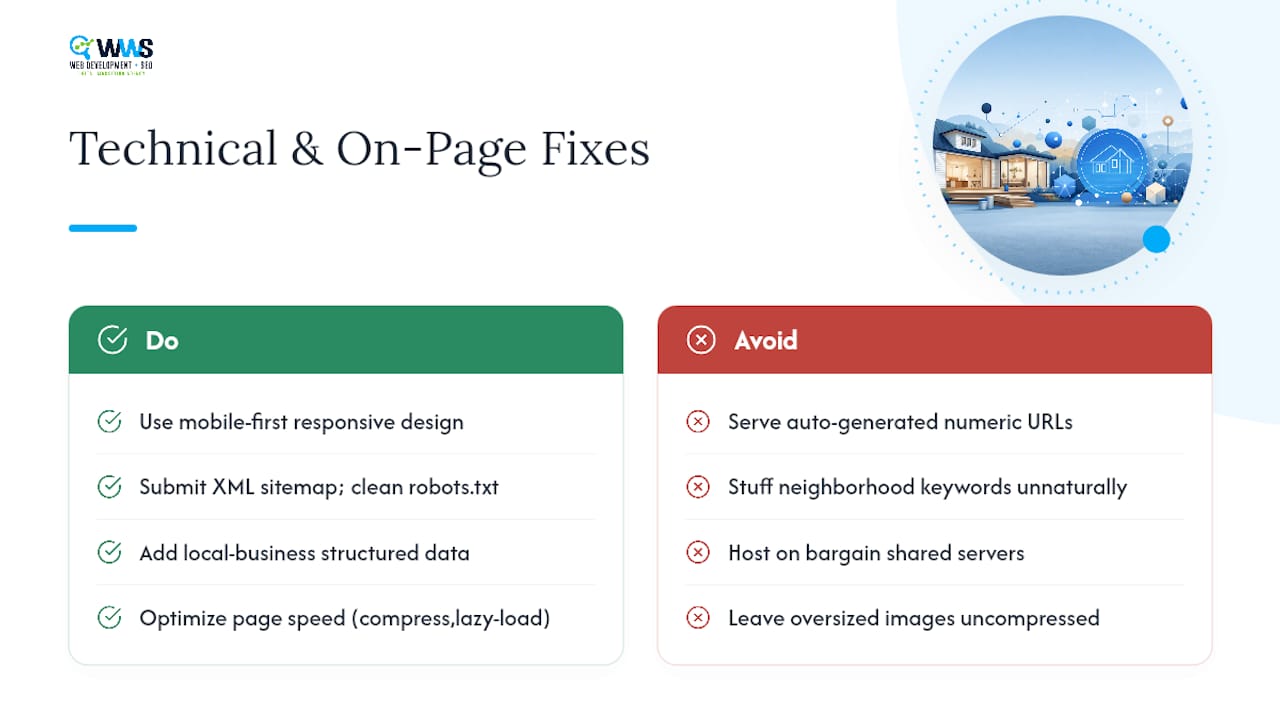
Start with the basics: a mobile-first responsive layout (most remodeling searches happen on a phone from someone’s kitchen or driveway), a submitted XML sitemap, a clean robots.txt file, and simple URL structures like /kitchen-remodeling-aurora-IL/ instead of auto-generated strings full of numbers. Add local-business structured data to service and project pages so search engines can directly parse your business name, address, phone number, service area, and reviews.
Page speed deserves particular attention because contractor sites tend to be photo-heavy. Run every key page through PageSpeed Insights, which flags oversized images, render-blocking scripts, and layout shift issues that hurt both rankings and real user experience. Compress every gallery image, lazy-load anything below the fold, and choose hosting built for image-heavy sites rather than a bargain shared server.
Speed shapes conversions directly. Faster-loading contractor sites convert better and hold rankings more reliably, because PageSpeed Insights data reflects the same load-time factors that frustrate real visitors on a job-site phone connection.
Round it out with on-page basics: service-focused H1 and H2 headings, natural mentions of the neighborhoods you serve (never stuffed), and internal links running from project pages back to the relevant service page. That internal linking pattern helps both search engines and homeowners understand how your work connects across project types.
Reviews and Project Photos as Ranking and Conversion Signals
Reviews function as both a ranking signal and the single biggest trust builder on your entire site. A remodeler with 150 detailed Google reviews beats a remodeler with 12 generic ones, even with a weaker website, because homeowners are hiring someone to spend weeks in their home.
A repeatable collection system beats sporadic requests every time:
- Send a review request by text message shortly after project completion, while the finished result is still fresh.
- Follow up by email if no review has come in, with a direct link to your Google review page.
- Ask a specific question in the request (“What was the biggest difference the new kitchen made for your family?”) rather than a generic “please leave us a review,” since specific prompts produce more detailed, more useful reviews.
- Pair every review request with a request for photos of the finished space, which you can use in galleries and social posts.
Feature real reviews directly on service and project pages, not just on a separate testimonials page nobody visits. Pull a line or two into the FAQ section too. When a review answers “did they finish on time,” that’s free, credible content that answers a real homeowner objection.
Negative reviews need a calm, factual public response, never a defensive one. Acknowledge the issue, note what was done to address it, and move the conversation offline. Homeowners reading reviews pay close attention to how a business handles a complaint, sometimes more than the complaint itself.
Pro Tip: Screenshot your best reviews and turn them into simple graphics for social media. It costs nothing and gives your review content a second life beyond the GBP listing.
Local Citations, Partnerships, and Link Tactics Worth Your Time
Citation building for remodelers doesn’t need to be complicated, but it needs to be consistent. Your business name, address, and phone number (NAP) should match exactly across every directory: Google Business Profile, Yelp, Angi, Houzz, Better Business Bureau, and any local chamber of commerce listing. Even small inconsistencies, like “St.” versus “Street,” can weaken the trust signals these platforms send to search engines.
Beyond the standard directories, a few link sources carry real weight for remodelers:
- Supplier and manufacturer sites that feature contractor case studies (cabinet makers, window manufacturers, tile suppliers)
- Local news or home-and-garden media covering neighborhood projects
- Trade association pages, especially state or regional remodeling associations
- Project spotlights from architects or designers you’ve partnered with on a job
Broader link-building tactics like targeted outreach apply here too. Reaching out to a supplier whose product you used on a standout project, and offering photos in exchange for a feature, tends to work better than cold outreach to unrelated sites.
Avoid the shortcuts that used to work and now actively hurt you: bulk directory submission services, paid or reciprocal link exchanges, and link farms unrelated to home improvement or local business. These patterns are easy for Google to detect, and the downside outweighs any short-term gain.
Tying SEO to Booked Projects and Revenue
None of this matters if you can’t show an owner that SEO produced actual booked jobs. The measurement setup doesn’t need to be elaborate, but it does need to exist from day one.
- Install call tracking with a dynamic number insertion tool so calls from organic search, GBP, and paid ads are tagged separately.
- Use consistent UTM parameters on any links shared in email, social posts, or directory listings so traffic sources stay distinguishable in analytics.
- Tag every quote request form submission with its source page and route it into a CRM or even a shared spreadsheet, so leads can be traced from click to signed contract.
- Match booked jobs back to their original lead source monthly, so the connection between a specific page and real revenue becomes visible over time.
Monthly reporting should stay simple: total calls, quote requests, booked consultations, and the conversion rate from lead to signed job. Showing an owner “we generated 34 calls and closed 9 jobs worth $210,000” lands harder than any ranking report ever will.
Contractors without a dedicated analytics team can still run this. The goal is a clear line from search visibility to dollars in the bank, not a dashboard full of metrics nobody checks.
Should You Hire an Agency for Remodeling Contractor SEO?
The honest answer depends on capacity, not ambition. A contractor with the time to update GBP weekly, write project pages, and chase down reviews can absolutely run a lean version of this system alone. A contractor buried in job-site management, with no time for content or technical fixes, usually loses more money delaying than they would spend hiring help.
DIY tends to make sense when the business is small, the owner has a few hours a week, and the website already has a solid technical foundation. Hiring makes more sense once lead volume needs to scale, technical debt has piled up, or the owner has tried DIY for six months with no measurable movement in calls or quote requests.
If you’re evaluating an agency, ask for specifics, not promises:
- Can they show documented case studies with real before-and-after metrics, not just screenshots of ranking positions?
- Is the work done in-house, or outsourced to subcontractors you’ll never talk to directly?
- Can they show actual GBP and service-page examples from other remodeling or contractor clients?
- Do they provide a tracking and reporting template before you sign anything, or promise to “figure it out later”?
- Are they a verified Google Partners agency, and can they explain what that certification actually covers?
Watch for red flags that show up constantly in this industry: guaranteed #1 rankings (no legitimate agency can promise this), vague monthly reports with no call or lead data, zero examples from local contractor clients, and no conversion tracking discussion at all. An agency that can’t explain how they’ll measure booked jobs isn’t ready to be trusted with your marketing budget.
What an In-House Certified Agency Brings to Remodeler SEO
Handled properly, remodeler SEO is one connected system: GBP optimization, service and project pages, gallery production, review collection, and call tracking, all built to reinforce each other. Splitting that work across three freelancers and a separate web developer creates handoffs, and handoffs create delays and inconsistent messaging across the site.
WWS – Web Development + SEO built its process specifically to avoid that fragmentation, running GBP, website, and content work through one certified in-house team rather than outsourcing pieces to subcontractors. At As an official Google and Meta Partner, the team holds Google and Facebook certifications directly, and has completed over 200 client partnerships across contractor, restaurant, and local service categories in the Chicago area.
The practical advantage of in-house delivery is speed without sacrificing quality: a GBP change and a service page update can happen in the same week, by people who already know the account, instead of waiting on three separate vendors to sync up.
— Online Marketing Experts
How WWS – Web Development + SEO Builds SEO Systems for Remodelers
WWS – Web Development + SEO gives Chicago-area remodelers a single accountable team instead of the usual patchwork of a web developer, a separate SEO freelancer, and an agency managing reviews on the side. Every piece, from GBP setup to call tracking, runs through one in-house group that already knows your account.
For remodeling contractors, that work includes custom-built service and project pages, full Google Business Profile optimization, project-gallery production designed to convert browsers into quote requests, structured review collection programs, call tracking setup, and monthly reporting tied to actual booked jobs, not just rankings. As an official Google and Meta Partner with over 200 successful local client partnerships, WWS – Web Development + SEO applies the same in-house process across contractors, restaurants, and other Chicago-area service businesses.
If your current site is missing dedicated project pages, your GBP hasn’t been touched in months, or you simply don’t know which calls are coming from search, a local SEO strategy built for service businesses is the logical next step. Contractors ready to see what a focused, in-house build looks like for their own business can request a consultation to find a web developer nearby with a real portfolio of custom-coded remodeling sites.
Sources
A handful of resources cover most of what a contractor needs to check work or verify an agency’s claims:
- Local business structured data (Google Developers)
- PageSpeed Insights
- Google Partners agency listing
- How to rank for project keywords: Remodeling Contractor SEO Guide (DailyMoss)
FAQ
How much should I pay for SEO services?
Costs vary widely by market and scope, but most local service businesses budget a monthly retainer rather than a one-time fee, since SEO results build over 3 to 12 months and require ongoing GBP, content, and review work rather than a single project.
What is an SEO contractor?
An SEO contractor, in this context, refers to a remodeling or construction business optimizing its own online visibility, not a company that performs SEO as its trade; the strategies covering GBP, service pages, and reviews apply directly to contractors marketing their own services.
What is the 80/20 rule in SEO?
Applied to remodeler SEO, the 80/20 rule means roughly 80% of leads typically come from a small set of high-intent assets, usually the Google Business Profile and a handful of well-built project pages, rather than from broad blog content or low-intent keywords.
How do I advertise a remodeling company?
The strongest combination pairs an optimized Google Business Profile and dedicated project pages with a steady review program and call tracking, so every dollar spent on ads or SEO can be traced back to actual booked consultations rather than raw traffic.