





The three highest-impact moves for kitchen remodeling SEO are optimizing your Google Business Profile, building dedicated project pages targeting local keywords, and running a review-driven map-pack strategy. Together they close most of the gap between an invisible contractor and one booking consultations weekly. Expect meaningful movement over several months, not overnight. A certified in-house Google and Meta Partner builds this exact stack for remodelers across the Chicago area.
TL;DR:
- Claiming and optimizing your Google Business Profile with complete services, accurate categories, and regular project photos can produce visible results within about a month.
- Fixing critical technical issues like slow page speed and image optimization should be addressed within one to two weeks for immediate ranking benefits.
- Creating dedicated project pages and service-area landing pages requires several weeks but significantly improves local relevancy and search visibility over time.
- Collecting detailed, service-specific reviews promptly after project completion boosts map-pack rankings and trust signals, especially when reviews mention specific services and locations.
- Prioritizing foundational SEO elements over content creation ensures long-term growth; patience and consistent tracking are key to measuring true lead generation improvements.
Table of Contents
- Priority Checklist for Kitchen Remodeling SEO
- How Do You Optimize Google Business Profile for Kitchen Remodeling?
- What Makes a Kitchen Remodeling Project Page Rank?
- Why Do Page Speed and Mobile Issues Hurt Remodeling SEO?
- What Content Attracts Homeowners at Each Stage of Research?
- How Should Remodelers Collect and Manage Reviews?
- How Do You Measure SEO Results for a Remodeling Business?
- Should Remodelers Use Paid Ads and AI Alongside SEO?
- Should You DIY Your SEO or Hire a Specialist Agency?
- What Kitchen Remodelers Get Wrong About SEO Priorities
- Get Your Kitchen Remodeling Playbook Built by WWS
- Sources
- FAQ
Priority Checklist for Kitchen Remodeling SEO
Not every task deserves equal attention this month. Some fixes move rankings in weeks; others compound over a year. Here’s the order that actually produces leads, ranked by impact against effort.
- Claim and fully build out your Google Business Profile. Add every service (cabinet refacing, island installs, full gut remodels), select accurate categories, and upload real project photos. This is a same-week fix with visible impact within about a month.
- Fix the top 3 technical issues flagging on PageSpeed Insights. Slow, bulky image galleries kill both rankings and patience. Budget one to two weeks depending on developer availability or resource capacity.
- Launch service-area landing pages for your top 3 to 5 target cities or neighborhoods. Each page needs unique copy, not a swapped city name on a template. This typically takes a few weeks to write and index properly.
- Publish individual project pages for your last 10 to 15 completed jobs. Each one is a standalone SEO asset with its own keywords, photos, and story. Plan on rolling these out over several weeks to a couple of months.
- Build a standing review request workflow. Automate the ask at project completion so reviews accumulate without manual chasing. Set up once, run indefinitely.
- Develop a content calendar mixing cost guides, trend posts, and FAQs. This is the long game: allocate one to two pieces monthly for the next six to twelve months.
- Pursue local citations and supplier backlinks. Slow to build, but it compounds domain authority over time.
Assign items 1 through 3 to whoever manages your Google Business Profile or hire it out immediately. Items 4 through 7 work well delegated to a marketing contractor or handled by an agency retainer, since they require sustained attention rather than a single sprint. For a broader framework on sequencing local visibility work, this local SEO checklist breaks down the same logic across business types.
How Do You Optimize Google Business Profile for Kitchen Remodeling?
Local search is the primary driver of kitchen remodeling leads, and an optimized Google Business Profile with active photo uploads and service-specific reviews is what gets a remodeler into the map pack in the first place. Homeowners searching “kitchen remodeler near me” rarely scroll past the top three map results, so this profile is the highest-leverage asset you own.
Start with categories and services. Your primary category should be the most specific accurate option, then list every individual service under the Services tab such as cabinet refacing, countertop installation, island builds, and full gut renovations. Vague categories dilute relevance signals Google uses to match your listing to a search.
Photos matter more than most contractors assume. Upload finished project shots weekly, not in a single dump after signing up. Name image files descriptively before upload (“white-shaker-kitchen-remodel-naperville.jpg” beats “IMG_4821.jpg”), and write captions that mention the specific service and neighborhood.
Reviews need structure, not luck:
- Ask shortly after project completion, when satisfaction peaks.
- Send a direct link with a short prompt asking clients to mention what was done (“cabinet refacing,” “island installation”) rather than a generic thumbs-up.
- Respond to every review within 48 hours, referencing the specific project when possible.
- Flag and professionally respond to negative reviews rather than ignoring them.
Pro Tip: Ask happy clients to mention the room and the specific service in their review text. “Best kitchen remodeler” ranks you for nothing specific. “Redid our kitchen island and cabinets in Schaumburg” ranks you for exactly what people search.
Citation consistency rounds this out. Your business name, address, and phone number need to match exactly across Yelp, Houzz, Angi, and the Better Business Bureau. Mismatched suite numbers or phone formats confuse Google’s trust algorithms more than owners realize. For a deeper walkthrough of the profile setup itself, see this Google Business Profile optimization guide.
What Makes a Kitchen Remodeling Project Page Rank?
Every completed job deserves its own page, not a line item buried in a gallery. A dedicated project page is a standalone piece of on-page SEO for kitchen design work, and it’s often the single most underused asset on a remodeler’s site.
Structure each page around a clear formula: headline naming the project type, location, and core service (“Modern Farmhouse Kitchen Remodel in Naperville”), followed by a descriptive lead paragraph covering the homeowner’s goals and the scope of work. Visual assets alone don’t rank; they need to be made discoverable through SEO so search engines and homeowners can actually find them.
Below the lead paragraph, include the details homeowners are actually researching:
- Project specs: square footage, layout changes, and timeline from demo to completion.
- Materials used, including cabinet brand, countertop material, and flooring.
- Before-and-after photo sets, minimum 6 to 10 images per project.
- A short client story or challenge the project solved.
Image SEO carries real weight on visually driven pages. Every photo needs a descriptive filename, alt text describing the specific feature (“quartz waterfall island in Aurora kitchen remodel”), and a caption. Serve images through srcset for responsive sizing and compress everything to WebP or AVIF before upload; a gorgeous gallery that loads slowly loses more leads than it wins.
Structured data closes the loop. Add LocalBusiness schema site-wide, Service schema on each service page, and ImageObject schema on project galleries so search engines understand what they’re looking at, not just what they’re seeing.
Finally, every project page needs a clear path to contact: a click-to-call phone number, an estimate request form above the fold, and a budgeting prompt that sets expectations before the homeowner even calls.
Why Do Page Speed and Mobile Issues Hurt Remodeling SEO?
Kitchen remodeling sites live and die on photography, and that’s exactly what tanks their speed scores. High-resolution galleries must be compressed and delivered in responsive formats without sacrificing the visual quality that sells the work.
The fix list is short but non-negotiable:
- Serve responsive images with srcset so mobile phones don’t download desktop-sized files.
- Convert galleries to WebP or AVIF; both cut file size significantly with no visible quality loss.
- Lazy-load images below the fold, but never lazy-load your hero image or first-visible gallery shot, which can delay Largest Contentful Paint.
- Audit Cumulative Layout Shift by locking image dimensions in your code so galleries don’t jump as they load.
- Check Interaction to Next Paint on mobile, especially on pages with filterable galleries or sliders.
PageSpeed Insights and Lighthouse are the tools to run this audit; both flag the exact elements dragging down Core Web Vitals and rank fixes by expected impact. Running your homepage and top project pages through PageSpeed Insights monthly catches regressions before they cost rankings.
Beyond speed, larger portfolios need housekeeping: canonical tags on any duplicate-content risk (city variations of the same service page), a clean XML sitemap that updates as new projects publish, and sensible robots.txt rules that don’t accidentally block image directories Google needs to crawl. A remodeler with 200 project pages has a real crawl budget to manage; one with 15 does not, so don’t over-engineer this before you have the volume to justify it.
What Content Attracts Homeowners at Each Stage of Research?
Kitchen remodels are high-ticket, research-heavy purchases. Homeowners study styles, costs, and contractor timelines for weeks or months before ever picking up the phone, and your content needs to meet them at each stage of that research, not just at the moment they’re ready to call.
Top-funnel content captures inspiration searches: style galleries (“modern farmhouse kitchen ideas”), trend roundups, and short before-and-after video clips. These rarely convert immediately but build the audience that eventually does.
Mid-funnel content answers the practical questions that keep homeowners up at night:
- Cost guides breaking down price ranges by scope (cosmetic refresh versus full gut renovation).
- Timeline explainers covering permit delays, material lead times, and typical project length.
- Detailed case studies pairing a specific project with real before-and-after photography.
Bottom-funnel content closes the deal: service-area landing pages targeting “kitchen remodeler in [city]” searches, paired with FAQ-rich pages answering the exact questions people type into Google right before they call.
Internal linking ties this together. Link cost guides to relevant project pages, link project pages back to the service-area page covering that neighborhood, and refresh older posts twice a year with updated pricing and new project examples. Static content ages fast in a market where material costs shift constantly. For a broader look at how this plays out for trade businesses generally, see this SEO guide for Chicago contractors.
How Should Remodelers Collect and Manage Reviews?
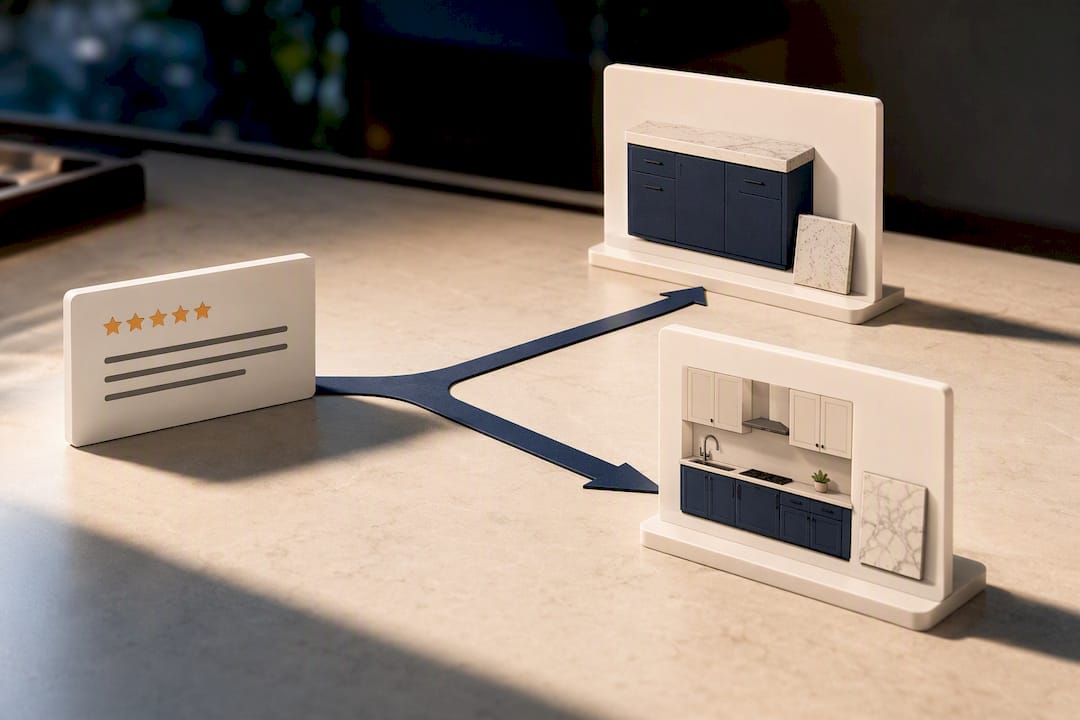
Reviews do double duty: they influence map-pack ranking and they’re often the deciding factor when a homeowner is choosing between three contractors who all look qualified on paper.
Time the ask right. The best moment is 24 to 48 hours after project completion, right after the final walkthrough when satisfaction is highest and the kitchen still looks brand new.
- Send a direct review link by text and email, not just one or the other.
- Ask specifically: “Would you mind mentioning the cabinet refacing and island work in your review?”
- Respond to every review, positive or negative, within two business days.
- For negative reviews, acknowledge the issue publicly, then move the conversation offline to resolve it.
Pro Tip: A short, service-specific review beats a five-star review with no detail. “Great job!” tells Google nothing. “They handled our full kitchen gut renovation in six weeks” tells Google exactly what to rank you for.
Once reviews accumulate, syndicate the strongest ones onto relevant service and project pages, not just your homepage testimonials section. A review mentioning “quartz countertops” belongs on the countertop service page, reinforcing relevance right where a homeowner is deciding.
How Do You Measure SEO Results for a Remodeling Business?
Tracking needs to answer one question clearly: is this driving booked consultations, not just website traffic?
- Track organic leads separately from paid and referral leads using UTM parameters on every campaign link and a clean GA4 goal setup.
- Set up call tracking so every phone call from your website is attributed to the source that generated it, organic search included.
- Build form-submission and consultation-booking goals in GA4 so you know exactly which pages produce action, not just pageviews.
- Add heatmaps or session recordings on your top 3 to 5 highest-traffic pages to see where visitors hesitate or abandon a form.
- Review results monthly, but judge trends over 90 to 180 days. Organic SEO lift is gradual, and judging it week to week leads to premature, wrong conclusions.
The KPIs that actually matter are organic leads, tracked phone calls, booked consultations, and, where possible, revenue tied back to organic sessions. Everything else, including raw traffic and keyword rank checks, is a supporting metric at best.
Should Remodelers Use Paid Ads and AI Alongside SEO?
Organic SEO takes months to fully ramp, and a remodeler needing consultations booked this quarter shouldn’t wait it out empty-handed. Running Google Ads or Meta ads targeted at high-ticket renovation searches fills that gap while your project pages and content climb the rankings.
AI tools speed up the content workflow considerably, useful for outlines, first-draft FAQs, and scaling out service-area pages faster than a single writer could alone. But AI without human oversight tends to produce thin, generic, or duplicated copy that fails to reflect your actual materials, local market, or completed projects, which search engines increasingly discount.
- Use AI to draft, never to publish unedited.
- Localize every AI-assisted page with real project details and neighborhood specifics.
- Watch for repeated phrasing across pages, a sign of over-reliance on the same prompt.
- Track assisted conversions to see whether paid campaigns are actually lifting organic lead volume, not just running parallel to it.
Should You DIY Your SEO or Hire a Specialist Agency?
Niche-specific SEO consistently outperforms generic approaches because it aligns visual assets, supplier relationships, and service pages with how homeowners actually search for remodeling work. That alignment is hard to build part-time.
Keep it in-house if you have marketing staff with real bandwidth, no urgent lead shortage, and a website already free of major technical debt. Hire a specialist when you’re facing slow seasons, a site that’s never been properly optimized, or a goal to meaningfully scale lead volume within the year.
A capable agency engagement typically includes Google Business Profile management, project page builds, technical fixes, and monthly reporting tied to actual leads. WWS – Web Development + SEO holds Google and Meta Partner certification, runs entirely in-house with no outsourcing, and has completed over 200 client partnerships, including work for a kitchen and bath client documented in a full case study.
What Kitchen Remodelers Get Wrong About SEO Priorities
Most remodelers chase blog content before their Google Business Profile is even fully built out. That’s backwards. A remodeler with a solid Google Business Profile and several focused project pages will often out-rank a competitor with many blog posts but a neglected profile, because local intent searches rely heavily on map-pack signals.
The conventional advice, “just post consistently,” undersells how much of this is structural. A slow site, missing schema, or a GBP with three photos from 2022 will cap your ceiling no matter how much you write. Fix the foundation first: profile, project pages, page speed. Content is the accelerant, not the ignition.
What gets underrated is patience with the right kind of tracking. Owners who quit after 60 days because “nothing changed” usually had the wrong KPI in view. Call tracking and consultation bookings tell the real story long before keyword rankings look impressive on a spreadsheet.
Prioritize the boring, structural work first. The creative content work matters, but it works far better once the foundation can actually hold the weight.
— Online Marketing Experts
Get Your Kitchen Remodeling Playbook Built by WWS
WWS – Web Development + SEO is is the alternative to piecing together freelancers and disconnected tools for kitchen remodeling SEO in the Chicago area: one certified, in-house team handles your Google Business Profile, project page builds, technical fixes, and monthly reporting under a single roof, so nothing gets lost between vendors.
As an official Google and Meta Partner, our team of certified specialists has completed over 200 client partnerships, including documented results for a kitchen and bath business facing the exact ranking challenges covered in this playbook. We handle local SEO, GBP optimization, project page development, Core Web Vitals fixes, and lead tracking as one connected engagement rather than five separate invoices.
If your kitchen remodeling business needs more booked consultations without the guesswork of managing multiple specialists, request a consultation with a specialized agency and get a prioritized plan built around your actual market and current site.
Sources
- Sink Into Search: Mastering SEO for Kitchen & Bath Designers – NKBA
- SEO for Kitchen Remodeling | Enests
- PageSpeed Insights
FAQ
Is $10,000 enough for a kitchen remodel?
A modest budget typically covers a cosmetic refresh, cabinet refacing, or countertop and hardware updates rather than a full gut renovation, and your content should set that expectation clearly on cost-guide pages.
Is $20,000 enough for a kitchen remodel?
A mid-range remodel often includes new cabinets or refacing, updated countertops, and new flooring, though exact scope depends heavily on regional labor and material costs.
Is $30,000 enough for a kitchen remodel?
A fuller remodel generally includes new cabinetry, countertops, appliances, and layout tweaks, making it a common threshold homeowners research before contacting contractors.
How do I promote my remodeling business online?
Start with a fully optimized Google Business Profile, build individual project pages for past work, and collect service-specific reviews. A specialist partner like WWS – Web Development + SEO can implement this stack faster than a DIY approach for owners without in-house marketing staff.
How long does kitchen remodeling SEO take to show results?
Most remodelers see measurable organic lift within 90 to 180 days, with Google Business Profile improvements often showing movement faster than content or technical fixes.