



Why Every Small Business Website Needs SEO to Survive Online
Knowing how to do SEO for a website step-by-step is one of the most valuable skills a business owner can have in 2026 — because organic search still drives more traffic than social media, paid ads, and direct visits combined.
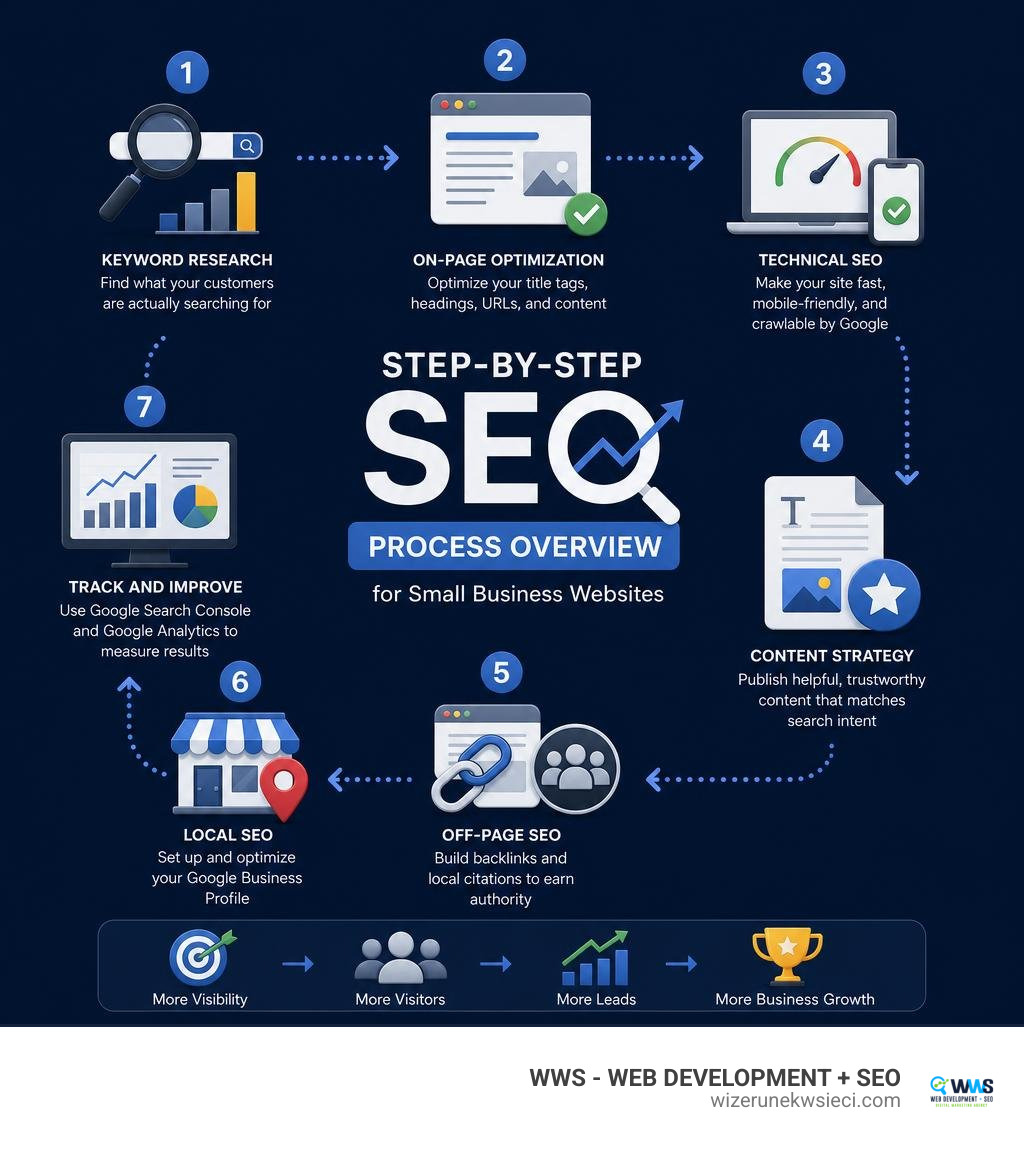
Here is a quick overview of the core steps:
- Keyword Research — Find what your customers are actually searching for
- On-Page Optimization — Optimize your title tags, headings, URLs, and content
- Technical SEO — Make your site fast, mobile-friendly, and crawlable by Google
- Content Strategy — Publish helpful, trustworthy content that matches search intent
- Off-Page SEO — Build backlinks and local citations to earn authority
- Local SEO — Set up and optimize your Google Business Profile
- Track and Improve — Use Google Search Console and Google Analytics to measure results
Think about what’s at stake. The #1 result on Google gets an average click-through rate of 27.6% — roughly 10 times more clicks than the top paid ad. If your business isn’t showing up on page one, you’re essentially invisible to the customers who are actively looking for what you offer.
As one well-known SEO saying goes: “It is not the job of search engine optimization to make a pig fly. It is the job of SEO to genetically re-engineer the website so that it becomes an eagle.” That’s exactly the mindset this guide takes — not quick tricks, but real, lasting improvements.
This guide walks you through every major step, in plain English, with no fluff.
I’m Tomasz Lasota, founder of WWS — Web Development + SEO, and over 22+ years of hands-on digital marketing work I’ve helped hundreds of small and medium-sized businesses across the Chicago metro area master exactly how to do SEO for their websites step-by-step — from first setup to page-one rankings. Whether you’re starting from scratch or fixing what isn’t working, what follows is the same framework we use with our clients every day.
Quick look at how to do seo for website step-by-step:
Understanding How Search Engines Work and Rank Sites
To optimize your website successfully, you must first understand how search engines function. Google doesn’t manually review the billions of pages on the internet; instead, it relies on a fully automated, multi-step process to discover, analyze, and rank content.
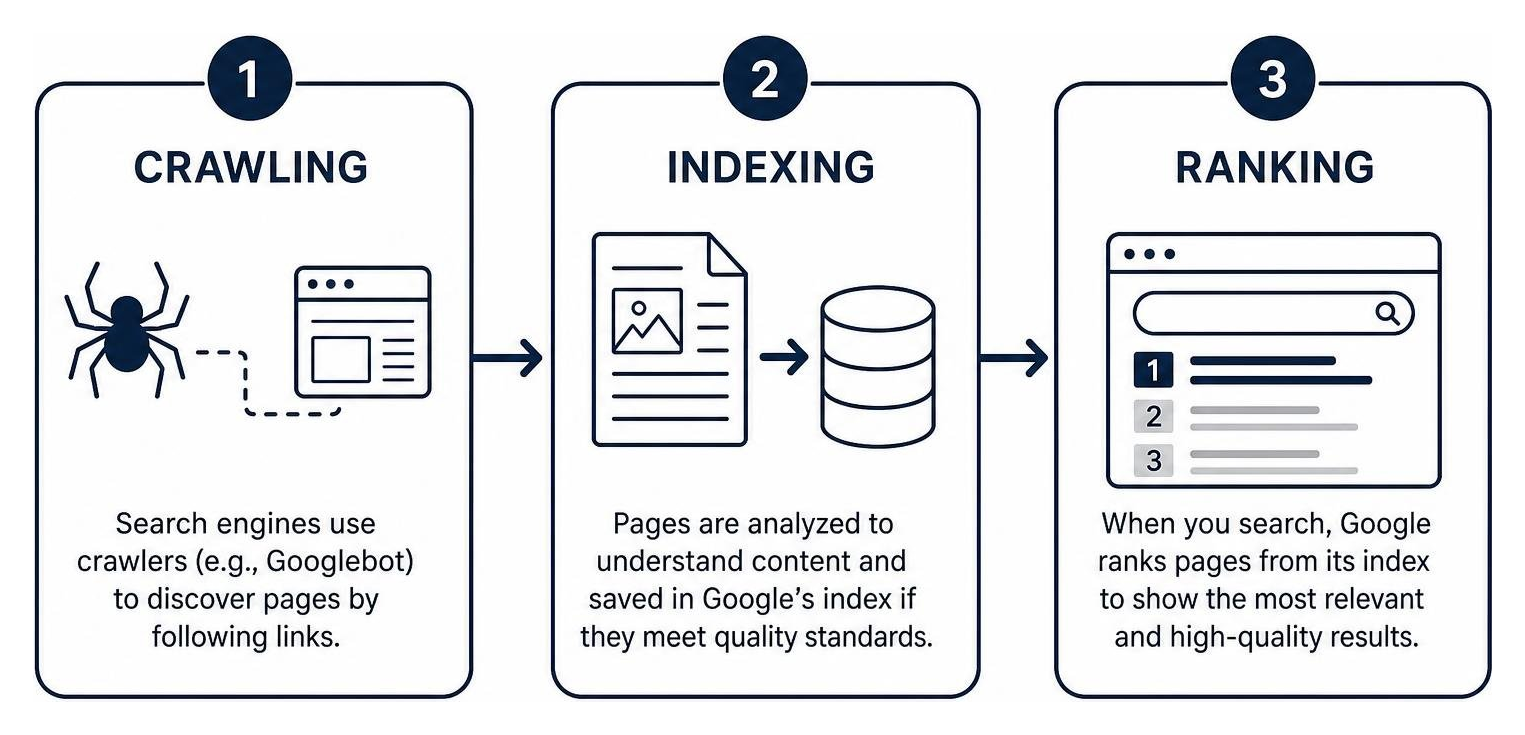
This process is divided into three fundamental stages:
- Crawling: Google uses automated software programs called “crawlers” or “spiders” (such as Googlebot) to constantly explore the web. They find new and updated pages primarily by following links from pages they have already crawled.
- Indexing: Once a crawler finds a page, Google analyzes its text, images, and overall structure to understand what the page is about. If the page meets Google’s quality standards, it is saved in a massive database called the Google Index. If Google cannot find or read your page, it cannot index it.
- Ranking: When someone types a query into Google, the search engine’s complex algorithms search the index to find the most relevant, high-quality answers. Google evaluates hundreds of ranking signals, including page speed, mobile-friendliness, backlinks, and content relevance, to decide which pages appear at the top.
For a deeper dive into these fundamentals, we highly recommend reading the official Google Search Engine Optimization (SEO) Starter Guide.
In 2026, the ranking landscape has shifted. With the widespread integration of AI-powered search features like Google’s AI Overviews and tools like ChatGPT, search engines do more than just match keywords. They interpret context and user intent.
Interestingly, data shows that 73% of the websites that appear in Google’s AI Overviews also rank in the top 10 traditional organic search results. This means that mastering traditional SEO fundamentals is still your best ticket to appearing in both classic search results and modern AI-generated answers.
How to Do SEO for Website Step-by-Step: The Core Pillars
To make the optimization process manageable, we divide search engine optimization into four core pillars. A successful strategy requires a balance of all four; focusing entirely on one while ignoring the others is like building a house on a cracked foundation.
| SEO Pillar | Focus Area | Key Elements |
|---|---|---|
| Technical SEO | Website performance & health | Crawlability, page speed, mobile-friendliness, HTTPS security, XML sitemaps |
| On-Page SEO | Individual page optimization | Title tags, meta descriptions, heading structure (H1-H3), URL slugs, image alt text |
| Content Strategy | Answering user queries | Keyword clustering, search intent matching, E-E-A-T, information gain |
| Off-Page SEO | Building authority & trust | Backlinks, local citations, Google Business Profile, brand mentions |
Let’s break down how to execute these pillars step-by-step to transform your website from a hidden page on the web into a highly visible customer magnet.
Phase 1: How to Do SEO for Website Step-by-Step with Keyword Research
Keyword research is the bedrock of your entire SEO strategy. It is the process of identifying the exact words and phrases your potential customers use when searching for your services. Without proper keyword research, you risk writing content that nobody is searching for.
To build a winning keyword strategy, follow this step-by-step workflow:
1. Brainstorm Seed Keywords
Start by listing 5 to 10 broad terms that describe your business. For example, if you are a contractor in Arlington Heights, IL, your seeds might include:
- “home remodeling”
- “kitchen renovation”
- “bathroom remodeler”
- “basement finishing”
2. Expand Your List Using Search Language
Once you have your seed keywords, expand them using real-world search data. You can use Google Autocomplete (the suggestions that appear as you type) and the “People Also Ask” boxes on search results pages. You can also explore online communities like Reddit or local Chicagoland forums to see the exact language and questions your target audience uses when looking for help.
3. Analyze Search Volume and Keyword Difficulty (KD)
Use keyword tools to analyze your list. Pay close attention to two metrics:
- Search Volume: How many times a keyword is searched per month.
- Keyword Difficulty (KD): A score from 0 to 100 representing how hard it is to rank on page one.
For new or growing websites, we recommend targeting keywords with a KD under 30. These are low-competition terms where you can achieve faster rankings.
4. Focus on Long-Tail Keywords and Search Intent
Long-tail keywords are longer, more specific phrases (usually 3+ words). They make up approximately 92% of all search queries. While they have lower search volumes than broad terms, they carry much higher buying intent.
For example, instead of trying to rank for “remodeling” (highly competitive, vague intent), target a long-tail phrase like “historic home remodeling contractor Schaumburg IL”. The user searching for the latter is much closer to making a hiring decision.
Always align your content with one of the four primary types of search intent:
- Informational: The user wants to learn something (e.g., “how to prepare for a kitchen remodel”).
- Navigational: The user is looking for a specific brand or website.
- Commercial: The user is researching options before buying (e.g., “best remodeling contractors near Cook County”).
- Transactional: The user is ready to buy or hire (e.g., “hire bathroom remodeler Des Plaines IL”).
For a visual walkthrough on choosing the right target terms, watch this helpful video on SEO for Beginners: Rank #1 In Google (2023) – YouTube.
Phase 2: How to Do SEO for Website Step-by-Step through On-Page Optimization
On-page SEO is the practice of optimizing individual web pages to help search engines understand their context and match them to relevant queries. Once you have mapped your target keywords to specific pages, it’s time to optimize the on-page elements.
At WWS, we apply a meticulous approach to every on-page element to ensure your business stands out. You can learn more about our tailored approach on our Website SEO service page.
Here is your step-by-step on-page checklist:
The title tag is the blue clickable link that appears in search results. It is one of the most important on-page ranking signals.
- Best Practice: Keep it under 60 characters so it doesn’t get cut off. Place your primary keyword near the beginning, and end with your business name.
- Example:
Kitchen Remodeling Services Des Plaines IL | WWS
2. Write Engaging Meta Descriptions
While meta descriptions do not directly affect search rankings, they heavily influence your click-through rate (CTR).
- Best Practice: Keep them between 120 and 155 characters. Write a clear, persuasive summary of the page with a strong call to action (CTA).
- Example:
Looking for expert kitchen remodeling in Des Plaines? WWS delivers custom designs, quality craftsmanship, and reliable service. Call today for a free audit!
Headings organize your content for both readers and search engines.
- Best Practice: Use exactly one H1 tag per page, which should include your primary keyword (e.g.,
). Use H2 and H3 tags to break up subtopics, naturally incorporating secondary and long-tail keywords.
4. Keep URL Slugs Short and Clean
A clean URL structure helps both search engines and users understand where they are on your site.
- Best Practice: Use short, lowercase, keyword-rich URL slugs separated by hyphens. Avoid long numbers, dates, or random characters.
- Good URL:
https://wizerunekwsieci.com/kitchen-remodeling-des-plaines - Bad URL:
https://wizerunekwsieci.com/p=9876?remodel-service-2026
5. Optimize Images with Alt Text
Search engines cannot “see” images the way humans do; they rely on file names and alt text to understand them.
- Best Practice: Save image files with descriptive names (e.g.,
modern-kitchen-remodel-des-plaines.jpginstead ofIMG_4829.jpg). Write descriptive, natural alt text (8 to 12 words) that explains what is in the image, incorporating local keywords where natural.
6. Build a Strategic Internal Linking Network
Internal links connect different pages on your website, passing authority (PageRank) between them and helping Google discover new content.
- Best Practice: Link from your high-authority pages (like your homepage) to your service pages and blog posts using natural, descriptive anchor text. Avoid generic anchor text like “click here” or “read more.” Instead, use descriptive phrases like “explore our Contractor SEO Chicago strategies.”
Technical SEO: Building a Strong Foundation
No matter how incredible your content is, your website will struggle to rank if it has severe technical issues. Technical SEO is all about ensuring that search engine crawlers can find, read, and index your pages without obstacles.

To build an unbreakable technical foundation, focus on these critical areas:
1. Ensure Fast Page Load Times and Core Web Vitals
In 2026, user experience is paramount. A slow-loading website frustrates users and leads to high bounce rates. In fact, 5-second load times will cause 90% of users to leave your site without interacting with it.
Google measures page experience through a set of metrics called Core Web Vitals:
- Largest Contentful Paint (LCP): Measures loading performance. Target: under 2.5 seconds.
- Interaction to Next Paint (INP): Measures visual responsiveness. Target: under 200 milliseconds.
- Cumulative Layout Shift (CLS): Measures visual stability. Target: under 0.1.
Actionable speed fixes: Compress all images using modern formats like WebP, leverage browser caching, minimize CSS/JavaScript, and use a Content Delivery Network (CDN).
2. Prioritize Mobile-Friendliness
Google uses mobile-first indexing, meaning it primarily crawls and ranks the mobile version of your website. Your site must adapt seamlessly to smartphones and tablets. Avoid intrusive pop-ups that block content on mobile screens, and ensure all buttons are easy to tap.
3. Secure Your Site with HTTPS
Website security is a confirmed Google ranking signal. Ensure your site has an active SSL/TLS certificate, changing your URL protocol from HTTP to HTTPS. This encrypts the data exchanged between your users and your server, protecting sensitive information.
4. Create and Submit an XML Sitemap
An XML sitemap is a blueprint of your website that lists all your important pages. It helps Google find and crawl your content quickly.
- How to submit: Generate an XML sitemap (usually automated if you use an SEO plugin like Rank Math or Yoast on WordPress) and submit it directly to Google Search Console under the “Sitemaps” section.
5. Optimize Your Robots.txt File
Your robots.txt file acts as a technical greeter, telling search engine crawlers which parts of your site they are allowed to visit and which parts they should ignore (such as admin login pages). Ensure you aren’t accidentally blocking Googlebot from crawling your primary service pages.
Off-Page SEO and Local Visibility
Off-page SEO refers to actions taken outside of your own website to impact your rankings within search engine results pages. Think of off-page SEO as building your digital reputation. The most influential off-page signal is the acquisition of high-quality backlinks (links from other websites to yours).
1. Build High-Quality Backlinks
Google views backlinks as votes of confidence. A link from a trusted, relevant website tells Google that your content is authoritative.
- Digital PR & Expert Contributions: Share your expertise with local Chicagoland business directories, trade publications, or local blogs to earn quality backlinks.
- Avoid Spammy Tactics: Never buy backlinks or participate in shady link schemes. Google’s algorithms are highly sophisticated; low-quality, manipulated links can lead to ranking penalties. Focus on earning links naturally through outstanding content and genuine local relationships.
2. Dominate Local SEO and the Map Pack
If you run a local service business, local search is your lifeline. About 46% of all Google searches look for local information, and 58% of consumers search for local businesses on a smartphone every single day.
To capture these high-intent local leads, you must optimize for local search. At WWS, we specialize in helping local businesses capture this market. Discover how we can help you on our Local SEO page.
Step 1: Claim and Optimize Your Google Business Profile (GBP)
Your Google Business Profile is the listing that appears in Google Maps and the local “Map Pack” at the top of search results.
- Action: Claim your listing at
google.com/business. Complete every single field, including your exact business name, address, phone number (NAP), website URL, business hours, and service area. Add high-quality photos of your office, team, and completed projects. - Pro Tip: Learn more about maximizing your local presence with our guide on Google Business Profile Optimization.
Step 2: Maintain NAP Consistency Across the Web
Your Name, Address, and Phone number (NAP) must be identical across your website, your Google Business Profile, and all online directories (like Yelp, YellowPages, and local Chicagoland chamber of commerce sites). Inconsistent details confuse search engines and damage your local ranking authority.
Step 3: Actively Collect and Respond to Client Reviews
Reviews are the primary trust factor for local searches. Encourage your satisfied clients to leave detailed, honest reviews on your Google Business Profile. Always respond to every review — both positive and negative — professionally and promptly.
For businesses in specific industries, tailored local strategies are crucial. If you run a service business in the Chicago suburbs, explore our specialized guides:
- Contractors: SEO for Contractors Chicago or Contractor SEO Chicago
- Roofing Companies: SEO for Roofing Companies Chicago or Chicago Roofing SEO Get Found Online
- Electricians: SEO for Electricians Chicago or Electrician Marketing Chicago
Tracking Performance and Measuring Success
SEO is not a “set-it-and-forget-it” project. It is an ongoing process of monitoring, adjusting, and refining. To know if your efforts are paying off, you must set up the right measurement tools from day one.

The two most essential free tools provided by Google are:
1. Google Search Console (GSC)
Google Search Console tells you how Google’s crawlers view your website and how users find you in search results.
- What to monitor:
- Crawl Errors: Check the “Indexing” report regularly to ensure Google isn’t having trouble reading your pages.
- Impressions: The total number of times your site appeared in search results.
- Clicks & CTR: How many people clicked through to your site and the percentage of searchers who did so.
- Average Position: Where your pages rank for specific search queries.
2. Google Analytics 4 (GA4)
While GSC tracks search engine behavior, GA4 tracks user behavior once they arrive on your website.
- What to monitor:
- Organic Traffic: Monitor the volume of visitors arriving via search engines over time.
- User Engagement: Track how long users stay on your pages and which content they interact with most.
- Conversions: Set up key event tracking to measure actions that directly impact your bottom line, such as contact form submissions, phone calls, or consultation bookings.
Frequently Asked Questions about Website SEO
How long does it take to see results from SEO?
SEO is a long-term investment, not an overnight fix. For most newly optimized small business websites, you can expect to see initial signs of progress — such as rankings for low-competition long-tail keywords — within 4 to 8 weeks.
Significant growth in competitive organic traffic and core keyword rankings typically takes 3 to 6 months, while highly competitive terms can take 9 to 18 months of consistent effort to reach the top spots.
Can I do SEO for my website myself?
Yes, it is entirely possible to handle basic SEO tasks yourself. Many micro-business owners manage their own marketing. In fact, 80% of micro-business owners manage their marketing themselves, and 55% do SEO on their own.
However, as your business grows, SEO becomes increasingly complex, requiring deeper technical knowledge, advanced keyword clustering, and ongoing content creation. Many business owners find that partnering with a professional agency saves time and delivers a much higher return on investment.
What are the most common SEO mistakes to avoid?
- Keyword Stuffing: Artificially cramming your target keywords into your text over and over. This ruins the user experience and can result in Google penalizing your site. Write naturally for humans first.
- Duplicate Content: Copying text verbatim from other websites. Google values original information and may ignore pages with duplicate content.
- Neglecting Internal Linking: Failing to connect your pages internally, which leaves “orphan pages” that search engines cannot find.
- Ignoring Page Speed: Keeping uncompressed, massive images on your site that slow down loading times and drive mobile users away.
Conclusion: Partner with Wizerunek w Sieci for SEO Success
Mastering how to do SEO for a website step-by-step takes time, patience, and consistent execution. When done right, it builds a powerful digital asset that brings high-intent customers to your business day and night without the ongoing cost of paid advertising.
At WWS (Wizerunek w Sieci), we understand that running a business is a full-time job. You shouldn’t have to spend your evenings studying search engine algorithms or fixing technical website errors.
Led by Tomasz Lasota, our agency is based in Des Plaines, IL (636 S River Rd #218). We specialize in custom web development and tailored online marketing for small and medium-sized businesses. We serve clients across the Chicago metropolitan area — including Arlington Heights, Schaumburg, Naperville, Elk Grove Village, and Mount Prospect — with deep roots in the Polish-American community (Polonia Chicago) and clients nationwide.
We pride ourselves on our bilingual capabilities (English and Polish), meticulous attention to detail, and personalized approach. We treat your business as if it were our own.
Ready to take your online presence to the next level? Explore our Boost Your Business with Expert SEO Chicago Services and check out our guide on Chicago SEO Agencies Your Guide to Ranking Up. You can also browse our successful projects on our Case Studies page.
Let’s turn your website into a highly visible, lead-generating machine. Visit wizerunekwsieci.com today to claim your free website audit!