



Build a Lead Generation Website That Turns Visits Into Calls
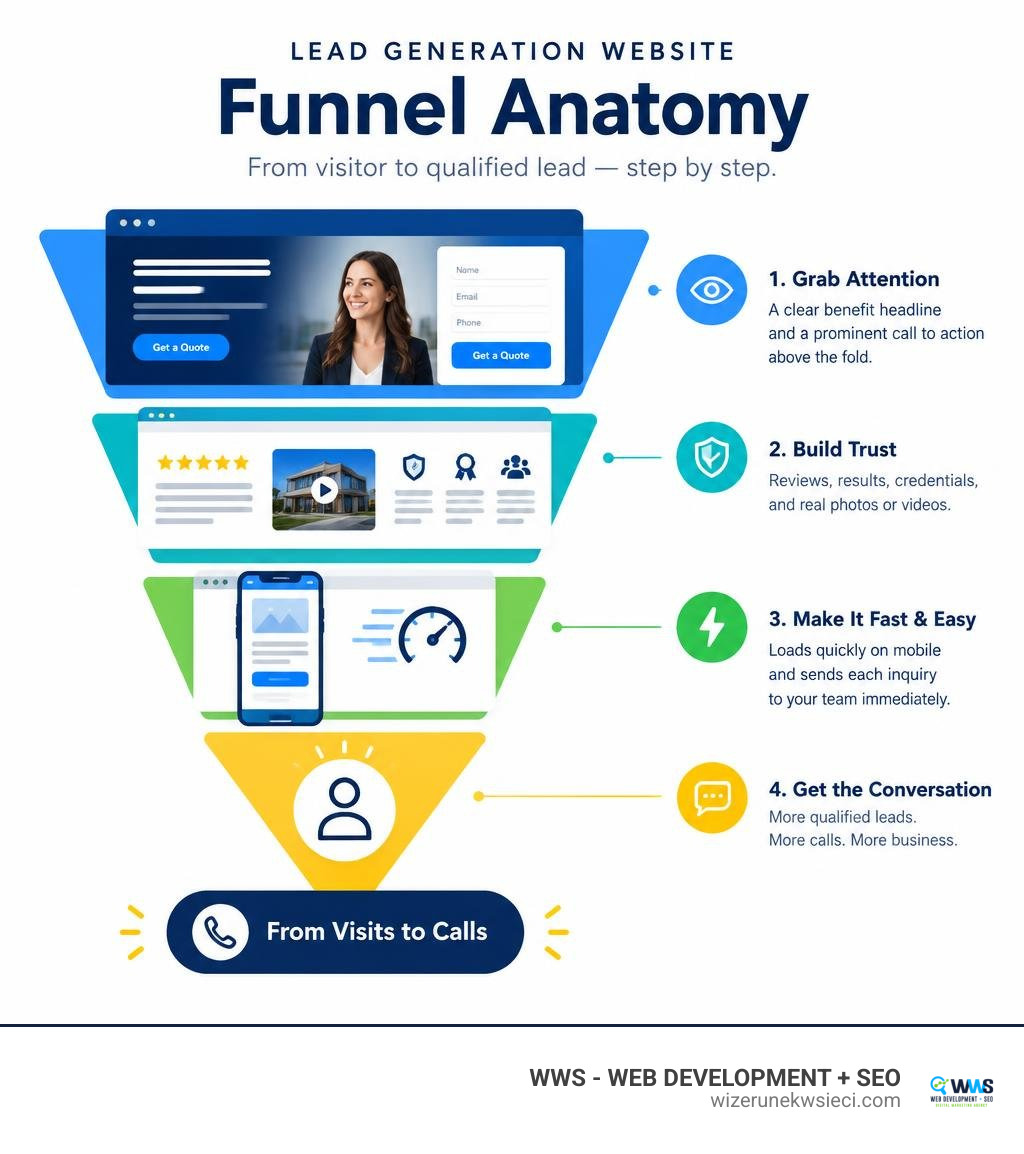
To build a lead generation website, start with one action you want visitors to take: call, request a quote, book an appointment, or schedule a consultation. Then create a focused page that:
- States a clear customer benefit in the headline.
- Shows a prominent call to action and short form above the fold.
- Builds trust with reviews, results, credentials, and real photos or videos.
- Loads quickly on mobile and sends each inquiry to your team immediately.
A brochure site explains what your business does. An e-commerce site sells a product online. A lead generation site has a different job: move a qualified prospect from search, ad, or referral to a conversation with your business. Every page element should reduce doubt and make that next step easy.
I’m Tomasz Lasota, a digital marketing strategist with more than 22 years of experience helping small and medium-sized businesses turn their websites into practical growth tools. I help owners build lead generation website architectures that support more calls, qualified inquiries, and measurable revenue.
Relevant articles related to build lead generation website:
Why Traditional Brochure Websites Fail to Convert Leads
Most small business websites operate like digital brochures. They list company history, display generic stock imagery, show a dozen navigation links, and hide contact information behind a generic contact tab. While this format tells people that a company exists, it does very little to prompt immediate action.
According to industry marketing research, 61% of marketers state that generating high-quality leads remains their single biggest operational challenge. The typical service-business website converts only 2% to 4% of its inbound traffic into actual inquiries.
When you restructure your digital presence into a dedicated conversion funnel, that conversion rate can climb toward 20%. The economic impact is massive: a page converting at 20% acquires customers at one-tenth the acquisition cost of a page converting at 2%.
| Feature / Element | Traditional Brochure Website | High-Converting Lead Generation Website |
|---|---|---|
| Primary Focus | Informational brand overview | Single, clear conversion action |
| Header Navigation | 6–10 navigation menu links | Stripped or minimal header to stop bounce leaks |
| Call to Action (CTA) | Passive (“Contact Us” page link) | Direct, benefit-driven, above the fold |
| Form Placement | Hidden on a dedicated sub-page | Visible immediately above the fold |
| Mobile Experience | Scaled desktop layout | Sticky CTAs and click-to-call direct dial |
| Lead Routing | Standard inbox email notification | Instant CRM webhook & automated SMS response |
| Conversion Rate | Typical baseline of 2% to 4% | Optimized benchmarks reaching up to 20% |
To reliably capture qualified leads from inbound traffic, a site must actively address customer friction rather than passively wait for users to figure out where to click.
Core Differences Between Lead Capture and Standard Web Design
Standard web design often prioritizes artistic aesthetics over consumer psychology. In contrast, lead capture architecture uses direct-response principles to guide visitor behavior.
When someone lands on your page from a local search or paid campaign in Cook County or the Northwest Suburbs of Chicago, they arrive with a specific problem that needs solving. If they encounter visual clutter, confusing dropdown menus, or vague slogans, they bounce back to search results.
Purpose-built lead capture funnels eliminate top-level navigation menus on dedicated landing pages. Removing external exit points keeps visitor attention locked onto your primary value proposition.
By combining focused messaging with direct response custom website design, you ensure that your site speaks directly to the search intent of your prospective customer.

How to Build Lead Generation Website Funnels That Convert at 20%
Achieving double-digit conversion rates requires structuring your page around trust, clarity, and friction reduction. Visitors make split-second decisions about whether a business is legitimate. Design functions as a direct trust signal—a clean, professional layout immediately signals competence, while outdated or broken styling creates hesitation.

Every high-performing lead generation funnel aligns technical performance with persuasive structural layers. When engineering a high-converting funnel, pairing thoughtful conversion psychology with robust seo web design ensures your site not only ranks in local search results across Chicagoland, but turns those visitors into scheduled consultations.
Essential Above-the-Fold Elements to Build Lead Generation Website Authority
The top section of your page—the area visible before scrolling—carries the heaviest conversion weight. Over 60% of modern web traffic comes from mobile devices, meaning your above-the-fold architecture must communicate your core value instantly.
Your hero section should include five essential elements:
- Benefit-Driven Headline (under 10 words): Clearly state what the client gains, rather than just your trade name.
- Supportive Subheadline: Address the primary objection, timeline, or specific service territory (such as Chicago, Des Plaines, or Arlington Heights).
- Embedded Capture Form or Click-to-Call CTA: Make taking the next step effortless without requiring a single scroll.
- Primary Trust Badges: Display Google review ratings, industry licenses, or local business accreditations.
- Authentic Visual Proof: Use genuine photography of your local team or authentic customer video testimonials instead of canned stock images.
Including genuine video reviews and clear risk-reversal guarantees—such as upfront transparent estimates or satisfaction guarantees—dramatically lowers the psychological barrier to submitting an inquiry.
Frictionless Form and Funnel Design to Build Lead Generation Website Momentum
Form friction is one of the most common reasons visitors abandon a quote request. Every additional input field you add to a lead capture form reduces its completion rate by 5% to 10%.
For initial inquiries, stick strictly to the 3-to-5 field rule:
- Full Name
- Phone Number
- Email Address
- Single Qualifying Dropdown (e.g., Service Needed or Project Timeline)
If your service requires deeper project details before you can quote accurately, avoid throwing a massive 12-field form at a first-time visitor. Instead, implement multi-step forms or interactive quiz funnels.
Multi-step forms break the intake process into digestible micro-commitments, asking low-friction questions first (such as your zip code or project type) before requesting contact details on the final step.
Technical Infrastructure, Page Speed, and Rapid Lead Response
A well-crafted offer will fail if your technical foundation is sluggish. Page speed directly dictates conversion rate optimization performance.
Data shows that a 1-second delay in page load time reduces conversions by up to 7%. Pages that load within 1 second achieve an average conversion rate of 3.05%, whereas pages that take 4 seconds drop to an average conversion rate of 0.6%.
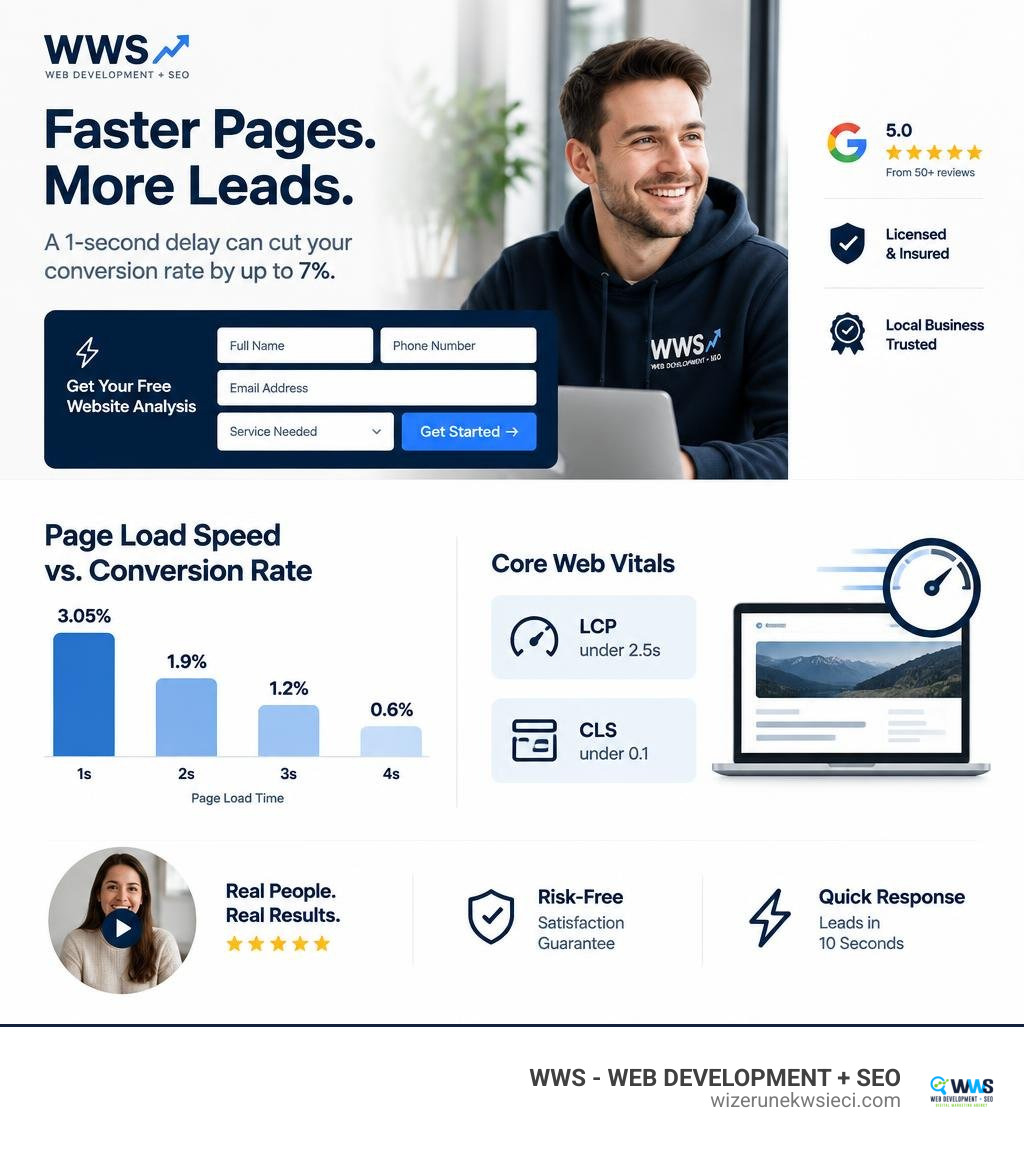
Optimizing Core Web Vitals—specifically keeping Largest Contentful Paint (LCP) under 2.5 seconds and Cumulative Layout Shift (CLS) under 0.1—is critical for retaining paid and organic visitors.
Our development team streamlines these high-performance builds by leveraging clean Next.js frameworks, optimized hosting infrastructure, and modern development workflows to write lightweight, highly responsive code. Maintaining clean code is a core component when ensuring new sites are fully SEO enabled from day one.
The Power of the 10-Second Webhook Lead Response
Capturing the form submission is only half the battle; the speed at which your team responds determines your closing rate.
Research indicates that contacting an inbound lead within the first minute yields up to 4x more sales conversions compared to delayed outreach. In competitive home services and commercial contracting, the first business to respond wins the job 78% of the time.

By wiring your lead generation forms to automated webhooks via CRM platforms, you can instantly trigger automated SMS confirmations to the prospect and send an immediate push notification or outbound VoIP call to your sales team within 10 seconds of submission.
Tracking, Analytics, and Conversion Instrumentation
You cannot optimize what you do not measure. A high-converting lead generation setup requires reliable tracking instrumentation deployed before driving traffic.
Key tracking components include:
- Google Analytics 4 (GA4): Configured with custom conversion events for form completions, click-to-call taps, and calendar bookings.
- PostHog or Heatmapping Tools: Visual session replays and split-testing tools to identify where visitors hesitate or drop off.
- Dynamic Call Tracking: Software that swaps phone numbers dynamically based on traffic source to measure exact ROI from organic search, Google Ads, or local directory traffic.
Equipping your business with the right small business lead generation tools in 2026 ensures that every marketing dollar spent is backed by verifiable attribution.
Traffic Acquisition: Driving Qualified Prospects to Your Funnel
Building a high-converting website architecture provides the engine, but you still need high-intent traffic to generate revenue.
For local service providers across Chicago, Cook County, and Lake County, combining immediate paid traffic with sustainable organic growth creates a balanced acquisition pipeline.
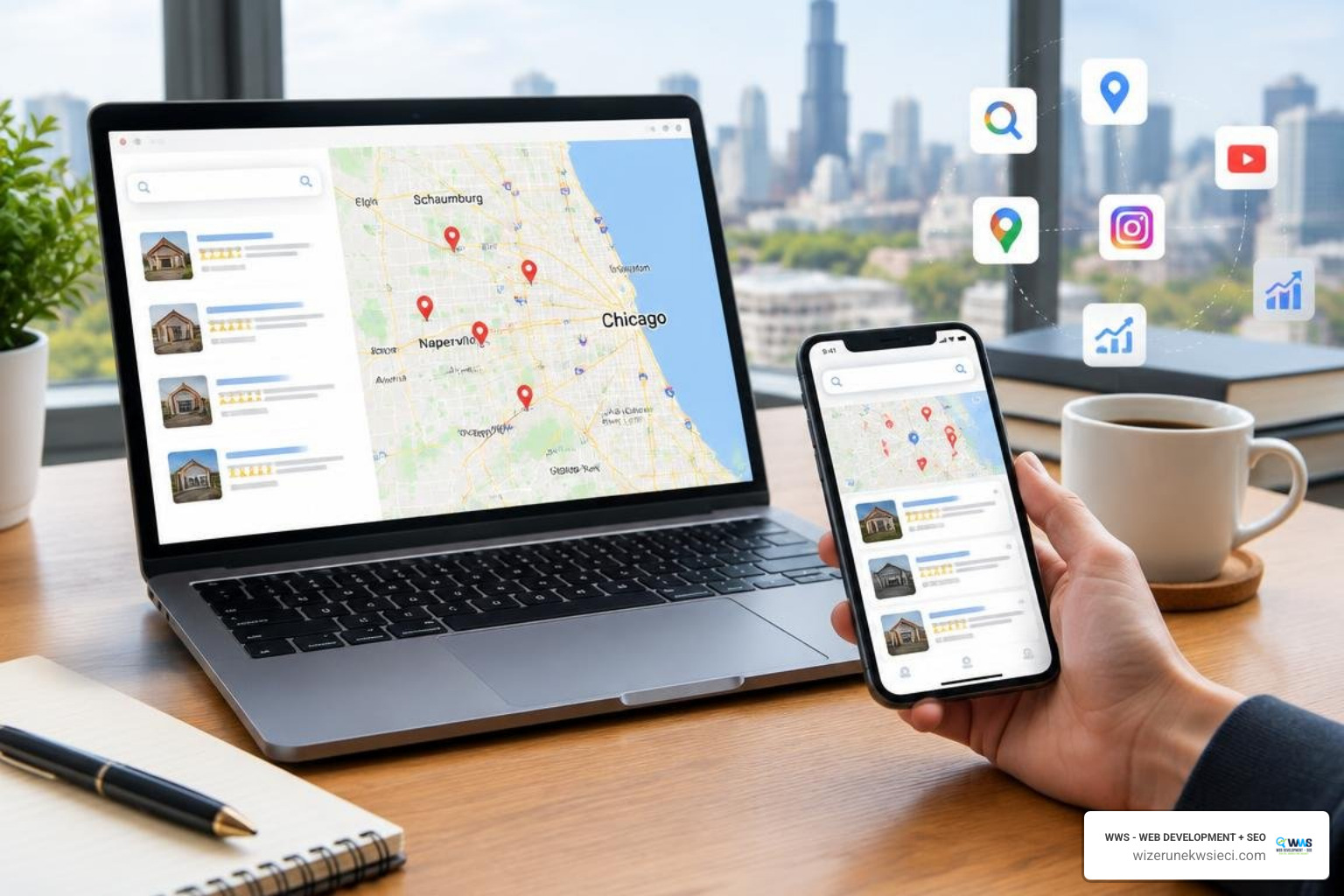
The most reliable traffic channels for local service lead generation include:
- Google Local Services Ads (LSA): Pay-per-lead placement appearing at the very top of Google search results, backed by the Google Guaranteed badge.
- High-Intent Google Ads (PPC): Targeting specific commercial search terms (e.g., commercial roofing contractor Elk Grove Village) directing to tailored landing pages.
- Localized Organic SEO: Building out geo-targeted service pages optimized for local intent across suburban markets like Schaumburg, Naperville, and Glenview.
Using dedicated local landing page design tailored to specific service-location pairings significantly lowers paid ad acquisition costs while improving organic relevance. Mastering search engine marketing lead generation gives local businesses a dependable pipeline of pre-qualified customer inquiries.
Leveraging AI and Modern Builders for Rapid Deployment
Modern development practices have transformed how quickly high-performance landing pages can be built, tested, and iterated.
Using specialized AI-assisted development tools and modern headless architectures, our team can quickly launch programmatic service-city landing pages. This allows small businesses to test new geographic service areas across Illinois without spending months building separate websites from scratch, all while working with a dedicated agency partner rather than a self-service tool.
Frequently Asked Questions About Building Lead Capture Sites
How many fields should be on a lead generation form?
For most small business lead generation pages, keep your initial capture form between 3 and 5 fields. Capturing a prospect’s name, phone number, email address, and a single qualifying dropdown provides enough context for your sales team while keeping friction low. Every extra field beyond five can reduce conversion rates by 5% to 10%.
Why does page speed impact lead generation conversion rates?
Page speed directly affects user bounce rates, especially on mobile devices where network speeds fluctuate. A 1-second delay in page load time can reduce overall conversion rates by up to 7%. Pages that load within 1 second convert at roughly 3.05%, while pages taking 4 seconds or longer drop to conversion rates below 0.6%.
What is the 5-minute rule for inbound lead response?
The 5-minute rule refers to the practice of contacting an inbound web lead within 5 minutes of form submission. Responding within this short window dramatically increases your qualification rate, and calling within the first minute can deliver up to 4x more sales conversions than delayed responses. In service industries, the first qualified vendor to respond secures the contract up to 78% of the time.
Conclusion
A successful website is not an online art gallery—it is an automated sales asset designed to generate qualified inquiries, quote requests, and booked appointments. By replacing cluttered menus with focused above-the-fold value propositions, minimizing form friction, maintaining rapid technical page speeds, and setting up instant response automations, your business can turn ordinary web traffic into a predictable stream of qualified clients.
At Wizerunek w Sieci / WWS — Web Development + SEO, we specialize in helping small and medium-sized businesses throughout the Chicago metropolitan area, Cook County, and nationwide build high-performing digital marketing systems. Headquartered in Des Plaines, IL, our bilingual team combines custom technical web development, local SEO, and paid advertising management with hands-on, personalized service tailored to your market.
For small business owners, WWS offers the ideal middle ground between large national agencies and local freelancers: you get professional agency expertise, dedicated resources, and proven systems, along with the personal attention, local knowledge, and bilingual support that only a neighborhood partner can provide. Whether you are looking to revamp an underperforming website or launch a dedicated tailored website SEO and lead generation development strategy, we are here to help your business grow.
Ready to turn your website into a reliable customer generation machine? Contact WWS today at wizerunekwsieci.com to schedule your free website and conversion audit.