





How to Generate High-Value Leads with Google Ads for Contractors
Running profitable google ads for contractors comes down to a simple, disciplined framework that captures homeowners when they are actively ready to hire:
- Target high-intent search terms: Focus on localized, transactional phrase-match terms (like “bathroom remodel contractor near me”) while blocking budget-wasting searches with robust negative keyword lists.
- Build dedicated campaigns by service: Keep distinct trades or job types separated into individual campaigns to maintain high Quality Scores and control specific ad budgets.
- Send traffic to custom landing pages: Never send paid clicks to your homepage; use simple, mobile-optimized landing pages with direct click-to-call buttons and short quote forms.
- Follow up in under 5 minutes: Set up dynamic call tracking to measure real ROI and call new leads immediately to lock in estimate appointments before your competitors respond.
I am Tomasz Lasota, founder of WWS — Web Development + SEO in Des Plaines, IL, with over 22 years of hands-on experience helping local businesses scale profitably with google ads for contractors. In this complete guide, I will share the exact strategies, budget formulas, and tracking setups we use to fill project pipelines across the Chicago area and nationwide.
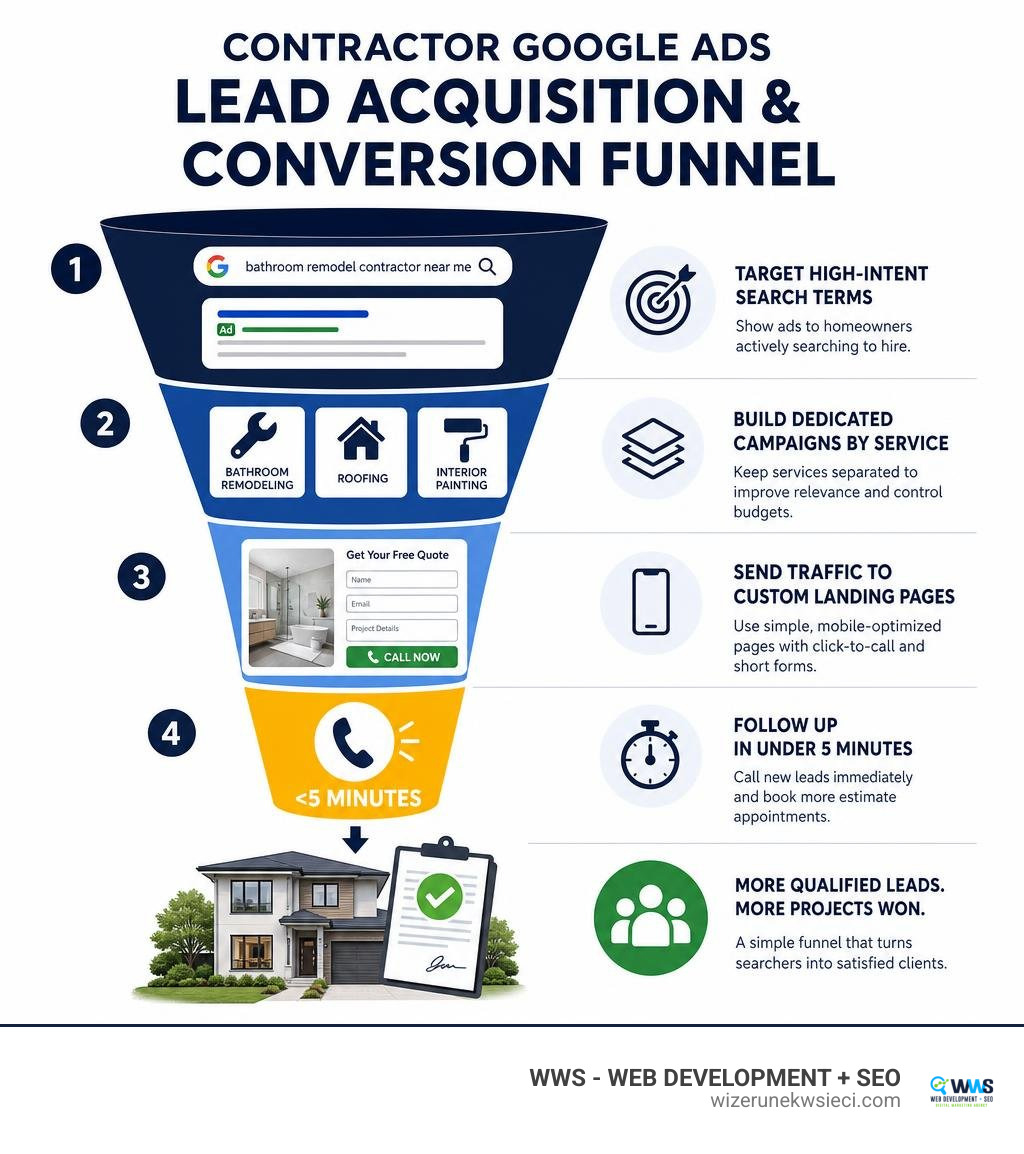
Google ads for contractors terms simplified:
Google Ads vs. Local Services Ads (LSAs): Choosing the Right Strategy
When setting up online paid advertising, trade businesses often ask whether they should run traditional Google Search Ads or Google Local Services Ads (LSAs). Both ad platforms put your business in front of homeowners searching for repairs, installations, and renovations, but they operate on distinct commercial models.
Traditional Google Search Ads rely on a pay-per-click (PPC) model where you bid on specific keywords. When someone types in a query and clicks your ad, you pay for that site visit regardless of whether the prospect calls or leaves your page. Google Local Services Ads operate on a pay-per-lead (PPL) model. Your ad sits at the very top of the search engine results page (SERP) featuring your business name, review rating, operating hours, and a green Google Guaranteed or Google Screened badge. You only pay when a customer calls or messages you directly through the ad unit.
| Feature / Metric | Google Search Ads (Traditional PPC) | Google Local Services Ads (LSAs) |
|---|---|---|
| Pricing Model | Pay-per-click (CPC) | Pay-per-lead (PPL) |
| Average Cost | ~$5.31 to $7.85 per click (Home Improvement) | ~$53 blended per qualified lead |
| Average Book Rate | 30% to 37.6% booking rate | 43.9% booking rate across verified trades |
| Placement | Below LSAs, above/below organic listings | Top of SERP (captures 13.8% of total clicks) |
| Trust Badges | Seller ratings and ad extensions | Google Guaranteed / Google Screened badge |
| Dispute Mechanism | None for standard clicks | Direct refunds for invalid or out-of-area calls |
| Traffic Destination | Custom dedicated landing pages | Direct phone call or Google booking interface |
To read more about the specifics of the Google verification badge, review The Ultimate Guide to Google Guaranteed Ads Benefits.
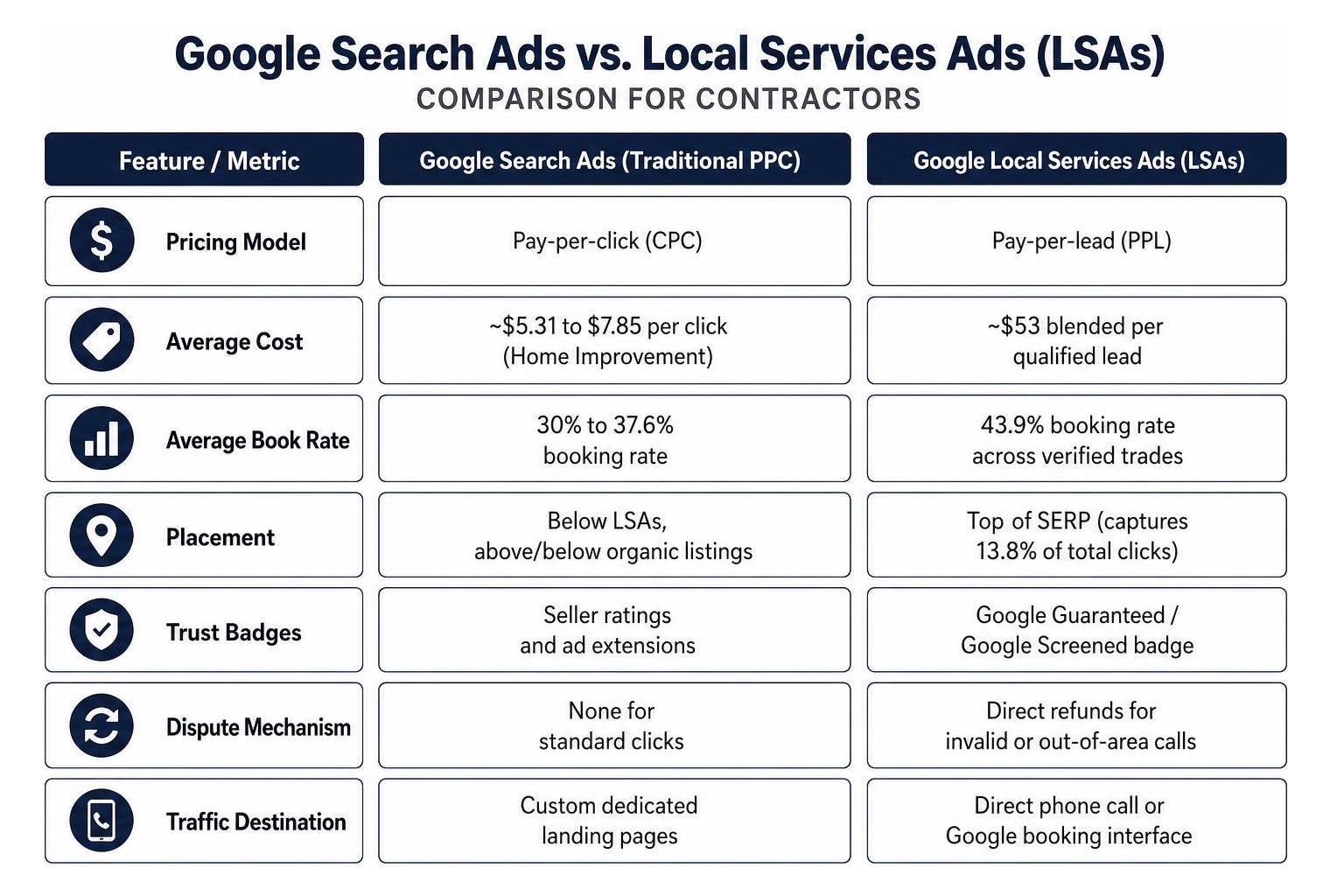
Understanding the Difference Between Clicks and Verified Leads
Google Local Services Ads require trade businesses to pass a thorough onboarding and screening process before going live. This includes submitting general liability insurance policies, owner background checks, and local municipal registrations. For example, trade professionals operating in the Northwest Suburbs must comply with local guidelines such as Contractor Licensing | Village of Mount … to maintain active operations.
Once verified, LSAs protect your ad spend through an active dispute workflow. If an inquiry turns out to be a telemarketer, a wrong number, a search outside your defined zip codes, or a service you do not offer, you can submit a dispute in your dashboard within 30 days to claim an ad credit refund.
Standard Google Search Ads do not offer click refunds for unqualified visitors. However, Search Ads allow complete control over high-intent search keywords, custom ad copy, negative match lists, and direct routing to high-converting landing pages.
Stacking Search Ads and LSAs for Maximum Search Coverage
Relying on a single marketing channel leaves valuable search real estate open to your competitors. Data shows that home service businesses running both Local Services Ads and traditional Google Search Ads simultaneously capture 23% more total lead volume than companies relying on one format alone.
When a homeowner in Cook County or Lake County searches for emergency pipe repair, electrical panel upgrades, or complete kitchen remodeling, having your verified badge at the very top along with a prominent search text ad below gives your contracting company double the exposure. Stacking these campaigns establishes immediate credibility and secures maximum search engine visibility across your territory. If you are just starting out, consult our A Quick Start Guide to Google Ads for Local Businesses to lay the proper foundation.
How to Build a High-ROI Campaign Using Google Ads for Contractors
Setting up a profitable ad account requires strict organization. The most expensive mistake contractors make is dumping every trade service—from minor handyman repairs to $80,000 custom home additions—into a single campaign. Doing so forces your budget to split across unrelated search terms, tanks your Quality Score, and raises your average cost-per-click.

We recommend creating separate campaigns for each primary service vertical. If you offer general contracting, roofing, and plumbing, create independent campaigns with dedicated budgets:
- Campaign 1: Kitchen Remodeling (Targeting full redesigns, island installations, cabinetry overhauls)
- Campaign 2: Bathroom Remodeling (Targeting walk-in showers, master bath renovations, tub-to-shower conversions)
- Campaign 3: Home Additions & Framing (Targeting second-story additions, bump-outs, basement conversions)
For specialized trades like plumbing, similar principles apply. You can explore our breakdown in Plumbing Google Ads: The Ultimate Guide to Unclogging Your Lead Pipeline for service-specific campaign grouping.
Accounts maintaining high Quality Scores (between 8 and 10) pay up to 37% less per click than the industry median. If your relevance drops and your Quality Score falls to 4 or below, Google levies an ad auction pricing penalty of up to 64% per click. For new campaigns, start with manual CPC bidding for the first 30 to 60 days to collect baseline conversion data before testing automated smart bidding strategies like Target CPA.
Structuring High-Intent Keyword Match Types in Google Ads for Contractors
To keep acquisition costs sustainable, prioritize transactional and high-intent local keywords. Homeowners using high-intent keywords are searching to hire a qualified professional immediately, rather than researching DIY instructions.
Target phrase match ("keyword") and exact match ([keyword]) variations:
"kitchen remodeling contractor near me""licensed general contractor [city]""commercial tenant build out company"[bathroom renovation estimate][emergency roof repair company]
Broad match keywords without strict controls will quickly drain your budget on informational and non-commercial searches. Unchecked accounts routinely waste 15% to 25% of their ad spend on irrelevant search terms.
To protect your budget, build a comprehensive negative keyword list before launching your campaigns:
- DIY & Educational Terms: how to, tutorial, plan, blueprint, youtube, classes, training, courses, license requirements
- Employment Searches: jobs, careers, hiring, salary, apprenticeships, union wages, resume
- Low-Budget & Bargain Terms: cheap, free, lowest price, discount, craigslist, liquidation, clearance
- Parts & Retail: menards, home depot, lowes, harbor freight, wholesale, parts, supplies
- Wrong Project Scope: commercial (if you only service residential), small repair (if you only take full remodels), handyman
For more detailed keyword categorization and bid strategy examples, see The Ultimate Guide to Comparing PPC Management for Electricians.
Writing Ad Copy That Drives Direct Phone Calls and Pre-Qualifies Budgets
Between 70% and 80% of searchers only read ad headlines before deciding whether to click. Your ad copy must communicate your core service, geographic focus, and primary trust signals in seconds.
To avoid tire-kickers on high-ticket remodeling jobs, use ad copy that sets clear expectations:
- Headline 1 (Intent Match): Custom Kitchen Remodeling | Chicagoland
- Headline 2 (Trust Factor): Licensed & Insured | 20+ Yrs Exp
- Headline 3 (Budget Qualification): Full Renovations From $25,000
- Description 1: Upgrade your home with master craftsmanship. Schedule your on-site design consultation today!
- Description 2: Family-owned, bilingual team serving Arlington Heights, Schaumburg, and surrounding suburbs. Call now.
Always include call assets, structured snippet assets (e.g., Services: Kitchens, Bathrooms, Basements, Additions), and sitelink assets pointing to specific project galleries. If you work in roofing or storm restoration, targeted ad copy is critical to filter out insurance disputes and low-value repairs; learn more in our guide on how to Stop Chasing Storms and Buy Quality Roofing Leads Near You.
Precision Geo-Targeting and Demographic Overlays
Contracting businesses often make the mistake of setting their target radius too broad. A 50-mile radius increases drive times, inflates fuel costs, and produces leads in areas where you cannot provide competitive estimates.
Instead, use precision zip code and radius targeting centered around your highest-margin service communities. If your office is based near Des Plaines, IL, target affluent suburbs like Park Ridge, Glenview, Northbrook, Highland Park, and Naperville.
Layer demographic targeting over your geographic settings. For high-ticket additions and major renovations, exclude the lower 50% household income brackets to ensure your ads are shown to homeowners with the budget for substantial improvements.
Landing Page Optimization and Dynamic Call Tracking for Maximum Conversions
Sending paid ad clicks to a standard website homepage is the easiest way to lose leads. Homepages are filled with navigation menus, general company histories, and links to unrelated services, leading to bounce rates above 70%.
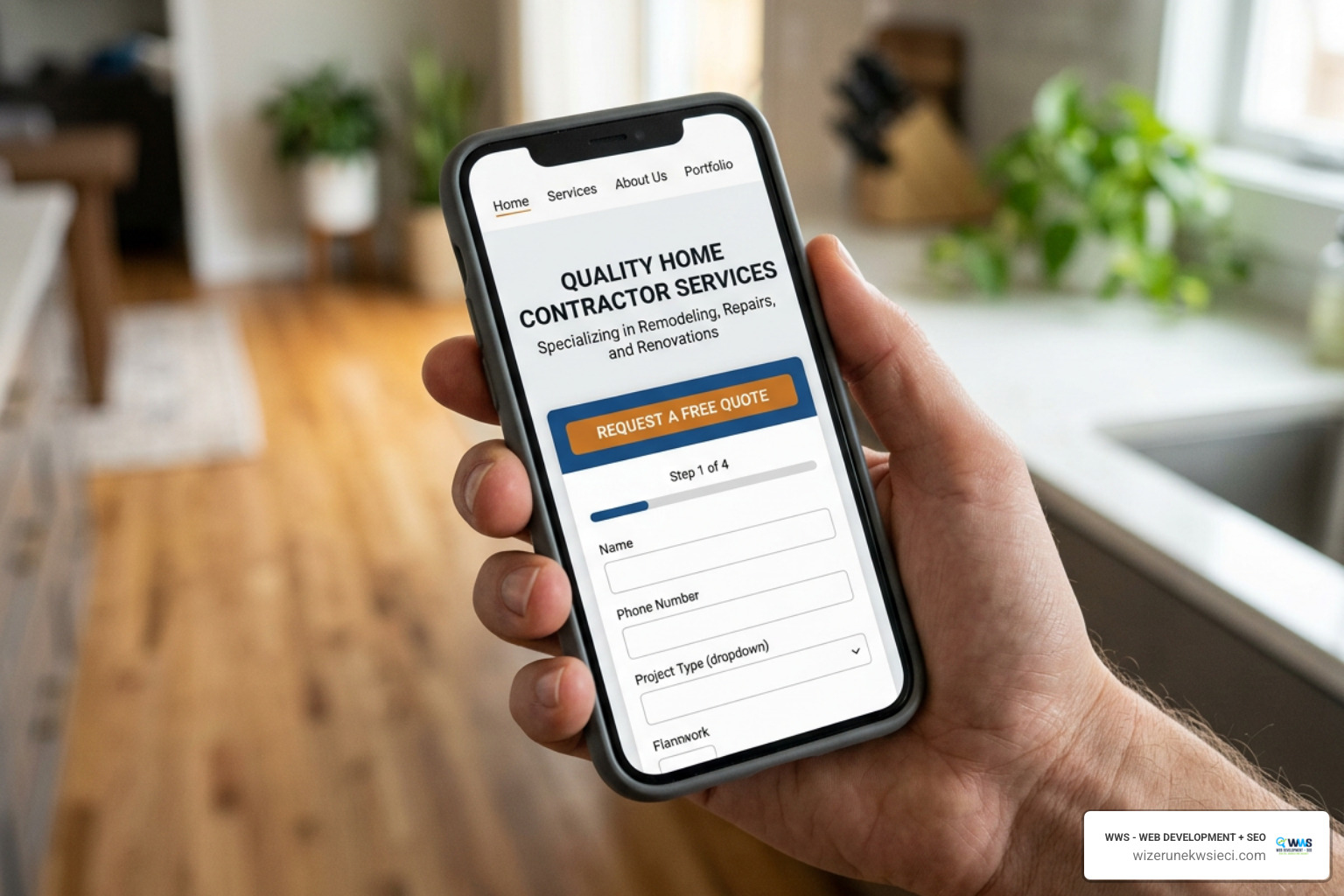
Dedicated landing pages convert paid contractor traffic at 6% to 10%, compared to only 2% to 3% on generic homepages. A focused landing page gives prospective clients exactly what they searched for, with clear trust signals and an obvious call to action.
Critical On-Page Elements That Turn Clicks Into Signed Estimates
A high-converting contractor landing page should include the following core elements:
- Prominent Click-to-Call Buttons: Over 60% of paid home services traffic comes from mobile devices, and up to 70% of qualified remodeling leads prefer to call directly. Place a persistent click-to-call button at the top of the mobile viewport.
- Short Multi-Step Forms Above the Fold: For luxury remodeling and large builds, multi-step forms that ask for project type, square footage, timeline, and address qualify buyers more effectively than basic three-field forms.
- Verified Local Proof: Showcase high-resolution photos of your past projects, customer reviews, local badges, and your contractor licensing and insurance details.
- Transparent Service Area List: List the exact towns and neighborhoods you service (e.g., Proudly serving Rosemont, Niles, Elk Grove Village, and Palatine).
Implementing Dynamic Call Tracking to Attribute Revenue
Home services businesses that implement dynamic call tracking see their overall cost-per-lead drop by an average of 20% while increasing close rates by 7%.
Using call tracking platforms like CallRail, Dynamic Number Insertion (DNI) assigns a temporary phone number to each website visitor based on the exact keyword and ad they clicked.

Set your primary conversion threshold to trigger only for phone calls lasting longer than 60 or 90 seconds. This prevents wrong numbers, hang-ups, and sales calls from registering as completed leads in your Google Ads dashboard, keeping your optimization data accurate.
Budgeting, Lead Follow-Up Speed, and Seasonal Scaling Strategies
To run paid campaigns sustainably, you need to know your target numbers before spending your budget.
Budget Planning and Benchmarks for Google Ads for Contractors
The average cost per lead for construction and general contracting on Google Ads sits at $165.67, with an average cost per click of $5.31 to $7.85 in the home improvement sector.
Use this simple formula to calculate your maximum allowable Cost Per Lead (CPL):
Max Allowable CPL = Average Job Value × Net Profit Margin × Close Rate
For example, if an average kitchen renovation brings in $40,000, your net profit margin is 20% ($8,000 profit), and your sales close rate on qualified leads is 25% (1 in 4 leads closes):
Max Break-Even CPL = $40,000 × 0.20 × 0.25 = $2,000
To maintain a healthy marketing return, allocate 10% to 15% of your net profit per job toward acquisition costs. In this scenario, your target acquisition cost per lead should range between $200 and $300.
Recommended monthly test budgets:
- Small Markets / Single Trades: $1,500 – $2,500/month
- Metro Suburbs & Mid-Size Markets: $3,000 – $5,000/month
- Competitive Metro Remodeling: $6,000 – $10,000+/month
The 5-Minute Lead Follow-Up Rule and Seasonal Budget Management
Data reveals that 74.1% of contractor phone calls go unanswered. Furthermore, contacting an inbound lead within 5 minutes results in a significantly higher close rate than waiting an hour. Submitting project estimates within 24 hours increases win rates by 30%.
Contracting demand follows natural seasonal patterns. Residential remodeling inquiries peak from January through May (spring planning) and September through October (pre-holiday upgrades), with slower volume during mid-summer and late December.
Instead of shutting down campaigns during slower months—which resets Google’s machine learning history and Quality Score momentum—lower your daily budget to a maintenance tier (30% to 50% of peak spend). Shift your ad messaging toward off-season planning discounts, bathroom upgrades, interior framing, or basement buildouts to keep your project pipeline steady year-round.
Frequently Asked Questions About Contractor Paid Search
How much should a contractor spend per month on Google Ads?
For small to mid-sized markets across the Midwest, a starting budget of $2,000 to $3,500 per month provides enough click volume to optimize conversions. In larger metropolitan regions or competitive remodeling trades, plan for $4,000 to $7,000+ per month to maintain consistent lead flow.
Why should contractors avoid broad match keywords when starting out?
Broad match keywords allow Google to show your ads for any search query related to your words. This often triggers clicks on DIY tutorials, job postings, material prices, and unrelated trades, depleting your budget without delivering qualified estimate requests. Stick to phrase match and exact match until you have established solid negative keyword lists and clear conversion baselines.
What is a good cost per lead for general contracting and remodeling?
Cost per lead varies based on the size and scope of the job. Minor bathroom repairs or routine service calls average $50 to $90 per lead. Mid-range kitchen and bathroom renovations typically cost $120 to $220 per lead, while full additions and luxury builds ($80,000+) range from $250 to $450+ per qualified lead.
Conclusion
Google Ads remains one of the most reliable ways for contractors to build a steady pipeline of high-ticket renovation, construction, and repair jobs. Success requires choosing the right campaign structure, filtering out unqualified clicks with negative match lists, building dedicated mobile landing pages, and following up with inbound leads right away.
Managing high-performing paid campaigns while running day-to-day job sites can be challenging for busy business owners. At WWS (Wizerunek w Sieci), we provide the dedicated resources of an experienced marketing team combined with responsive, personalized service. Based in Des Plaines, IL, we help trade businesses throughout Chicago, the surrounding suburbs, and across the United States scale their operations through transparent, data-driven Paid Campaigns.
Whether you need support with Google Search Ads, Local Services Ads, local SEO, or custom web development, our bilingual team (English & Polish) is ready to help you grow your business. Contact WWS today at wizerunekwsieci.com to schedule your free campaign consultation.