





Fix your Google Business Profile, publish an HTML menu, and build steady review recency. Those three moves capture most near-me diner searches before you spend a dollar on anything else. Everything else in restaurant local seo, from schema markup to citation cleanup, either supports those three levers or fixes friction after a diner has already found you.
TL;DR:
- Focus on claiming, verifying, and optimizing your Google Business Profile with specific categories and complete, regularly updated information to improve visibility in local search.
- Publish your menus as structured HTML pages with schema markup, ensuring each location has its own optimized webpage and full schema implementation.
- Generate a consistent flow of recent reviews, automate review requests, and respond promptly to maintain active reputation signals and improve rankings.
- Keep your website fast on mobile devices and ensure your location and menu pages are crawlable, with correct metadata and schema validation, to enhance user experience and search performance.
- Prioritize activities that drive immediate results, like GBP optimization and review recency, while systematically cleaning citations and improving delivery platform accuracy over time.
Table of Contents
- What Is Restaurant Local SEO and Where Do You Start?
- Google Business Profile: Claim, Categories, and Profile Hygiene
- Menus and Location Pages: HTML Menus, Unique Pages, and Schema
- Reviews and Reputation: Generate Recency, Respond, Automate
- Technical Site Health: Mobile Speed and Conversion
- Local Keywords and Content That Converts
- Citations and NAP Consistency: Audit and Cleanup
- Delivery, Ordering, and Reservation Signals
- Measure What Matters: KPIs That Show Real ROI
- Agency vs. DIY: When to Keep It In-House and When to Hire Help
- Strategies for Managing Negative Reviews Effectively
- Optimizing for Voice Search in Local SEO
- Leveraging Social Media Platforms for Local Restaurant Visibility
- Optimizing for ‘Near Me’ and Proximity Search Queries
- Local Link Building Strategies for Restaurants
- Prioritization for the Busy Owner
- How WWS Can Help: Services and the Next Step
- Sources
- FAQ
What Is Restaurant Local SEO and Where Do You Start?
Restaurant local SEO is the practice of optimizing your Google Business Profile, website, and third-party listings so nearby diners find your restaurant first when they search “best tacos near me” or “brunch in [neighborhood].” It sits inside the broader field of local search optimization, but restaurants play by different rules than dentists or plumbers. Google weighs relevance, distance, and prominence differently when someone is hungry right now, and Google’s own guidance on local ranking confirms that verification, complete business information, fresh photos, and review responses are the actions that move the needle.
Think of the Local Pack, that map and three-listing block Google shows above organic results, as the entire game. Most restaurant local SEO strategies that fail do so because owners chase blog traffic instead of Local Pack visibility. Industry breakdowns of restaurant ranking factors show Google Business Profile signals carry roughly a third of the weight in local-pack placement, which is why every tactic below routes back to that profile.
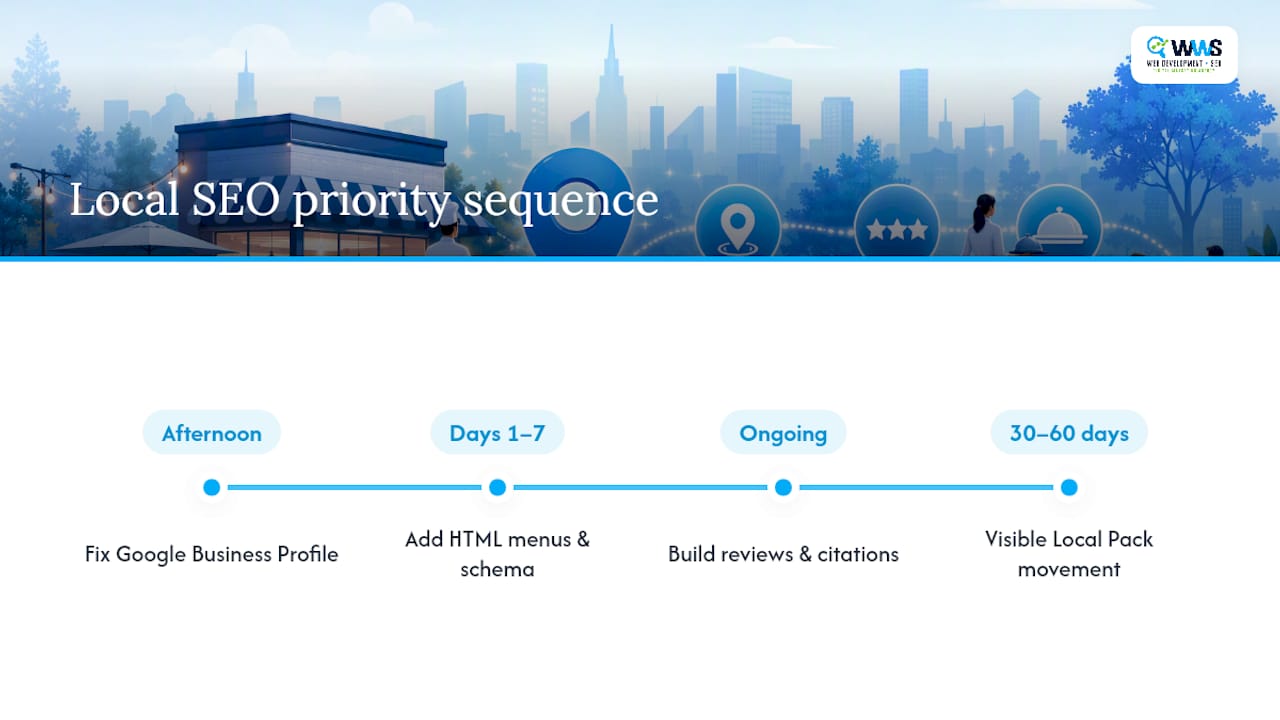
Start with what you can fix in an afternoon: your Google Business Profile setup. Then move to structural fixes like HTML menus and schema. Reviews and citations run in parallel because they take longer to compound. That order isn’t arbitrary. It’s the sequence that produces visible movement inside 30 to 60 days instead of buried gains you won’t notice for a year.
Google Business Profile: Claim, Categories, and Profile Hygiene
Claim and verify your listing first. An unverified profile can still show up in search, but Google treats verified businesses as more trustworthy, and verification unlocks the editing controls you need for everything downstream. Verification typically happens by postcard, phone, or video call depending on your business type and history.
Category selection is where most restaurants leave visibility on the table. A generic “Restaurant” primary category competes against every eatery in your radius. Swapping it for something specific like “Peruvian Restaurant” or “Wood-Fired Pizza Restaurant” can surface your listing for a much wider set of cuisine-specific searches, because Google matches category to query intent before it even looks at your website copy. Add two to five secondary categories that reflect real formats you offer: “Brunch Restaurant,” “Gastropub,” “Caterer,” or “Delivery Restaurant Delivery Service” if that applies.
Once the category is locked, fill in every field Google gives you:
- Regular hours, plus special hours for holidays and one-off closures
- Attributes such as outdoor seating, wheelchair access, and dog-friendly patios
- Current photos of food, interior, and exterior, updated monthly at minimum
- Direct links to your menu, reservation platform, and ordering system
- A weekly Google Post highlighting a dish, event, or seasonal item
Pro Tip: Set a recurring calendar reminder for the first Monday of every month to refresh your GBP photos. Stale interior shots from your grand opening three years ago quietly signal to Google, and to diners, that the listing isn’t actively managed.
Watch four numbers inside your profile’s Insights: direction requests, phone calls, booking or ordering taps, and your impressions-to-actions ratio. If impressions are climbing but actions aren’t, your photos, hours, or menu links need attention before you touch anything else. A step-by-step GBP optimization walkthrough covers the verification process in more depth if you’re doing this for the first time.
Menus and Location Pages: HTML Menus, Unique Pages, and Schema
PDF menus are invisible to most of what makes local search work. Google can crawl text inside a PDF in theory, but it can’t easily connect a dish name to a price, a category, or a location the way it can with structured HTML. Operator guides consistently recommend publishing menus as HTML with dinner, brunch, and drinks menus living on separate URLs, not stacked into one long page or buried behind a “Menu” button that loads a PDF viewer.
Each physical location needs its own page, not a shared “Locations” page with an address swapped out. That page should include neighborhood-specific copy, parking or transit notes, and an embedded map, because generic multi-location templates rank worse than pages that read like they were written by someone who actually works there.
Here’s a detail almost no one implements: fewer than a third of restaurant sites use full Restaurant and Menu schema, according to one industry review of local SEO performance, which means proper JSON-LD markup is still a fast competitive edge rather than table stakes.
- Add Restaurant, LocalBusiness, Menu, and MenuItem JSON-LD using Schema as your field guide
- Validate every implementation with Google’s Rich Results Test before publishing
- If you run five or more locations, move to a store-locator system that autopopulates name, address, phone, hours, and menu links per location
Reviews and Reputation: Generate Recency, Respond, Automate
Total review count matters less than most owners think. What actually moves rankings and conversion is recency: a steady flow of recent reviews outperforms a large stockpile of old ones, because Google reads review velocity as a live signal that the business is active and trusted right now.
Build the ask into your existing workflow instead of treating it as a separate campaign:
- Print QR codes on table cards and receipts that link straight to your Google review form
- Trigger an SMS or email follow-up two to four hours after the check closes, while the meal is still fresh
- Fold review prompts into loyalty-program emails so regulars get asked without feeling singled out
- Use a review-automation tool to schedule the asks so staff never have to remember
A free review-collection app can handle the SMS and QR logistics if you’d rather not build this manually.
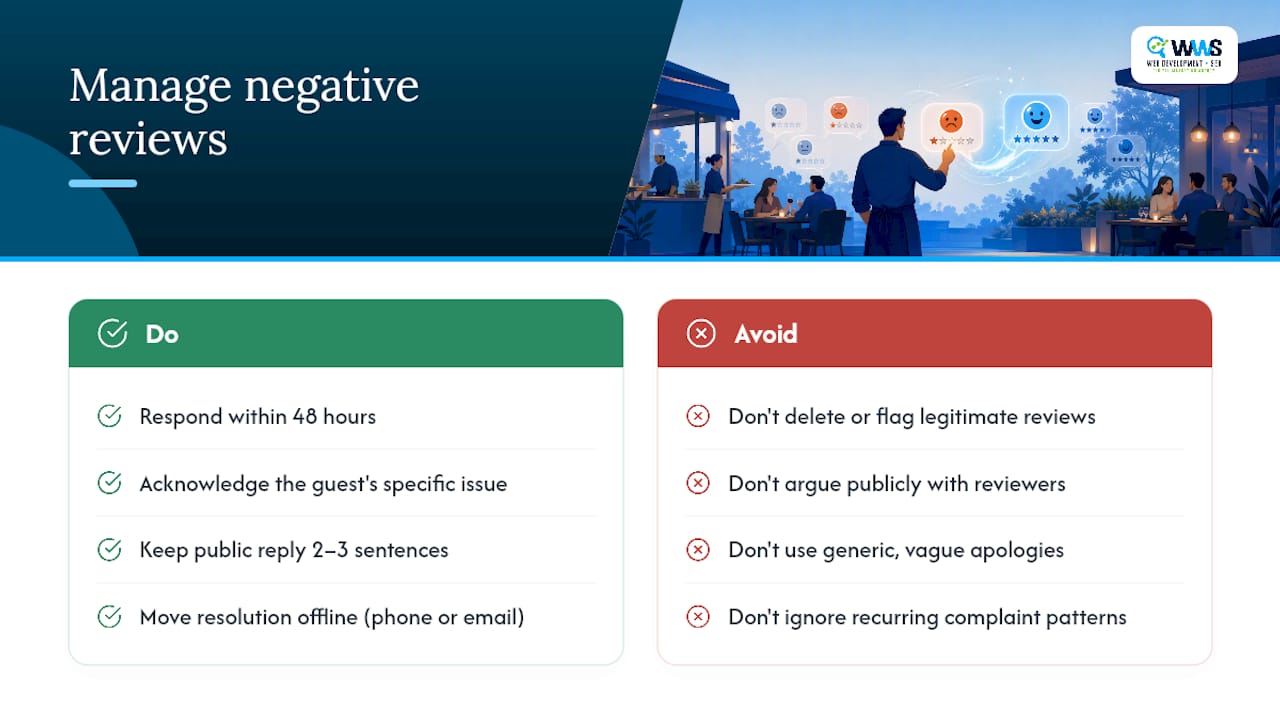
Responding matters as much as collecting. Reply within 48 hours, use the reviewer’s name, and reference something specific from their visit rather than a copy-pasted “Thank you for your feedback!” For negative reviews, acknowledge the issue publicly in two or three sentences, then move the resolution offline with a direct phone number or email. Never argue in the review thread.
Pro Tip: Assign one staff member, not the owner, to own review responses. Consistency in tone matters more than who technically writes the reply, and owners tend to get defensive when a review stings.
Technical Site Health: Mobile Speed and Conversion
A diner who taps your GBP link and waits four seconds for your homepage to load will hit the back button and call the next listing instead. Target a Largest Contentful Paint under 2.5 seconds on mobile. Compress your hero images, lazy-load anything below the fold, and cut heavy photo carousels that autoplay video, because those three fixes solve most restaurant speed problems without touching your hosting.
Make sure your menu and location pages are actually crawlable, not blocked by a robots.txt rule left over from a staging site, and write metadata that names your dish and neighborhood together rather than a generic “Menu | [Restaurant Name]” title tag.
Run these checks on a recurring basis:
- Google Lighthouse for a full performance and accessibility audit
- PageSpeed Insights to track your Core Web Vitals over time
- Rich Results Test to confirm your schema still validates after any redesign
- A manual mobile tap test on your call, order, and reservation buttons every quarter
Guidance on delivery-driven local visibility points to the same conclusion: mobile load speed and one-tap conversion paths determine whether a Local Pack click turns into a booking or a bounce. Track those buttons with UTM parameters so your analytics can tell you which channel actually drives the tap, not just the visit.
Local Keywords and Content That Converts
The working formula is simple: dish or cuisine, plus neighborhood, city, or landmark. “Deep dish pizza Wicker Park” beats “best pizza” every time on intent, because the searcher has already decided what they want and is filtering by location.
Pull your exact phrasing from four free sources instead of guessing:
- GBP Insights, which shows the literal search terms that led people to your listing
- Google’s autocomplete suggestions when you type your cuisine plus a neighborhood
- Delivery platform search bars, since diners phrase orders differently than reviews
- Your own reviews, where guests describe dishes in their own words, not menu jargon
Turn that language into real pages: individual dish pages for signature items, a landing page per neighborhood you deliver to, seasonal or holiday menu pages, and an FAQ section marked up with FAQPage schema. Keep a lightweight content calendar with one Google Post per week, rotating between a featured dish, an upcoming event, a seasonal special, and a staff or behind-the-scenes highlight. A broader local SEO strategy guide can help you extend this keyword approach beyond your menu pages.
Citations and NAP Consistency: Audit and Cleanup
NAP stands for name, address, and phone number, and inconsistent NAP across the web quietly confuses Google about which listing to trust.
- Pull your current citations from data aggregators like Foursquare, Data Axle, Neustar/Localeze, and Acxiom, since these feed dozens of smaller directories automatically
- Check for the small mismatches that cause big problems: “St.” versus “Street,” a missing suite number, or a phone number formatted with parentheses in one place and dashes in another
- Prioritize fixing Yelp, Apple Maps, OpenTable, TripAdvisor, and your delivery platforms first, since these carry the most search weight for restaurants specifically
- Set a quarterly reminder to re-audit, because franchise moves, phone number changes, and platform migrations drift your data faster than you’d expect
A local SEO checklist can help you track which platforms you’ve already corrected so you’re not re-auditing the same site twice.
Delivery, Ordering, and Reservation Signals
Add your DoorDash, Uber Eats, and Grubhub links directly inside your Google Business Profile’s ordering section, and keep menu prices matched across every platform. Mismatched pricing between your site and a delivery app creates the same trust problem as inconsistent NAP data.
- Complete your OpenTable or Resy profile fully and enable Google’s native Reserve action where it’s supported
- Treat every delivery and reservation platform listing as a citation, meaning your name, address, and phone must match exactly
- If you run a ghost kitchen or delivery-only concept, set that expectation clearly in GBP so diners aren’t confused when there’s no dining room to walk into
Correcting a single mismatched delivery listing can fix downstream inconsistencies that were quietly dragging down your broader local visibility.
Measure What Matters: KPIs That Show Real ROI
Four numbers tell you whether your restaurant local SEO work is paying off: direction requests, phone calls, booking or ordering taps, and reservations actually converted. Everything else is secondary.
- Track website clicks, impressions, review recency, and average rating as supporting metrics
- Attribute bookings and orders to specific channels using UTM parameters, reservation platform reports, and POS integrations where available
- Review your GBP Insights weekly for quick tactical adjustments, and do a fuller review monthly against your prior month
- Keep the dashboard simple: a single spreadsheet tracking these four primary numbers beats a complex analytics suite nobody opens
A proven local SEO checklist can serve as your monthly review template if you want a starting structure instead of building one from scratch.
Agency vs. DIY: When to Keep It In-House and When to Hire Help
Some of this you can do yourself in a weekend. GBP setup, basic category selection, QR-code review asks, and a simple HTML menu page fall into that category, and a motivated owner can knock most of it out in four or five focused hours.
Other tasks genuinely need specialized hands:
- Multi-location schema automation across five or more restaurant sites
- Citation network cleanup across dozens of aggregators and directories
- Structured local press outreach and link building campaigns
- Ongoing GBP management: weekly posts, review responses, and monthly reporting
This is where an experienced local digital marketing agency fits into the picture, providing in-house expert support for Chicago-area service businesses, including restaurants navigating exactly this DIY-versus-agency decision. A starter engagement typically begins with an audit of your current GBP, citations, and site health, followed by a prioritized fix list.
Pro Tip: Before hiring anyone, run your own restaurant name through Google on your phone in incognito mode. What you see, or don’t see, tells you more about your priority order than any audit report.
Strategies for Managing Negative Reviews Effectively
A one-star review sitting unanswered for two weeks does more damage than the review itself. Diners reading your profile judge your response as much as the complaint.
Respond within 48 hours, always. Acknowledge the specific issue the guest raised rather than a generic apology, and keep your public reply short, two or three sentences at most. Say what happened from your side only if it adds useful context, never to argue. Then move the resolution offline: give a direct phone number or email and offer to make it right, whether that’s a refund, a comped item, or simply a conversation.
Never delete or flag a review just because it’s negative unless it violates Google’s policies (fake reviews, hate speech, or reviews from someone who clearly never visited). Flagging legitimate criticism as fake and getting caught erodes trust faster than the original review did.
Watch for patterns. One complaint about slow service is an anomaly. Five complaints about slow service in a month is an operations problem your response protocol can’t fix, only your kitchen can. Track review themes monthly alongside your other KPIs so recurring issues surface before they tank your average rating.
Finally, don’t let a bad review sit alone on the page. A restaurant with one aging one-star review and no other recent activity looks worse than a restaurant with the same review buried under fifteen recent four and five-star ones. This is another reason review recency matters: fresh positive reviews dilute the visual and algorithmic impact of old complaints.
Optimizing for Voice Search in Local SEO
Voice queries through Google Assistant or Siri tend to sound like full sentences: “Where’s a good burger place open right now near me?” instead of the clipped “burgers near me” someone types. That shift rewards restaurants with conversational content and, again, a fully built-out Google Business Profile, since voice assistants pull answers directly from GBP data far more often than from your website copy.
Three things move the needle here. First, keep your hours meticulously accurate, including holiday hours, because voice search frequently answers “is it open now” questions directly from your profile without the diner ever tapping through to a page. Second, write your FAQ content in natural question-and-answer format, since that structure matches how voice queries are phrased and gives Google an easy snippet to read aloud. Third, make sure your phone number is correct and clickable everywhere, because a huge share of voice searches end in a phone call rather than a website visit.
You don’t need a separate “voice SEO strategy.” You need the same GBP completeness and structured FAQ content this guide already covers, applied with the awareness that a growing share of “near me” searches never show up as a click in your analytics at all. They show up as a phone ringing.
Leveraging Social Media Platforms for Local Restaurant Visibility
Social media doesn’t directly move your Google ranking the way a review or a citation does, but it does two things that indirectly help: it drives the searches that trigger your GBP to appear, and it feeds Google fresh signals about your business being active and relevant.
Instagram and Facebook location tags matter more than most owners realize. When guests tag your restaurant’s location on a post, that activity reinforces the same geographic relevance signals Google already tracks through your address and service area. Encourage tagging with a simple table-tent sign or a line on your receipt.
Post consistency also matters, though not as much as consistency on your GBP itself. A restaurant posting three times a week about specials, events, and behind-the-scenes moments builds an audience that searches for the business by name, and branded searches (people typing your restaurant’s actual name) are one of the strongest prominence signals Google uses for local ranking.
Treat your social bios the same way you treat a citation: name, address, phone, and website link must match exactly what’s on your GBP and everywhere else. A mismatched address on your Instagram bio is a small thing that adds up with every other inconsistency across the web.
Optimizing for ‘Near Me’ and Proximity Search Queries
“Near me” isn’t really a keyword you optimize for directly. It’s a proxy for proximity, and proximity is one of the three ranking factors Google explicitly weighs alongside relevance and prominence.
You can’t move your restaurant closer to every searcher, but you can make sure Google has the clearest possible read on exactly where you are. That means a precise pin placement on your GBP map (drag it manually if the auto-placed pin is even slightly off), a complete and accurate address with correct suite or unit numbers, and service-area settings configured correctly if you offer delivery beyond your immediate block.
Neighborhood-specific content plays a bigger role here than most owners assume. A dedicated page for “delivery to [neighborhood]” or “catering in [nearby suburb]” gives Google textual confirmation of the areas you actually serve, which matters most for restaurants sitting near a boundary between two neighborhoods or towns where proximity alone might point searchers toward a competitor just slightly closer to the query’s center point.
Local Link Building Strategies for Restaurants
Links from other local websites tell Google your restaurant is a real, recognized part of the neighborhood, not just a listing that exists online. For restaurants specifically, the most realistic link sources aren’t tech blogs. They’re hyperlocal.
Local news sites and neighborhood blogs regularly cover restaurant openings, chef features, and seasonal menu changes. A short pitch to a local food writer, especially around a menu launch or an anniversary, can land a feature with a link back to your site far more easily than cold outreach to a national publication ever would.
Chamber of commerce directories, neighborhood association websites, and local tourism board pages are frequently overlooked, but they carry real local relevance in Google’s eyes and are often free to join. Sponsorships of local youth sports teams, farmers markets, or community events almost always come with a website listing, which doubles as both goodwill and a citation.
Partnering with complementary local businesses, a nearby brewery, a florist doing your centerpiece flowers, a bakery supplying your desserts, creates natural cross-linking opportunities where each business links to the other from a “Local Partners” or “Who We Work With” page. None of this replaces the GBP and review work covered earlier, but it adds the kind of external validation that compounds over months rather than days.
Prioritization for the Busy Owner
Here’s the honest version: roughly 20% of these tasks produce 80% of your results. Everything else in this guide matters, but it matters less, and in a different order.
Expect GBP fixes to show movement within two to four weeks. Expect schema and citation cleanup to take a full quarter before you see it reflected in rankings. Measure before you redesign anything. A slow website killing conversions is a real problem, but it’s rarely the reason you’re invisible in the first place.
— Online Marketing Experts
How WWS Can Help: Services and the Next Step
WWS – Web Development + SEO is the alternative to a traditional marketing agency for restaurant local SEO in the Chicago area: instead of juggling a web developer, an SEO freelancer, and a social media contractor separately, every service runs through one in-house, Google and Meta certified team that already knows how Local Pack rankings work for restaurants specifically.
A typical starter engagement begins with an audit of your Google Business Profile, your current citations, and your site’s mobile speed, then delivers a prioritized fix list built around a 30/60/90 day plan: quick GBP and review wins in the first month, HTML menu and schema implementation by month two, and citation cleanup plus content expansion by month three. Our services relevant to this exact playbook include Google Business Profile optimization, full Local SEO retainers, and website SEO work covering the schema and speed fixes covered above.
With over 200 successful client partnerships across Des Plaines and the greater Chicago area, WWS – Web Development + SEO doesn’t just build websites. We drive real calls, consistent leads, and year-round revenue for local restaurants. If you want a clear picture of where your restaurant stands right now, request a Local SEO audit and get a prioritized fix list back within days, not months.
Sources
- Tips to improve your local ranking on Google
- Schema
- Restaurant SEO Complete Guide for Operators 2026: Buyer’s Guide
- Local SEO for Restaurants: The Complete Guide | Ninja
- Get Discovered by Nearby Diners With Local Restaurant SEO
FAQ
How Do You Do SEO for a Restaurant?
Start with your Google Business Profile: verify it, choose the most specific category available, and fill in every field including hours, photos, and menu links. Then publish an HTML menu with Restaurant schema and build a steady flow of recent reviews, since these three moves drive the majority of Local Pack visibility for most restaurants.
How Much Should I Pay for Local SEO?
Pricing depends on scope, whether you need a one-time GBP and citation audit or an ongoing monthly retainer covering reviews, content, and technical maintenance. WWS – Web Development + SEO’s Local SEO pricing is available on request based on your restaurant’s specific needs and current online presence.
How Do You Promote a Restaurant Locally?
Combine Google Business Profile activity (weekly posts, fresh photos, accurate hours) with a review-generation system using QR codes and post-visit follow-ups, plus neighborhood-specific content and local link building through food writers, chambers of commerce, and community partnerships. Delivery and reservation platform accuracy matters too, since these listings function as citations that reinforce your Google presence.
Why Are HTML Menus Better Than PDF Menus for SEO?
Search engines struggle to connect dish names, prices, and categories inside a PDF the way they can with structured HTML text. Publishing menus as HTML pages with separate URLs for dinner, brunch, and drinks makes every dish individually searchable.
Does Review Count Matter More Than Review Recency?
Recency generally matters more for restaurants than total volume. A steady flow of recent reviews signals an active, trustworthy business to Google, while a large stockpile of old reviews with nothing new coming in can actually work against you.