





Choose a Rank Tracker That Shows the Search Results Your Customers See
The best search engine ranking checker tool is the one that tracks your priority keywords by location, device, and time – then shows which page ranks, how it moved, and what is taking space above it in Google.
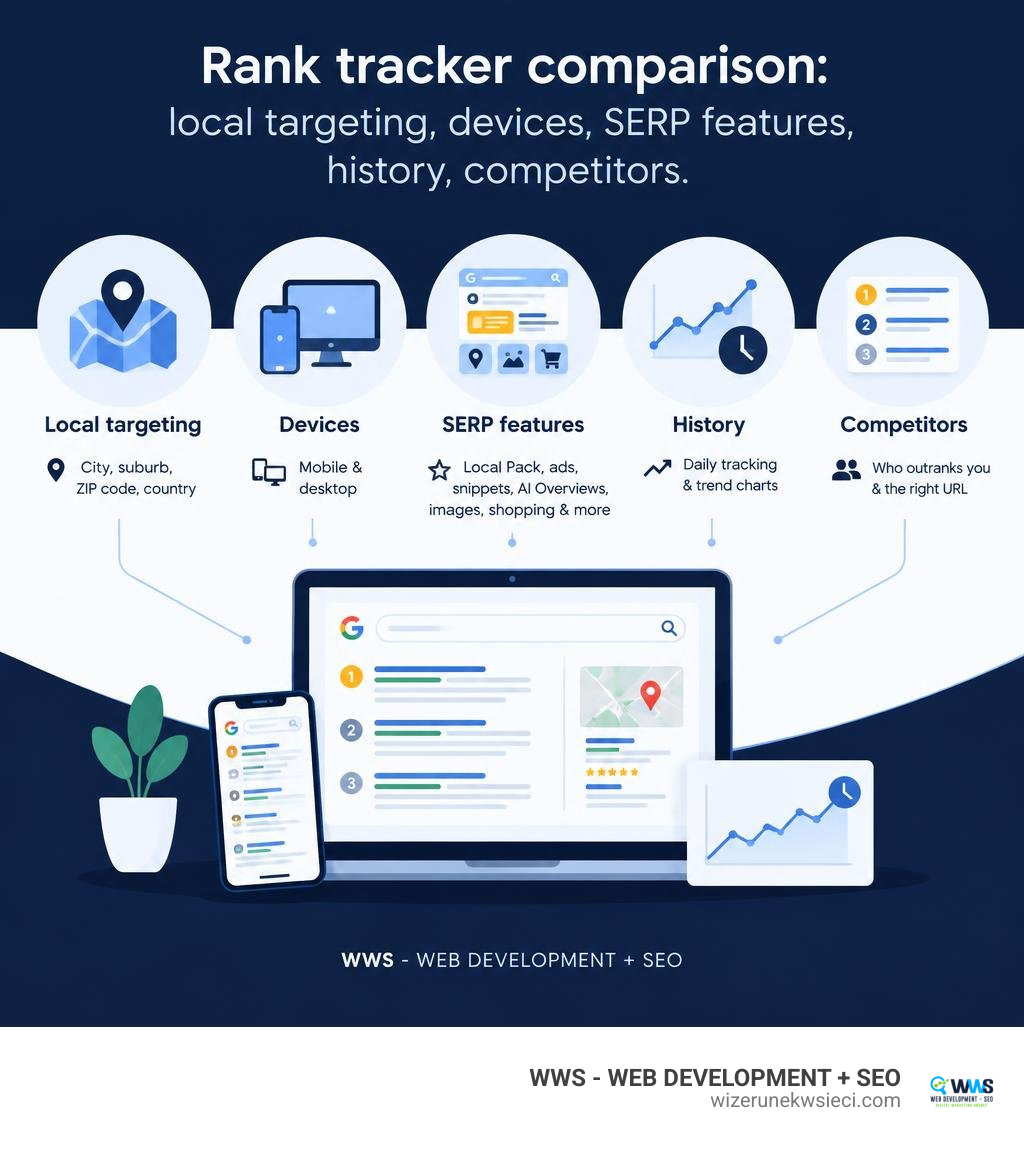
For most small businesses, compare tools on these essentials:
- Local accuracy: Can it check Chicago, a suburb, a ZIP code, or the countries you serve?
- Mobile and desktop results: A page can rank differently on each, and many local searches happen on phones.
- SERP feature reporting: Look for Local Pack, AI Overviews, ads, featured snippets, People Also Ask, images, and shopping results.
- History and alerts: Daily tracking and trend charts are far more useful than a one-time ranking snapshot.
- Competitor and URL views: You should see who outranks you and whether the right page is ranking.
Manual Google searches are not reliable rank checks. Google can change results based on your location, device, language, cookies, search history, and whether you are signed in. A quality tracker runs a more neutral query, so you can make decisions based on a clearer view of the SERP.
This roundup compares rank-checking options for business owners who need useful answers, not a wall of SEO data. The goal is not to chase a vanity position. It is to find the searches that can lead to more calls, appointments, and customers – then see what needs to improve.
I am Tomasz Lasota, a digital marketing strategist with more than 22 years of web development and SEO experience helping Chicago-area and U.S. small businesses improve search visibility. At Wizerunek w Sieci / WWS — Web Development + SEO, I use search engine ranking checker tool data alongside local SEO, website performance, and conversion insights to turn rankings into practical next steps.
Search engine ranking checker tool terms explained:
What Is a Search Engine Ranking Checker Tool and How Does It Work?
A search engine ranking checker tool is specialized software designed to query search engines programmatically and report exactly where a specific webpage appears in search engine results pages (SERPs) for target keywords. Instead of relying on manual browsing, businesses use these tools to simulate unbiased user queries, track visibility trends, and diagnose organic performance shifts over time.
When potential customers search for services, search engines evaluate hundreds of algorithmic signals to determine the most relevant pages. Understanding how to check my site ranking on Google enables business owners to observe actual organic visibility without personal browsing bias.
Understanding Neutral SERP Data vs. Personalized Search
When you search for your own business on a phone or laptop, Google personalizes the output. Your physical IP address, stored browser cookies, prior search history, and Google account profile heavily skew the results. If you frequently visit your own domain, search engines may place your website higher on your screen than it appears to a new prospective buyer searching from a neighboring town.
Neutral SERP data eliminates these personal filters. By stripping away tracking cookies, disabling personalized web search parameters (such as appending &pws=0), and querying through clean proxy networks, rank checkers present an objective view of the market. This non-personalized indexing shows where your site actually stands when a neutral customer searches for your services across Cook County or the broader Chicagoland area.
The Mechanics Behind a Search Engine Ranking Checker Tool
Modern tracking utilities operate through automated crawling engines and direct API queries. When a keyword check is initiated, the platform sends a localized query to search engines, retrieves the top 100 search results, and parses the underlying HTML and structured metadata.

This process extracts key data points including:
- Exact organic position (positions 1 through 100)
- The specific ranking URL (identifying page-level attribution)
- Title tags and meta description snippets displayed in search
- The presence of rich features such as AI Overviews, Local Packs, or People Also Ask boxes
Understanding how Google search optimization works helps clarify why these parsed data points matter. A top ranking on a desktop view in Des Plaines, IL might look completely different on a mobile device in Schaumburg or Naperville due to localized crawling parameters.
Essential Features to Evaluate in Rank Tracking Software
Selecting the right rank tracking software requires balancing depth of data with operational simplicity. Small and medium-sized business owners do not need bloated enterprise suites; they need reliable data that answers practical commercial questions.
| Feature Area | Free Spot Checkers | Professional Tracking Platforms |
|---|---|---|
| Tracking Frequency | On-demand single checks | Automated daily updates with historical logs |
| Keyword Volume | 1 to 10 keywords per check | Hundreds to thousands of tracked queries |
| Geo-Targeting | Country-level (rarely city-level) | Exact ZIP code, city, and GPS coordinates |
| Device Segmentation | Combined or desktop-only | Independent desktop and mobile tracking |
| SERP Feature Analysis | Basic organic link detection | Detailed tracking of AI Overviews, Snippets, Local 3-Packs |
| Competitor Monitoring | Manual input required | Automated side-by-side competitor benchmarking |
Geo-Targeting and Local Search Accuracy
For service businesses in the Chicago metropolitan area, broad national tracking provides little value. A commercial contractor or service provider in Elk Grove Village, Mount Prospect, or Arlington Heights needs to know how they rank within their direct service territory.
High-caliber rank checkers support hyper-local targeting down to specific postal codes, municipal boundaries, and geo-coordinates. This granularity is essential when executing targeted local SEO campaigns, where physical proximity to the searcher directly influences Google Maps and organic visibility.
Mobile vs. Desktop SERP Visibility
Google utilizes mobile-first indexing, meaning it crawls and evaluates the mobile version of your site as the primary benchmark. Search layout and click-through rates diverge significantly between screen sizes:
- Screen Real Estate: On desktop, the top organic result often captures roughly 28% of clicks, while position 10 captures around 1%. On mobile screens, paid search ads and map listings push organic listings below the initial fold, reducing click share for lower positions.
- Viewport & Layout Variance: Mobile SERPs frequently feature condensed snippets, horizontal image carousels, and visual call buttons that alter user interaction.
- Location Sensitivity: Mobile devices transmit exact GPS data, causing localized results to fluctuate more dramatically as users move between areas like Park Ridge, Niles, and Glenview.
SERP Feature Tracking and AI Overview Impact
Modern search results extend far beyond standard blue links. A comprehensive rank checker must monitor and identify rich SERP features:
- AI Overviews: Generative AI summaries placed at the apex of search results that synthesize answers directly, sometimes pushing standard listings down.
- Featured Snippets: Extracted text blocks that claim position zero for informational queries.
- Local 3-Packs: Map integrations that capture high-intent local service leads.
- People Also Ask (PAA): Expandable accordion questions revealing related user intent.
Monitoring these rich elements ensures you understand whether your organic position translates into genuine visual prominence.
Free vs. Paid Rank Checkers: Understanding Capabilities and Limitations
Free search engine rank checkers are helpful for occasional spot checks, but they come with technical constraints. Free utilities typically restrict queries to 5–10 searches per day, lack automated scheduling, and often cache results for up to seven days rather than querying live engines in real time.
Spot Checks vs. Automated Daily Tracking
A spot check provides a static snapshot in time. Automated daily tracking, by contrast, builds a historical timeline that reveals volatility, algorithm update impacts, and long-term momentum.
Free tools are ideal for verifying an immediate post-publish indexation or running quick checks. For continuous oversight, professional-grade monitoring platforms provide the structured data streams necessary for professional website positioning and strategic planning.
Integrating a Search Engine Ranking Checker Tool into Your SEO Stack
Rank data becomes truly actionable when paired with broader website diagnostic tools. Tracking keyword movement in isolation will not explain why a page climbed or slipped.
To build an effective optimization workflow, integrate rank data with:
- Keyword Research Suites: Discovering high-intent terms using structured processes for selecting strategic website keywords.
- Google Search Console (GSC): Comparing tracked positions against actual search impressions and user clicks.
- Technical Site Audits: Ensuring Core Web Vitals, site speed, clean code structure, and valid SSL configurations support search visibility.
- Backlink Auditing Tools: Evaluating domain trust scores and referring domain profiles that drive algorithmic authority.
How to Leverage Ranking Data for Competitor Analysis and Strategy
Rank checkers offer equal utility for auditing competing businesses. By querying your core commercial keywords without entering your own domain, you can extract the exact URLs dominating your market in locations like Northbrook, Evanston, or Oak Park.
Top 100 Visibility and Page-Level Movement
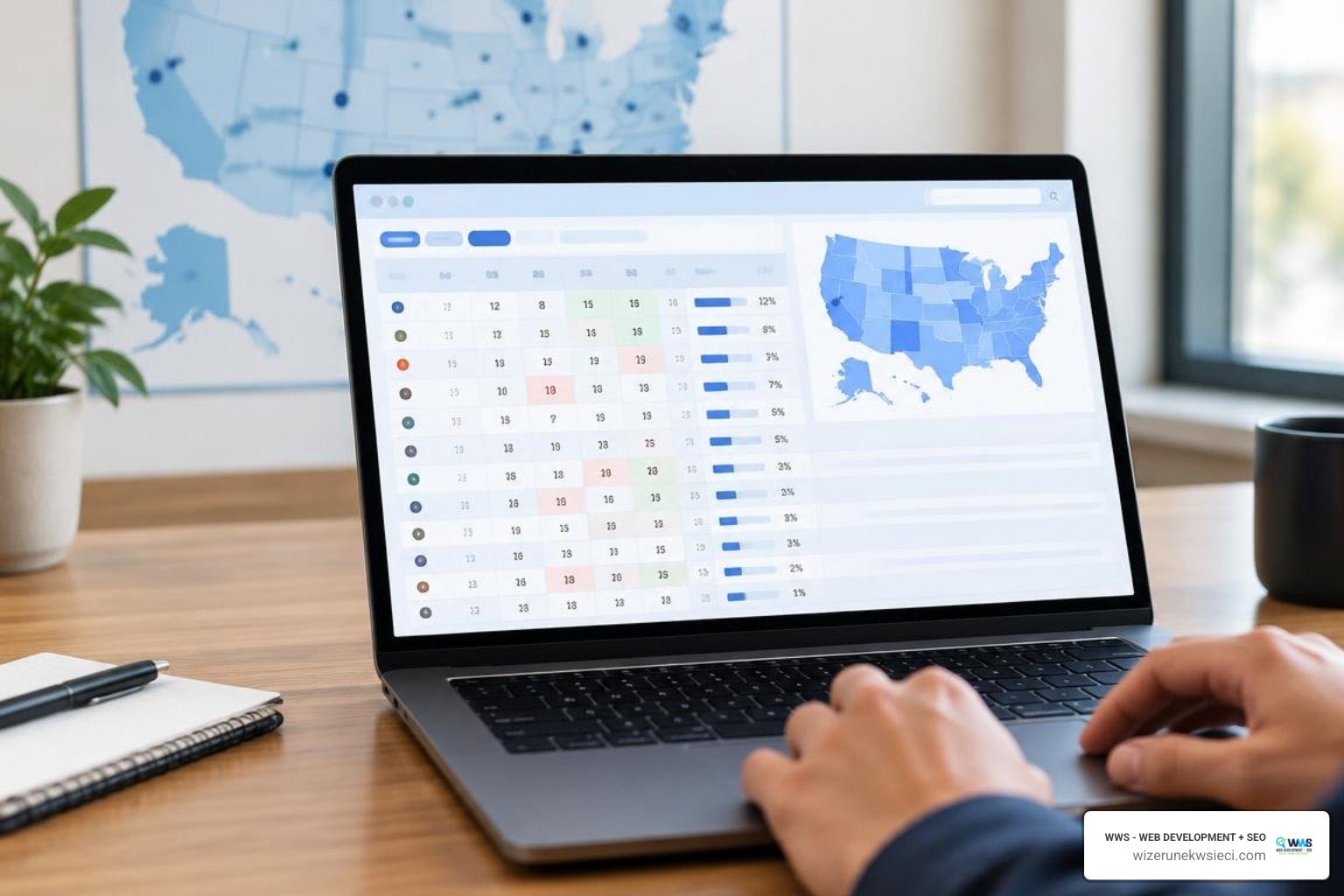
Evaluating the complete Top 100 results reveals strategic growth opportunities that standard top-10 reports overlook:
- Striking-Distance Keywords (Positions 11–30): Pages ranking on pages two and three represent immediate revenue potential. Minor on-page enhancements, internal linking adjustments, and structured data implementation can push these URLs onto page one.
- Keyword Cannibalization: If your rank tracker shows two different URLs from your website alternating in positions for the same keyword, your site suffers from internal competition that splits authority.
- URL Attribution & Page-Level Performance: Identifying exactly which page wins visibility allows you to optimize target landing pages rather than guessing which content Google prefers.
Translating Keyword Positions into Measurable Business Growth
A high keyword position is an operational metric; customer inquiries and revenue are business outcomes. Tracking keyword rankings serves to connect search visibility with commercial intent.
Focus tracking efforts on high-intent queries that indicate readiness to buy—such as localized service terms, product specifications, and direct commercial requests. When positions on high-intent terms improve, small businesses experience steady growth in phone calls, quote submissions, and qualified customer interactions.
Frequently Asked Questions About Rank Tracking
How often should small businesses monitor their keyword positions?
Small business owners should review ranking trends on a weekly or bi-weekly basis. While tracking software updates daily to record algorithmic fluctuations, daily manual obsession often causes unnecessary worry over routine search volatility. Monthly strategic reviews are ideal for evaluating overall campaign momentum, seasonal demand patterns, and core search engine updates.
Why do rank checker results differ from manual Google searches?
Manual searches reflect personal search histories, active browser sessions, device preferences, and micro-location signals derived from Wi-Fi access points or GPS. A rank tracker executes a clean, depersonalized query via server proxies, displaying the baseline search result seen by an uncommitted, first-time searcher.
Can rank trackers monitor localized map pack results?
Advanced rank tracking tools with local geo-grid or localized SERP capabilities can track Google Business Profile listings within the local 3-pack. Because map rankings depend heavily on physical proximity, these tools simulate searches from distinct coordinates across neighborhoods such as Rosemont, Buffalo Grove, Wheeling, or Skokie.
Conclusion
A search engine ranking checker tool is an essential diagnostic asset, but software alone cannot build market visibility. Software reveals where your business stands in search results; translating those insights into consistent phone calls, leads, and paying clients requires purposeful execution across web design, technical SEO, and conversion optimization.
At WWS (Wizerunek w Sieci), based in Des Plaines, IL, we represent the ideal middle ground between oversized national marketing corporations and unvetted independent contractors. We combine enterprise-grade technical expertise and data tracking tools with dedicated, bilingual (English and Polish) personal attention, serving businesses throughout Cook County, Lake County, the Northwest Suburbs, and across the United States.
Whether you operate a local trade business in Libertyville, a retail brand in Naperville, or a professional firm in Chicago, we build custom digital strategies focused on measurable bottom-line growth. Explore our comprehensive website SEO services to enhance your organic presence.
Ready to gain absolute clarity on your search visibility and turn rankings into steady business growth? Contact WWS today for a comprehensive, no-obligation website audit:
- Office Address: 636 S River Rd #218, Des Plaines, IL 60016
- Website: wizerunekwsieci.com