


Why Google Ads for Dance Studios Outperforms Passive Marketing
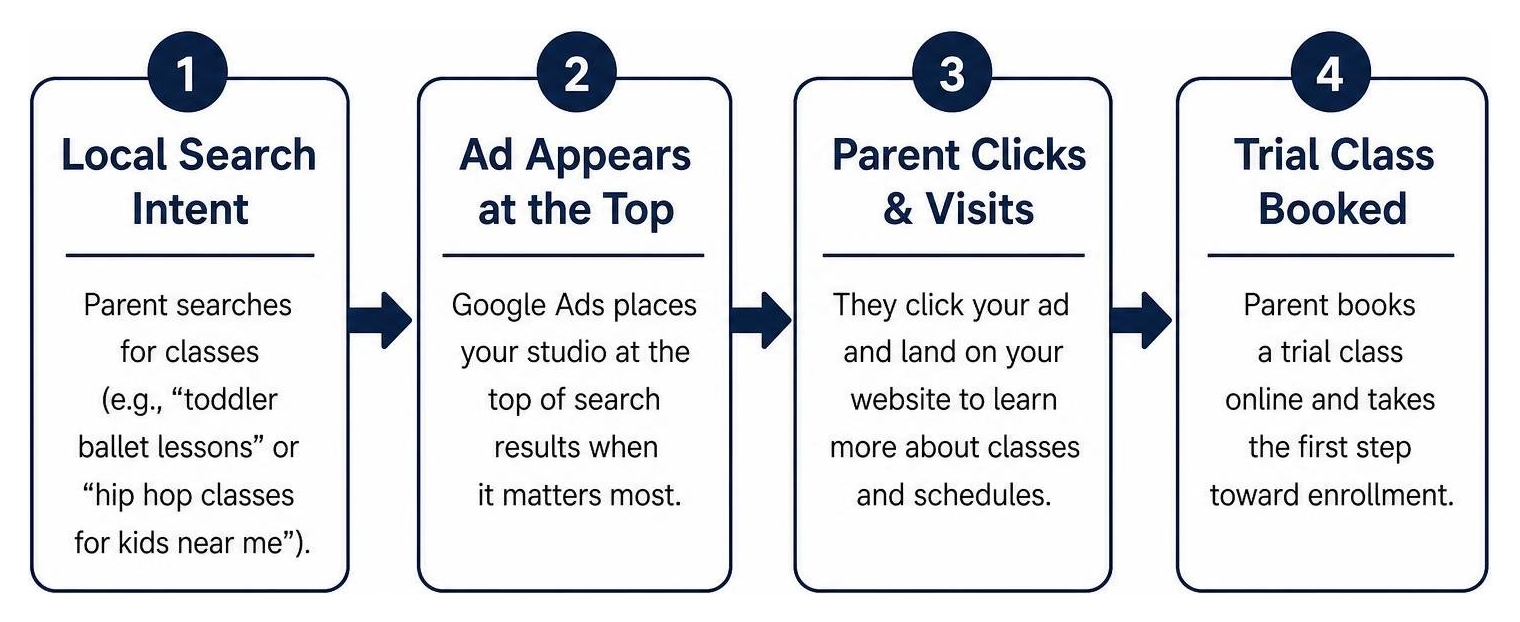
Dance studios successfully acquire new students through Google Ads by running search campaigns segmented by age and dance style, using tight geographic radius targeting around the studio, and directing clicks to dedicated trial class landing pages rather than a generic homepage. This combination captures parents at the exact moment they search for classes like “toddler ballet lessons” or “hip hop classes for kids near me,” putting your studio in front of motivated families ready to register right now.
Unlike passive promotional tactics—like handing out flyers at community fairs or relying solely on word of mouth—search advertising captures existing demand. Research shows that 71% of clicks on Google search results happen on the first page. If your studio is not prominently displayed when parents search, that enrollment goes directly to the studio down the road.
Setting up high-intent search campaigns through Google Ads for local businesses helps your studio achieve prominent top-of-page visibility. You do not have to wait months for organic rankings to climb before filling open spots in your fall or winter schedule.
Google Ads vs. Social Media for Student Acquisition
Many studio owners ask whether they should allocate their marketing dollars to social media platforms or Google Ads. Both have value, but they serve entirely different functions in a parent’s decision-making process.
Social platforms like Instagram, TikTok, and Facebook excel at discovery and visual storytelling. Millennial parents spend an average of 2 hours and 16 minutes daily on social media, while Gen X parents spend roughly 1 hour and 22 minutes. However, social users are scrolling to be entertained or connect with friends—not necessarily to register for a 4:30 PM Tuesday tap class.
| Strategic Dimension | Google Search Ads | Social Media Ads (Meta/TikTok) |
|---|---|---|
| User Intent | High active commercial intent (actively searching) | Passive browsing intent (interruption-based) |
| Conversion Speed | Rapid (same-day or within 48 hours for trial booking) | Slower (requires multiple touchpoints & retargeting) |
| Average Cost Per Click | $2.00 to $9.00 (varies by market and competition) | $0.80 to $2.50 |
| Cost Per Enrolled Student | Moderate to Low (high conversion rate from search) | Moderate (higher volume needed to filter intent) |
| Primary Goal | Direct enrollment and trial class booking | Brand awareness, community proof, and retargeting |
Search ads capture immediate demand from parents who already decided their child wants to dance. Social advertising works best as a secondary channel to build brand affinity or retarget parents who visited your website but did not complete a registration form. For immediate, predictable studio growth, search intent should always take priority.
Leveraging Google Guaranteed and Local Service Visibility
Beyond standard search text ads, studios can build authority through local trust programs. Parents want complete peace of mind when choosing an extracurricular environment for their children.
Understanding Google Guaranteed ads benefits allows business owners to display a verified green badge on local results, instantly signaling credibility and safety. When combined with traditional pay-per-click ads and a well-optimized Google Business Profile, your studio can dominate the top third of the search results page.
Strategic Account Structure and Geo-Targeting for Dance Programs
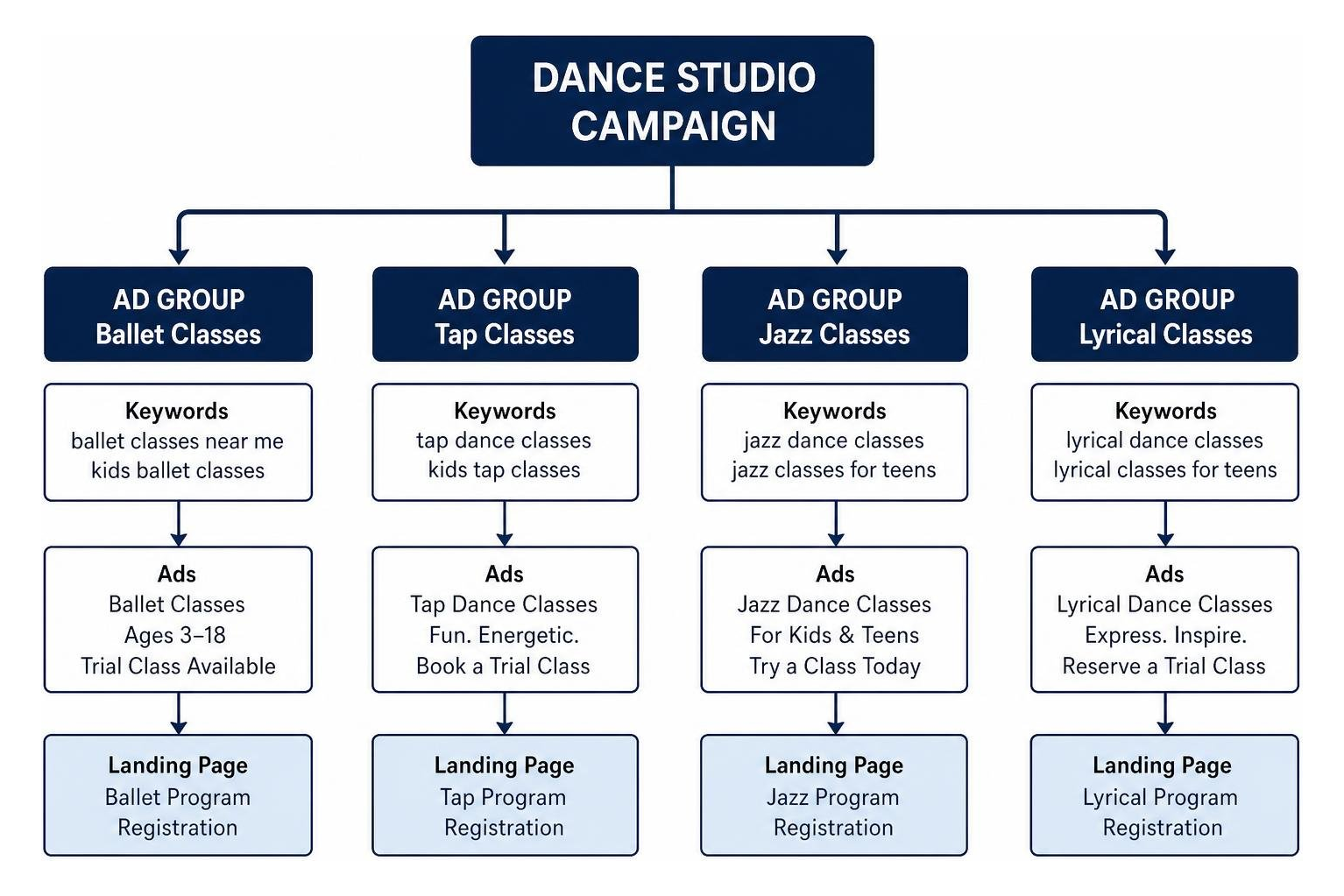
A poorly organized ad account burns money fast. If you run one single ad group containing every style of dance you teach, Google will show generic ads to parents looking for specific programs. A parent searching for “lyrical dance classes for teens” should not see an ad that reads “Dance Classes for All Ages.”
Successful dance studio campaigns rely on tight geo-targeting. Most parents will not drive 45 minutes twice a week through heavy traffic for a beginner recreational class. In dense areas like Cook County, IL, or the Northwest Suburbs of Chicago, a realistic driving radius is often 5 to 10 miles. In suburban areas near Naperville, Schaumburg, or Arlington Heights, that radius can comfortably expand to 12 or 15 miles.
Using targeted local business ads on Google allows you to set precise radius boundaries around your studio address. Set your location setting to “Presence: People in or regularly in your included locations” rather than “Presence or Interest.” This prevents people hundreds of miles away—who might simply be browsing dance videos—from clicking your ads.
Structuring Google Ads for Dance Studios by Age and Style
To achieve high Quality Scores and lower costs per click, build dedicated campaigns and ad groups organized by program category. Align these directly with your real Class Descriptions so visitors land on content that matches their search terms.
- Campaign 1: Preschool & Toddler Programs
- Ad Group A: “Toddler Dance Classes” (Keywords: toddler dance classes, preschool dance near me)
- Ad Group B: “Baby Ballet” (Keywords: baby ballet classes, ballet for 3 year olds)
- Campaign 2: Youth & Teen Styles
- Ad Group A: “Kids Ballet” (Keywords: ballet classes for kids, youth ballet school)
- Ad Group B: “Hip Hop” (Keywords: kids hip hop dance, hip hop classes for teens)
- Ad Group C: “Jazz & Contemporary” (Keywords: jazz dance lessons, contemporary dance classes)
- Campaign 3: Adult Dance Classes
- Ad Group A: “Adult Ballet” (Keywords: adult ballet for beginners, ballet barre classes)
- Ad Group B: “Adult Ballroom & Latin” (Keywords: ballroom dance lessons, salsa classes near me)
- Campaign 4: Competitive & Intensive Programs
- Ad Group A: “Dance Team Auditions” (Keywords: competitive dance team, dance company tryouts)
This granular structure ensures your ad headlines match the user’s exact phrase, which dramatically lifts your click-through rates and lowers what you pay per click.
Eliminating Budget Waste with Targeted Negative Keywords
Negative keywords prevent your ads from showing for irrelevant search queries. For dance studios, negative keyword lists are essential. Without them, you will pay for clicks from people seeking free YouTube tutorials, professional job seekers, or shoppers buying dance gear.
Add these negative keyword categories before spending a single dollar:
- Free & DIY Searches: free, youtube, online tutorial, how to dance at home, diy, routine videos
- Employment & Careers: jobs, hiring, dance teacher salary, employment, audition for instructors
- Retail & Apparel: shoes, leotards, tights, dancewear store, used costumes, tap shoes size 6
- Unrelated Entertainment: fortnite dance, tik tok trends, dancing with the stars, music video choreography
- Inappropriate Age/Style Variations: Add negatives for styles you do not offer (e.g., add pole fitness or exotic as negatives if you run a youth-focused academy).
Review your Search Terms Report weekly. When you see non-converting or irrelevant phrases triggering your ads, add them to your shared negative keyword list immediately.
Bidding Strategies, Seasonal Pacing, and Budget Realities
Across most metropolitan markets, clicks for dance studio searches range from $2.00 to $9.00 depending on local competition and style popularity. Most single-location studios invest between $800 and $3,500 per month to maintain consistent student enrollment year-round.
To understand how click costs translate into actual revenue, evaluate your numbers with a Google Ads cost calculator. If your average cost per click is $4.00, and your landing page converts 10% of visitors into trial class signups, each trial lead costs $40. If 60% of those trial attendees enroll in a full-semester program with an average lifetime value of $1,200, your return on ad spend is substantial.
Selecting the Right Initial Bidding Strategy in Google Ads for Dance Studios
When launching a brand-new campaign, Google has zero historical data about who converts on your website. Starting immediately with automated Smart Bidding strategies like “Maximize Conversions” or “Target CPA” can cause volatile swings and erratic spending.
- Phase 1 (First 30 Days): Start with Maximize Clicks (with a set maximum CPC bid limit) or Manual CPC. This approach drives initial traffic, helps you evaluate search term quality, and builds baseline conversion data without overpaying for single clicks.
- Phase 2 (After 30+ Conversions): Once your campaign reliably logs at least 30 conversions in a 30-day window, switch to Maximize Conversions or Target CPA (Cost Per Acquisition). Google’s machine learning will then use historical signals to bid aggressively on users most likely to fill out your trial form.
Pacing Your Enrollment Ad Spend Across the Year
Studio revenue follows a clear calendar cycle. Your ad spend should scale up during peak enrollment windows and scale down during recital and competition periods.
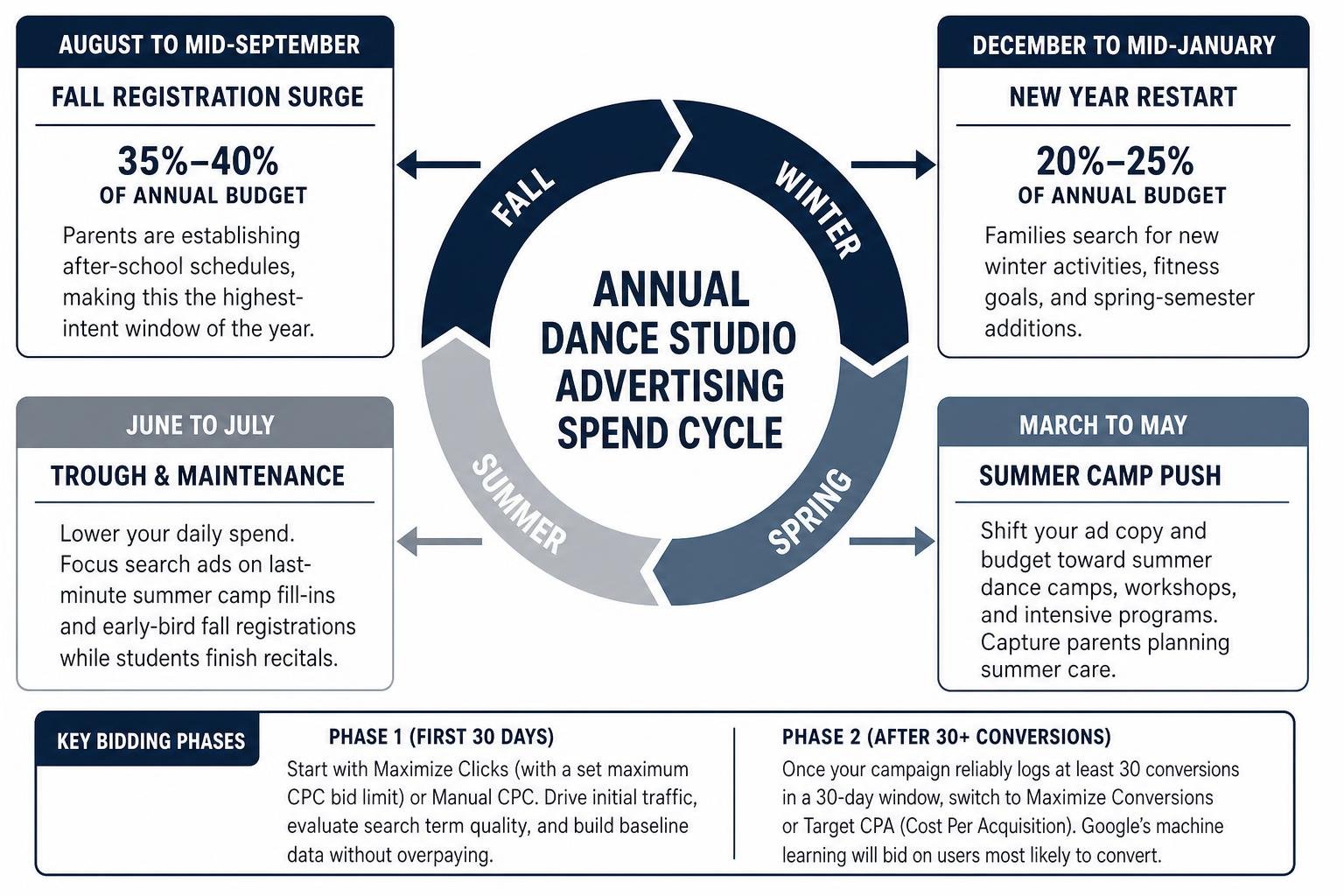
- August to Mid-September (Fall Registration Surge): Allocate 35% to 40% of your annual paid search budget here. Parents are establishing after-school schedules, making this the highest-intent window of the year.
- December to Mid-January (New Year Restart): Allocate 20% to 25% of your annual budget. Families search for new winter activities, fitness goals, and spring-semester additions.
- March to May (Summer Camp Push): Shift your ad copy and budget toward summer dance camps, workshops, and intensive programs. Many municipal and private community programs, such as local Dance Programs, begin promoting early spring schedules; your studio should capture parents planning summer care simultaneously.
- June to July (Trough & Maintenance): Lower your daily spend. Focus search ads purely on last-minute summer camp fill-ins and early-bird fall registrations while your current students finish recitals.
High-Converting Landing Pages and Call Attribution Setup
Sending paid ad clicks to your generic homepage is the fastest way to waste your marketing budget. Homepages contain too many distractions: recital announcements, uniform dress codes, general news, and multiple navigation links.
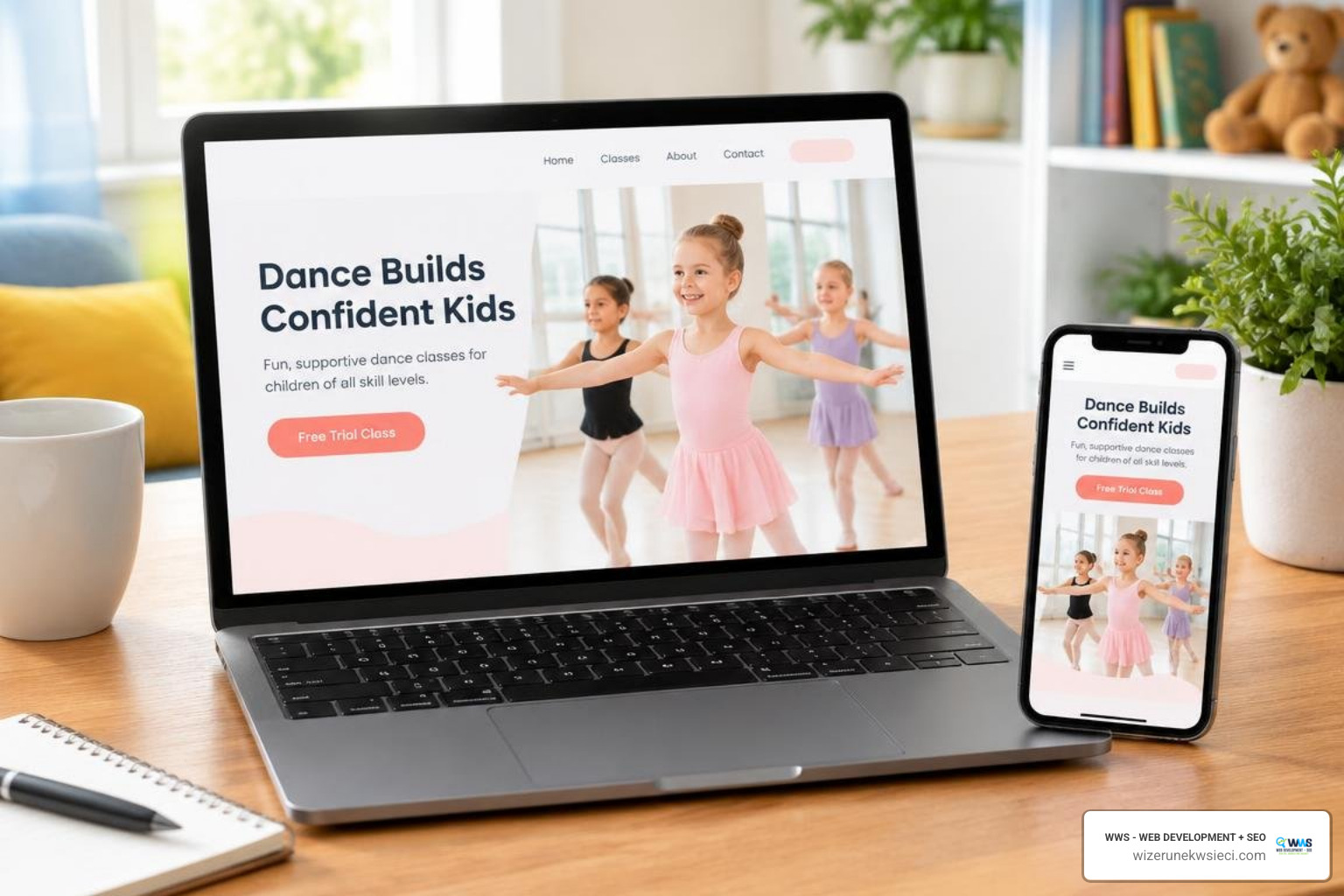
A parent who clicks an ad for “Preschool Tap Lessons” must land directly on a page dedicated exclusively to preschool tap. That page should feature an intuitive local landing page design built for fast mobile loading and frictionless trial bookings.
Essential Landing Page Elements That Drive Trial Class Signups
To maximize trial registrations, your landing pages must incorporate basic conversion rate optimization principles:
- Clear Headline Above the Fold: Clearly state the age group, style, and offer (e.g., “Introduce Your Child to the Joy of Dance – Free Beginner Trial Class in Des Plaines”).
- Short, Simple Signup Form: Ask only for necessary details: Parent Name, Email, Phone Number, Child’s Age, and Preferred Class Time. Long forms reduce conversions.
- Visible Contact Options: Include a clear, clickable phone number at the top of the page for parents who prefer calling directly.
- Authentic Visuals: Use real photos of your studio, happy students, and clean facilities rather than generic stock photography.
- Social Proof and Credentials: Highlight instructor certifications, safety standards, and short quotes from local parents.
- Clear Class Details: Outline what to wear, parking instructions, and what to expect during the first visit to remove friction.
Tracking Phone Calls and Lead Inquiries Accurately
You cannot optimize what you do not measure. A common error studio owners make is tracking only online form submissions while ignoring phone calls. Over 40% of parents with young children choose to call a local studio directly to ask questions about class placement or schedule adjustments before registering.
By using lead generation tools for small businesses, you can implement dynamic call tracking. This assigns a unique tracking phone number to Google Ads visitors. When a parent calls from the website, the call duration and campaign source are automatically recorded as a conversion inside your Google Ads account.
Connect your lead tracking to your studio management software. Measuring your true cost per registered student—rather than just cost per click—gives you an accurate picture of your campaign return on investment.
Frequently Asked Questions About Dance Studio PPC Campaigns
How much should a dance studio budget for Google Ads each month?
Most independent dance studios invest between $800 and $2,500 per month on Google Search campaigns. In highly competitive Chicagoland suburbs like Schaumburg, Glenview, or Naperville, click costs can be slightly higher, requiring a starting budget closer to $1,200 to $1,500 per month during peak August and January registration windows to capture sufficient search volume.
What are the most damaging negative keyword mistakes studios make?
The two most common negative keyword mistakes are:
- Failing to use negative keywords at all: This allows your budget to be drained by non-commercial searches like “free online dance videos” or “dance instructor jobs.”
- Adding broad negatives that block valuable searches: For example, adding the negative keyword lessons would inadvertently block queries like “ballet lessons for 5 year olds.” Always use negative phrase or exact match types to prevent blocking legitimate parent searches.
How quickly can a studio expect trial registrations from search ads?
Unlike organic search engine optimization, which takes time to establish rankings, Google Ads can generate qualified traffic the same day your campaign launches. When campaigns feature well-structured ad groups, tight geographic boundaries, and focused landing pages, studios frequently see trial class registrations within the first 48 to 72 hours of campaign activation.
Conclusion: Building Sustainable Studio Enrollment Growth
Growing a thriving dance studio requires a healthy balance of word-of-mouth recommendations, engaging community classes, and predictable student acquisition. High-intent search advertising bridges the gap between passive interest and filled studio rosters.
At Wizerunek w Sieci / WWS — Web Development + SEO, we specialize in helping local small businesses, dance academies, and service providers build dependable online marketing systems. Rather than choosing between a large national agency that barely knows your neighborhood and a local freelancer who may lack the resources to scale your campaigns, studio owners can rely on WWS as the ideal middle ground. We bring the professional expertise, tools, and strategic discipline of a full-service agency, paired with the personalized attention, local market knowledge, and bilingual (English and Polish) service you would expect from a trusted neighbor.
Headquartered in Des Plaines, IL, our team combines enterprise-grade search strategies with the attention to detail and genuine care independent business owners deserve.
Whether your studio serves families in Des Plaines, Chicago, Cook County, or communities across the United States, our team is ready to help you optimize your digital presence.
Ready to fill your upcoming class schedules with eager dancers? Explore our tailored paid campaigns or visit wizerunekwsieci.com to request your free website and advertising audit today.