



Why SEO for Auto Repair Shops Is Essential for Local Dominance
Executing local SEO for auto repair shops requires claiming and optimizing your Google Business Profile, generating steady review velocity, structuring dedicated website pages for specific repairs and diagnostic symptoms, and maintaining accurate NAP citations across automotive directories. These core tactics position your facility directly in front of nearby motorists facing urgent vehicle issues.
Across the United States, there are over 23.4 million monthly searches for automotive maintenance and repair services. For independent garage owners across Cook County and the surrounding Chicagoland area, capturing localized search volume translates directly into fully booked service bays. When a vehicle breaks down, the search window is immediate, highly localized, and carries immense buying intent. While paid pay-per-click (PPC) ads offer immediate placement, the average cost-per-click (CPC) for automotive repair terms sits around $4.77, quickly draining marketing budgets.
Building sustainable organic search equity allows your shop to capture ready-to-book vehicle owners without paying for every single phone call. To establish a structured digital foundation, business owners frequently start with A Comprehensive Guide to Local SEO for Businesses to understand how local signals work together.
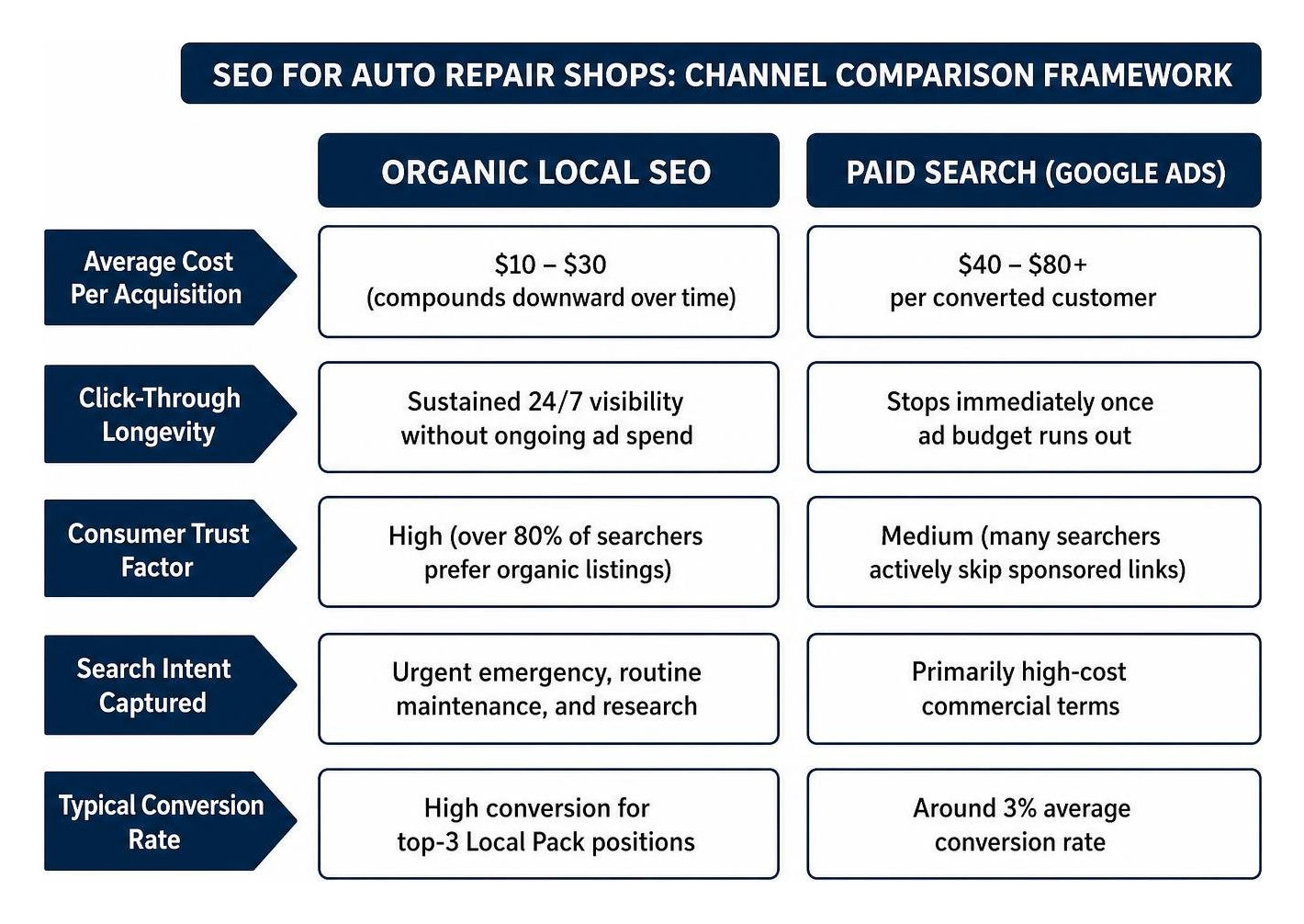
| Metric / Channel | Organic Local SEO | Paid Search (Google Ads) |
|---|---|---|
| Average Cost Per Acquisition | $10 – $30 (compounds downward over time) | $40 – $80+ per converted customer |
| Click-Through Longevity | Sustained 24/7 visibility without ongoing ad spend | Stops immediately once ad budget runs out |
| Consumer Trust Factor | High (over 80% of searchers prefer organic listings) | Medium (many searchers actively skip sponsored links) |
| Search Intent Captured | Urgent emergency, routine maintenance, and research | Primarily high-cost commercial terms |
| Typical Conversion Rate | High conversion for top-3 Local Pack positions | Around 3% average conversion rate |
Urgency-Driven Search and High Ticket Value
Automotive search behavior is uniquely characterized by high urgency. Approximately 65% of all auto repair queries occur on mobile devices, often originating from drivers parked on the side of the road or sitting at a red light staring at a newly illuminated check engine light. Phrases like “mechanic near me” generate over 823,000 monthly searches nationwide, reflecting immediate consumer distress.
Because the average auto repair ticket exceeds $400, securing top organic positioning yields substantial financial returns. When a driver types an emergency query, they rarely scroll past the top three map listings. If your shop is not clearly visible in that immediate decision window, that repair job goes directly to the shop down the street.
Overcoming the Trust and Transparency Gap
Car owners frequently experience anxiety when choosing a new mechanic. They fear overpaying, misdiagnosed issues, or unnecessary upsells. Over 80% of vehicle owners conduct online research before handing over their keys, looking for unmistakable signals of professionalism and integrity.
To bridge this trust gap, your digital footprint must showcase:
- Certifications and Credentials: Prominently display ASE (Automotive Service Excellence), AAA Approved Auto Repair, or manufacturer-specific badges.
- Warranty Guarantees: Highlight nationwide or multi-year parts and labor warranties (such as 24-month/24,000-mile guarantees).
- Transparent Pricing Guidelines: Provide clear diagnostic procedures and baseline estimates so prospective clients know what to expect.
- Bilingual and Community Ties: In culturally diverse regions like the Chicago northwest suburbs, having bilingual English and Polish support establishes immediate comfort for local motorists.
Dominating Google Maps and the Local 3-Pack
The Google Local 3-Pack—the map section appearing at the top of local search results—is the single most lucrative piece of digital real estate for any repair facility. Ranking in this pack is driven by three core algorithmic pillars: relevance, distance (proximity), and prominence.
To secure consistent placement across your target service area, shop owners must master profile configuration and ongoing listing engagement, as outlined in our guide on Map Pack Mastery: Secrets to Ranking Your Google Business Profile.
Google Business Profile Optimization
A complete profile is the foundation of local map rankings. An incomplete or unverified profile tells search engines that your business may not be operational or reliable.
- Primary and Secondary Categories: Set your primary category to match your highest-revenue focus, typically Auto Repair Shop. If your specialty is specific, you can use primary categories such as Brake Shop or Transmission Shop. Populate secondary categories with relevant terms like Oil Change Service, Tire Shop, Car Inspection Station, or Wheel Alignment Service.
- Comprehensive Business Description: Craft a 750-character profile description detailing your services, ASE-certified mechanics, local community involvement, and exact neighborhoods served across towns like Des Plaines, Elk Grove Village, or Schaumburg.
- Photo Depth: Listings featuring 20+ authentic photos receive significantly more profile interactions than listings with fewer than five. Upload clear interior and exterior shots of your facility, clean service bays, diagnostic equipment, and your staff at work.
- Weekly Google Posts and Q&A: Publish regular updates regarding seasonal vehicle maintenance (such as winter prep or summer A/C checks). Seed the public Q&A section with common customer queries—such as “Do you offer loaner vehicles?” or “Do you work on European imports?”—and answer them officially.
For a deeper dive into profile management, review our step-by-step walkthrough for Google Business Profile Optimization.
Review Generation and Velocity Tactics
Customer reviews directly influence both your map rankings and your click-through conversion rate. Shops holding 50+ authentic Google reviews earn 4.5 times more trust from prospective customers than those with minimal feedback.
However, total review volume is only half the battle. Review velocity—the consistency and recency of new reviews—is a critical ranking factor. A shop receiving 10 new reviews per month consistently outperforms a competing shop that has 500 total reviews but hasn’t received a new one in 60 days.
- In-Person Requests at Checkout: Train your service advisors to ask for feedback when handing over the keys: “If our team took great care of your vehicle today, a quick Google review helps our independent shop tremendously.”
- SMS Automation: Send an automated text message containing a direct short-link to your review screen within 30 minutes of vehicle pickup.
- QR Codes on Countertops and Invoices: Place scannable QR codes at your front counter, waiting lounge, and printed on the bottom of final invoices.
- 100% Response Rate: Respond to every single review within 24 to 48 hours. When replying, naturally mention the specific service performed (e.g., “Thank you for trusting us with your brake pad replacement and rotor resurfacing on your Honda CR-V”). When handling negative reviews, remain professional, express genuine regret, and invite the customer to call the shop directly to resolve the issue.
Website Architecture and On-Page Optimization
While an optimized map listing captures immediate local searches, a properly structured website expands your reach to rank for hundreds of long-tail service and symptom-based queries across your entire geographic market. Relying on a single-page website or cramming all services onto one generic page severely limits your organic visibility.
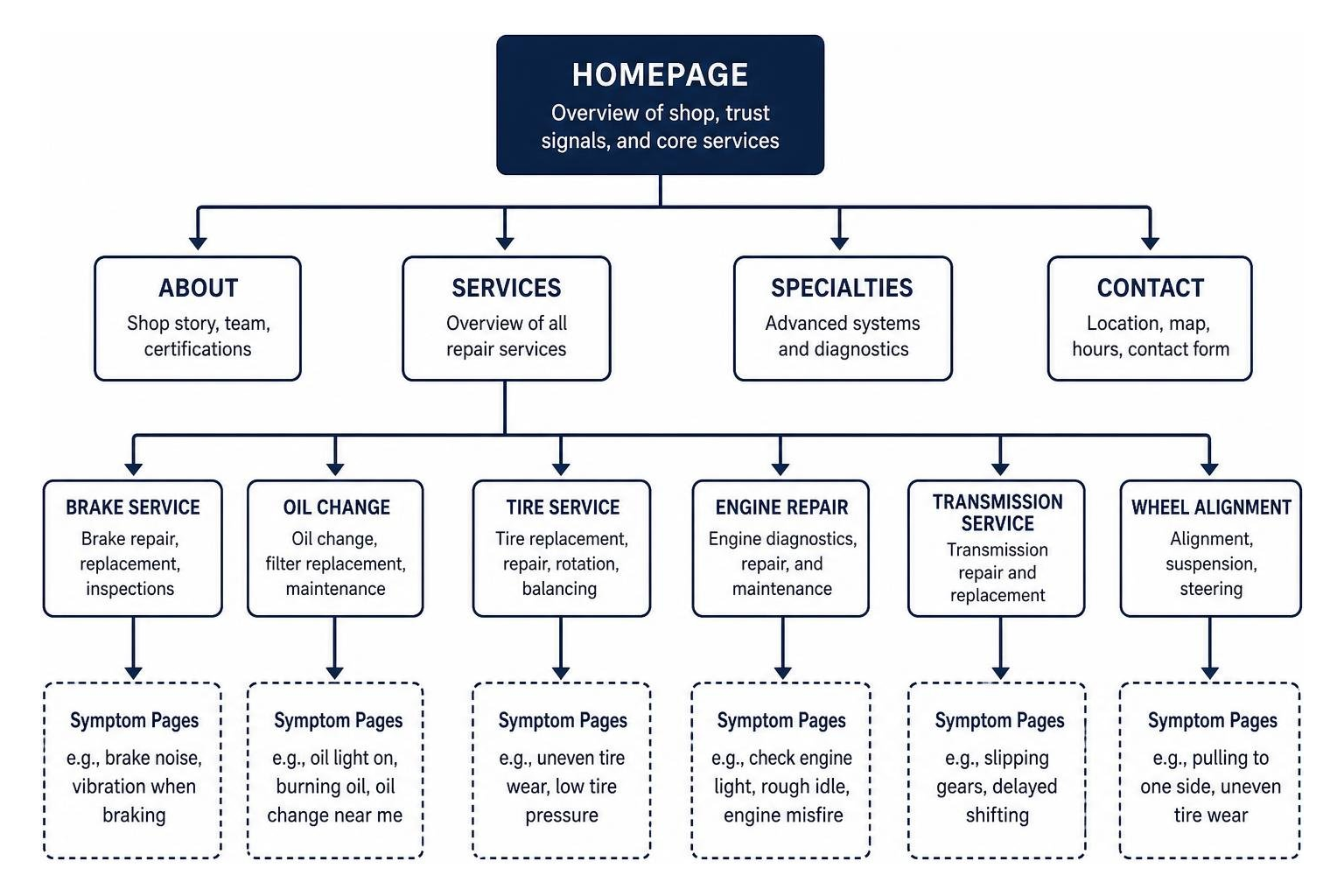
Effective automotive websites utilize clear topic silos where each core repair discipline receives its own dedicated, content-rich landing page. If you are building or redesigning your digital presence, applying dedicated SEO Web Design principles ensures your site structure is optimized for both search engines and potential customers.
Service Pages vs. Symptom Queries in SEO for Auto Repair Shops
Modern searchers do not always search by technical repair terms. A customer rarely starts by searching for “strut replacement”; instead, they search for “car squeaking over bumps” or “steering wheel vibrates when braking.”
Your website content strategy must address both search intents:
- Core Service Landing Pages: Build individual 800–1,200 word pages for primary offerings including brake repair, transmission rebuilding, auto air conditioning service, wheel alignment, oil changes, and engine diagnostics. Regional examples such as Altimate Auto Repair demonstrate how structured service navigation helps users quickly find specific repairs.
- Symptom-Based Content Clusters: Publish helpful diagnostic articles answering common vehicle warning signs. A blog post targeting “Why is my brake pedal soft and spongy?” can capture an undecided driver, provide immediate diagnostic value, and seamlessly guide them via internal links to book an inspection on your primary brake service page.
Targeting Specific Vehicle Makes and Models
If your shop has specialized diagnostic tools or certified technicians for specific brands—such as European imports (BMW, Audi, Mercedes-Benz, Volkswagen) or Asian makes (Toyota, Honda, Subaru)—creating dedicated make-specific pages captures highly lucrative, low-competition searches.
A page optimized for “BMW Specialist Repair in Des Plaines, IL” faces far less ranking competition than a generic automotive repair term, while attracting high-ticket customers seeking specialized care over dealership prices. For businesses serving multiple surrounding suburbs, deploying dedicated Service Area Pages allows you to rank organically in neighboring communities like Arlington Heights, Mount Prospect, and Park Ridge without triggering duplicate content penalties.
Technical Foundation, Citations, and Local Signals
A clean technical infrastructure ensures that search engine crawlers can index your pages effortlessly while providing mobile users with an instantaneous browsing experience.
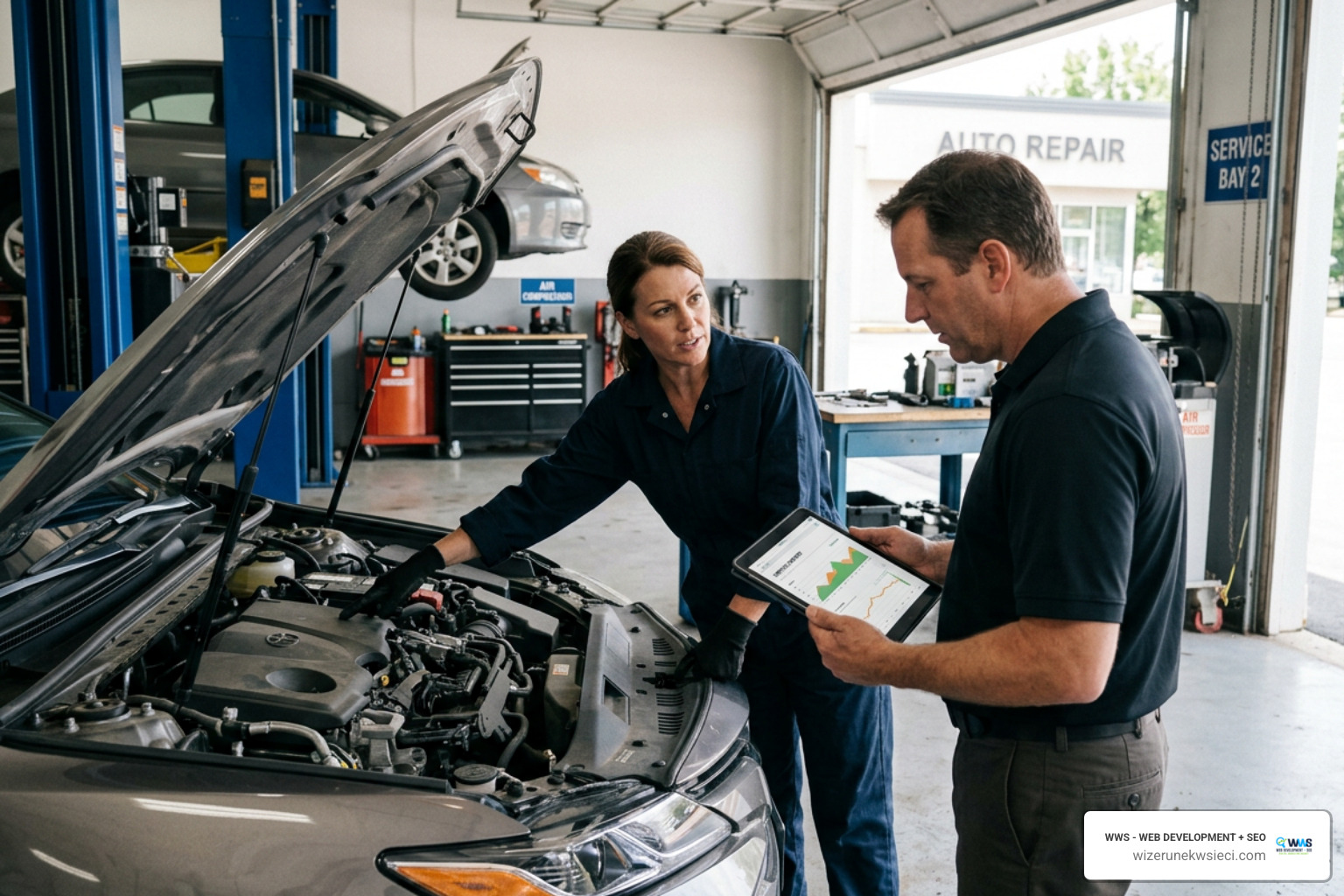
A comprehensive Technical SEO Audit will uncover underlying crawl errors, broken internal links, and Core Web Vital bottlenecks that may be holding back your organic performance.
Implementing AutoRepair Structured Data and Mobile Speed
Structured data (schema markup) is machine-readable code added to your website that explicitly tells search engines what your business is, what services you offer, and where you operate.
Every auto repair website should implement JSON-LD AutoRepair schema containing:
- Official business name and complete postal address.
- Exact geographical coordinates (latitude and longitude).
- Opening hours and emergency service availability.
- Accepted payment methods.
- Service catalog breakdown (
hasOfferCatalog) detailing specific repair services.
Alongside structured data, mobile page speed is paramount. With 65% of searches occurring on mobile devices, your site’s Largest Contentful Paint (LCP) must load in under 2.5 seconds. Optimize images by compressing heavy shop photos into modern WebP formats and eliminate render-blocking scripts that slow down mobile booking forms.
Building NAP Consistency and Citations in SEO for Auto Repair Shops
NAP consistency refers to keeping your business Name, Address, and Phone Number identical across all online directories, social profiles, and citation sources. Inconsistent abbreviations (e.g., “St.” vs. “Street” or differing suite numbers) create conflicting entity signals that suppress local rankings.
Prioritize claiming, verifying, and updating your profiles on the industry directories that carry real domain authority:
- Google Business Profile, Apple Maps, and Bing Places
- Yelp (see local examples like the Mount Prospect auto repair directory on Yelp)
- Automotive-specific directories: RepairPal, AutoMD, AAA, and Carfax Service Network
- Better Business Bureau (BBB) and local Chambers of Commerce across Chicagoland
Ten accurate, authoritative citations from respected automotive and community directories provide far greater ranking power than hundreds of spammy, automated directory links.
Frequently Asked Questions About Automotive Local Search
How long does local SEO take to produce measurable repair bookings?
Most auto repair shops begin noticing initial movement in their Google Maps visibility within 30 to 60 days following comprehensive profile optimization and citation cleanup. Achieving stable top-3 Local Pack rankings for competitive head terms and building organic visibility for core service pages typically takes 3 to 5 months of consistent effort. As your review volume and local content library compound, the cost per acquired customer steadily decreases.
How can independent shops compete against dealerships and national chains?
Independent repair facilities hold a distinct competitive advantage over large corporate chains: agility and local authenticity. Large dealership websites are often restricted by rigid corporate templates that lack deep, localized community content. Independent shops can easily dominate local search by building hyper-specific vehicle make pages, publishing symptom-based diagnostic guides, maintaining rapid review velocity, and showcasing personalized, transparent service that corporate franchises cannot match.
Do auto repair websites need separate pages for every service offered?
Yes. Creating dedicated URLs for each distinct service (e.g., /brake-repair/, /transmission-service/, /auto-ac-repair/) is essential for ranking outside the immediate map pack. A single homepage attempting to rank for dozens of unrelated services dilutes keyword relevance. Dedicated pages allow you to optimize specific title tags, provide in-depth service descriptions, embed localized customer testimonials, and include tailored structured data for each repair discipline.
Conclusion
Filling your auto repair bays month after month does not require endless spending on pay-per-click advertising or reliance on deep-discount coupon websites. By building a dominant local footprint—anchored by an optimized Google Business Profile, active review acquisition, robust technical architecture, and content-rich service pages—your shop establishes lasting authority that turns nearby searches into high-ticket repair appointments.
At Wizerunek w Sieci (WWS — Web Development + SEO), we combine the advanced technical capabilities of a full-scale digital agency with the dedicated, bilingual, and personalized care of a local partner. Whether your garage is located in Des Plaines, Chicago, Arlington Heights, or anywhere across the Chicagoland suburbs, our team understands the local market dynamics needed to help your business thrive.
Ready to see how your auto repair shop performs in local search? Visit Tomasz Lasota and the WWS team online at wizerunekwsieci.com or stop by our office at 636 S River Rd #218, Des Plaines, IL 60016 to claim your free website audit and discover our tailored Local SEO strategies.