





Compare Local Pack Rankings Before You Try to Improve Them
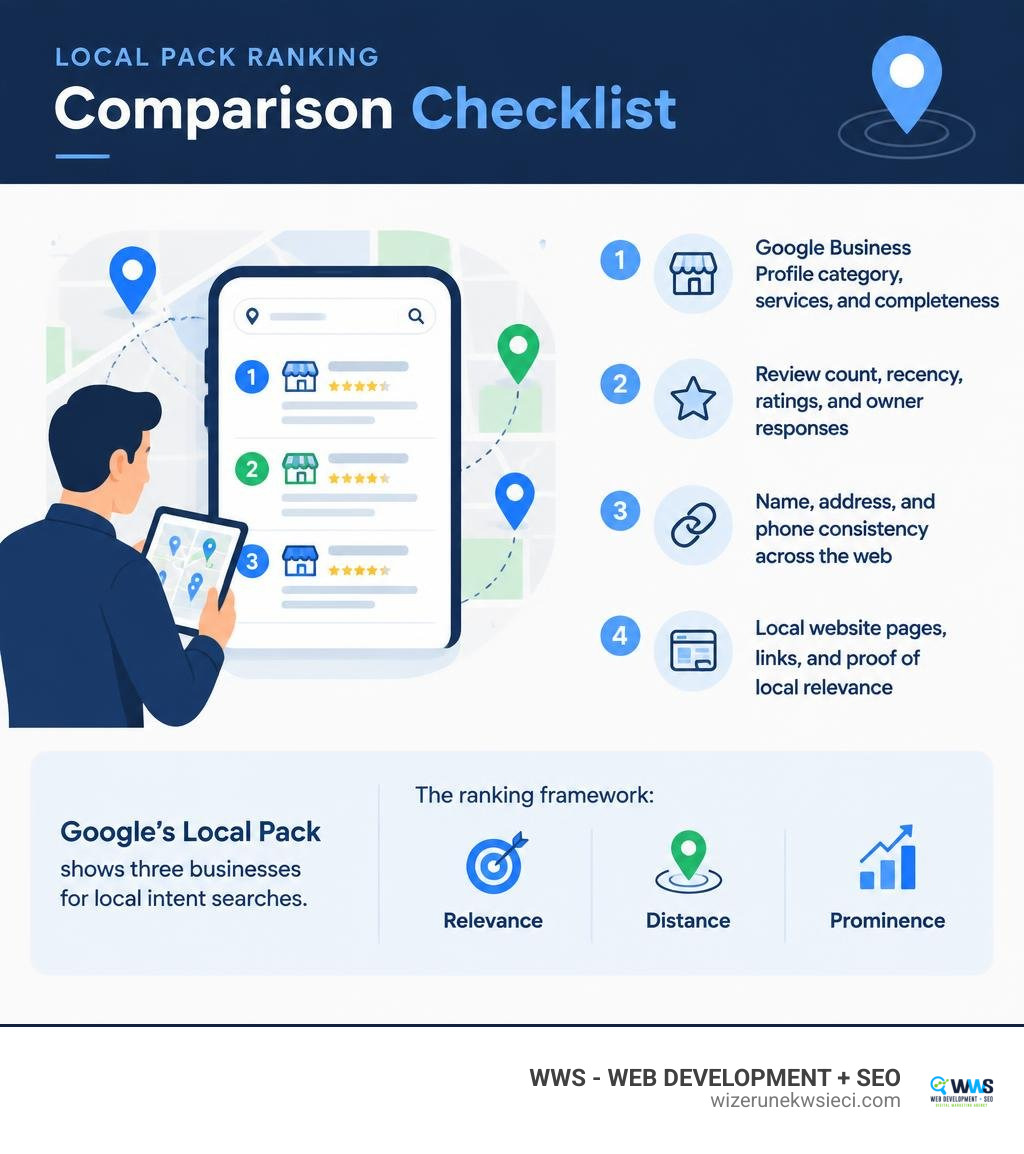
To improve local pack ranking, compare your Google Maps position with nearby competitors from several points across your service area, not from one search on your own device. Check the same search terms, record which three businesses appear, then compare the signals you can influence:
- Google Business Profile category, services, and completeness
- Review count, recency, ratings, and owner responses
- Name, address, and phone consistency across the web
- Local website pages, links, and proof of local relevance
Google’s Local Pack usually shows three businesses for searches with local intent. Its official ranking framework comes down to relevance, distance, and prominence. You cannot move your business closer to every searcher, but you can find where visibility drops and improve the profile, website, reviews, and business information that help Google trust and understand your company.
That is why a simple “we rank third” report is not enough. Rankings can change by neighborhood, device, search wording, and the searcher’s location. A coordinate-based comparison gives you a clearer picture of where competitors lead, where your business already appears, and which gaps are worth fixing first.
I am Tomasz Lasota, founder of Wizerunek w Sieci / WWS – Web Development + SEO in Des Plaines, with more than 22 years of digital marketing and technology experience. I help Chicago-area businesses, including many in Polonia Chicago, turn local pack ranking data into practical improvements that support more calls, leads, and customers.
Local pack ranking word list:
Core Factors Determining Local Pack Ranking Performance
Securing a top placement in Google’s 3-pack is not about tricking an algorithm; it is about building verifiable entity authority across the web. The local pack captures roughly 42% to 44% of all clicks on local search queries. For local service providers and storefronts across Cook County and Lake County, appearing in those top three spots often dictates whether customer phone calls come to you or go directly to your closest competitor.
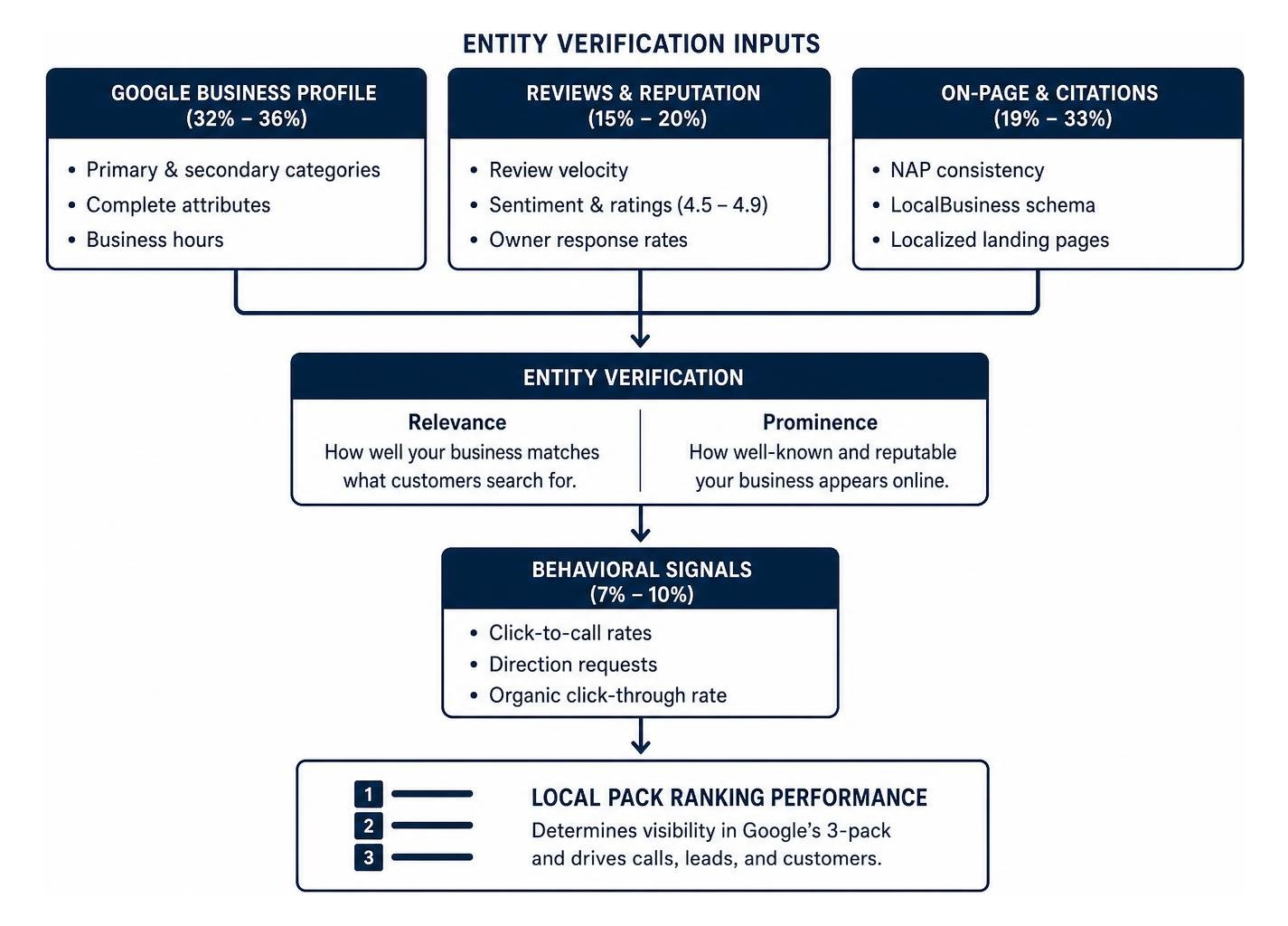
Google evaluates entity data using three primary pillars: relevance, distance, and prominence. Research shows that Google Business Profile (GBP) signals carry about 32% to 36% of total local ranking weight, followed by on-page website and citation signals at roughly 19% to 33%, and review signals accounting for 15% to 20%.
| Factor Category | Estimated Algorithm Weight | Primary Levers | Direct Business Impact |
|---|---|---|---|
| Google Business Profile | 32% – 36% | Primary category, secondary categories, complete attributes, business hours | Dictates core relevance for commercial search queries |
| Reviews & Reputation | 15% – 20% | Velocity, sentiment, keyword depth, owner response rates | Establishes consumer trust and drives conversions |
| On-Page & Citations | 19% – 33% | NAP consistency, LocalBusiness schema, localized landing pages | Provides third-party entity verification |
| Behavioral Signals | 7% – 10% | Click-to-call rates, direction requests, organic click-through rate | Creates an engagement feedback loop |
Evaluating Relevance and Prominence for Local Pack Ranking
Relevance determines how well your business profile matches what a customer types into Google. The single highest-leverage field on your profile is the primary category. Selecting an accurate category matching consumer intent tells search engines exactly what your business is, not just what services it offers. Secondary categories provide additional semantic context, allowing you to capture broader service searches.
Prominence represents how well-known and reputable your business appears across the web. Prominence relies on ongoing review velocity, high ratings (maintaining an average between 4.5 and 4.9 stars), and consistent citations. Our comprehensive guide to local SEO breaks down how establishing authority across directory networks builds long-term digital visibility.
Behavioral and On-Page Signals in 2026 Map Search
Google’s search engine and Gemini AI continuously evaluate user behavior to refine rankings. When searchers frequently click your listing, request driving directions, or tap your click-to-call button, Google interprets those actions as strong confirmation of entity relevance.
Your website functions as the foundational voting document for your map listing. Implementing structured data like LocalBusiness schema, ensuring rapid mobile page speed, and building localized landing pages reinforce your physical presence. Implementing effective near me optimization strategies ensures your on-page content directly aligns with high-intent mobile searches across nearby neighborhoods.
Step-by-Step Process for Comparing Competitor Map Positions
Evaluating local visibility requires an objective comparison against the competitors who consistently hold the top three positions in your market.

Setting Up Coordinate-Based Geo-Grid Audits
A single manual search from your office or home does not reflect what customers experience across town. Physical proximity acts as an algorithmic boundary: as distance from your business increases, ranking positions naturally drop.
To conduct an accurate audit:
- Define your primary revenue-driving keywords (for example, “commercial HVAC repair” or “dental implants”).
- Establish a geographic grid covering your target service radius across Chicagoland suburbs like Arlington Heights, Schaumburg, Naperville, Skokie, or Des Plaines.
- Track ranking positions from dozens of individual geographic coordinate points to create a comprehensive visibility heatmap.
- Compare your rank average against the top three dominant listings at each coordinate.
Using our actionable local SEO checklist, you can systematically track coordinate drift, identify coverage blind spots, and prioritize optimization efforts.
Benchmarking Profile Completeness and Engagement
Once coordinate data reveals who holds top positions, benchmark your profile against those competitors across key operational areas:
- Category Precision: Compare primary and secondary categories against leading competitors.
- Review Dynamics: Measure total review volume, monthly review velocity, and semantic diversity (natural mentions of services and locations within customer reviews).
- Profile Activity: Review the recency of photo uploads and Google Posts.
- Attributes and Products: Verify whether competitors have fully populated service menus, business attributes, and booking links.
Reviewing these points using proven Google Business Profile optimization techniques ensures your listing sends complete, trustworthy signals to search engines.
Diagnostic Framework: Bridging the Map Pack Visibility Gap
When auditing your business against competitors, analyze discrepancies through a diagnostic framework:

- The Citation Trust Floor: Consistent Name, Address, and Phone (NAP) details across authoritative directories validate your business entity. Earning verified media mentions, such as Illinois newspaper and media link citations, provides strong geographic prominence signals.
- Duplicate and Conflict Resolution: Multiple listings, old addresses, or conflicting phone numbers create algorithmic confusion that suppresses map rankings.
Geo-Grid Tracking and Local Pack Ranking Diagnostics
Geo-grid heatmaps illustrate the exact radius where your visibility begins to degrade. If your business ranks #1 within a one-mile radius but drops to position #8 three miles away, the issue is typically a prominence deficit rather than a relevance error.
To expand your effective ranking radius, focus on acquiring regular customer reviews from clients located across surrounding communities and publishing dedicated location pages on your website. Implementing proven map pack mastery methods allows you to systematically strengthen your geographic reach.
Multi-Location and Service-Area Discrepancies
Managing visibility for multi-location brands or Service-Area Businesses (SABs) requires distinct strategies. Brick-and-mortar storefronts display a public address, anchoring proximity directly to that physical location. Service-area businesses hide their street address and define service boundaries, relying more heavily on website authority and third-party entity verification.
For enterprises operating across multiple Chicago suburbs, building a structured multi-location SEO architecture prevents internal cannibalization and ensures each location profile gains independent authority.
Frequently Asked Questions About Map Pack Visibility
How often should local pack positions be audited?
Local pack rankings should be audited monthly using coordinate-based geo-grid tracking. Search results fluctuate due to competitor review velocity, algorithm refinements, and seasonal changes. Monthly audits allow you to catch visibility drops early and adjust your local marketing strategy accordingly.
Why do rankings vary between mobile and desktop devices?
Mobile searches rely heavily on precise, real-time GPS coordinates, whereas desktop searches often estimate position based on IP addresses or internet service providers. Furthermore, mobile user interfaces prioritize immediate contact actions like click-to-call buttons and direct turn-by-turn navigation.
Can prominence overcome a physical distance disadvantage?
Yes. While proximity sets an initial boundary, strong entity prominence can outrank a closer competitor. A business with exceptional review recency, deep service descriptions, verified citations, and high website authority will often rank higher across adjacent suburbs than a poorly optimized competitor located closer to the searcher.
Conclusion
Mastering local search requires continuous data collection, structured competitor benchmarking, and consistent optimization. By analyzing your ranking positions across coordinates rather than relying on single searches, you can identify clear opportunities to improve relevance, expand your ranking radius, and win more local customers.
At Wizerunek w Sieci / WWS — Web Development + SEO, based in Des Plaines, IL, we provide the ideal middle ground for small and medium-sized businesses: professional agency expertise combined with hands-on, personalized service. We proudly serve business owners across the Chicago metropolitan area, Cook County, Lake County, and the broader Polish-American business community (Polonia Chicago), as well as clients nationwide.
Whether you need a full digital audit, high-performance web development, or expert local SEO services, our team is here to help your business grow.
Ready to improve your local map visibility? Contact Tomasz Lasota and the WWS team today or visit wizerunekwsieci.com for your free website and local SEO audit.