


A good local citations strategy is not a race to submit your business to as many directories as possible. It is a short, disciplined process: audit what already exists, fix your name, address and phone number (NAP) everywhere, correct the data aggregators that feed hundreds of sites, add a small set of directories that matter for your trade, and check the whole thing on a schedule. This guide walks Chicago-area contractors, clinics, restaurants and other service businesses through that process, step by step.
TL;DR
- A local citation is any mention of your business name, address, phone number or website on a site you do not own. Structured citations are directory listings and social profiles, where every company’s details appear in the same format.
- Citations matter less as a direct ranking lever than they did a decade ago, but they still work as a trust and consistency signal, and Google counts web mentions as part of prominence.
- Quality beats volume: fix the big data sources first, then add industry-specific directories, not hundreds of generic ones.
- Service-area businesses must hide their address on Google Business Profile, and every citation has to follow the same choice.
- Citation work is ongoing. Plan a recurring audit, not a one-time submission sprint.
Table of Contents
- What a citation is and why it still matters
- Step 1: Lock down your master NAP record
- Step 2: Handle the service-area question first
- Step 3: Audit what already exists
- Step 4: Fix the data sources before the directories
- Step 5: Choose quality over quantity
- Step 6: Point citations at the right page
- Step 7: Build a repeatable maintenance routine
- Mistakes we see most often
- Why citations are getting more important for AI search
- Our perspective
- When to hand this to a team
- FAQ
- Sources
What a citation is and why it still matters
A citation is an online reference to your business details on a third-party platform. Search Engine Land describes them as references to your name, address, phone number and other details that build your digital footprint. They come in two forms:
- Structured citations: listings in directories, map apps and social profiles, with fields for each piece of data.
- Unstructured citations: mentions inside news articles, blog posts, chamber of commerce pages or event write-ups, where your details appear in running text.
Why bother? Google says local results are based mainly on relevance, distance and prominence. Prominence reflects how well known a business is, and it draws on information from across the web, including links, articles and directories. Google also states that you cannot pay for a better local ranking. Citations feed prominence and, just as important, they let Google cross-check that your business is real and that its details agree across sources.
There is also a customer-side reason. According to Ahrefs’ local SEO guide, industry experts note that the direct ranking impact of citations has declined since 2014, yet they remain a trust signal, and the guide cites a figure of roughly 80% of consumers losing trust in a business when they find wrong or inconsistent contact details. Treat that as an industry estimate rather than a hard law, but the logic is easy to see: a homeowner who calls a dead number from an old listing does not try again.
Step 1: Lock down your master NAP record
Before you touch a single directory, decide on one exact version of your business data and write it down. This is your master record. It should include:
- Business name, exactly as customers know it and as it appears on your sign, website and Google Business Profile
- Address format (“Suite 200” or “Ste 200”, not both), or a decision to hide it, covered below
- One primary phone number with a local Chicago-area code, used the same way everywhere
- Website URL, with the same protocol and trailing-slash habit throughout
- Primary category, a short description, hours, and your service area
Consistency is the rule. Ahrefs advises matching your website’s NAP exactly on every directory. Small variations such as “Inc.” in one place and nothing in another, or a tracking number in one listing and your main line in another, create the conflicting records that confuse both algorithms and customers.
A common trap: owners update Google Business Profile first and forget the website and social pages. A Google Business Profile Community thread on reinstating a profile makes this point in practice, noting that your website, social links and profile details should all agree. Change the website and social accounts first, then the profile, then the citations.
Name stuffing is not a shortcut
It is tempting to list “Chicago Roofing Contractor | Best Roof Replacement” as your business name. Do not. Use your real business name. Keywords in the name create mismatches across listings and risk suspension of your profile, and they undercut the whole point of consistent data.
Step 2: Handle the service-area question first
Most of our Chicago-area clients are contractors, restoration crews, HVAC and electrical companies. They travel to the customer. For these businesses, the address question decides how every citation is built.
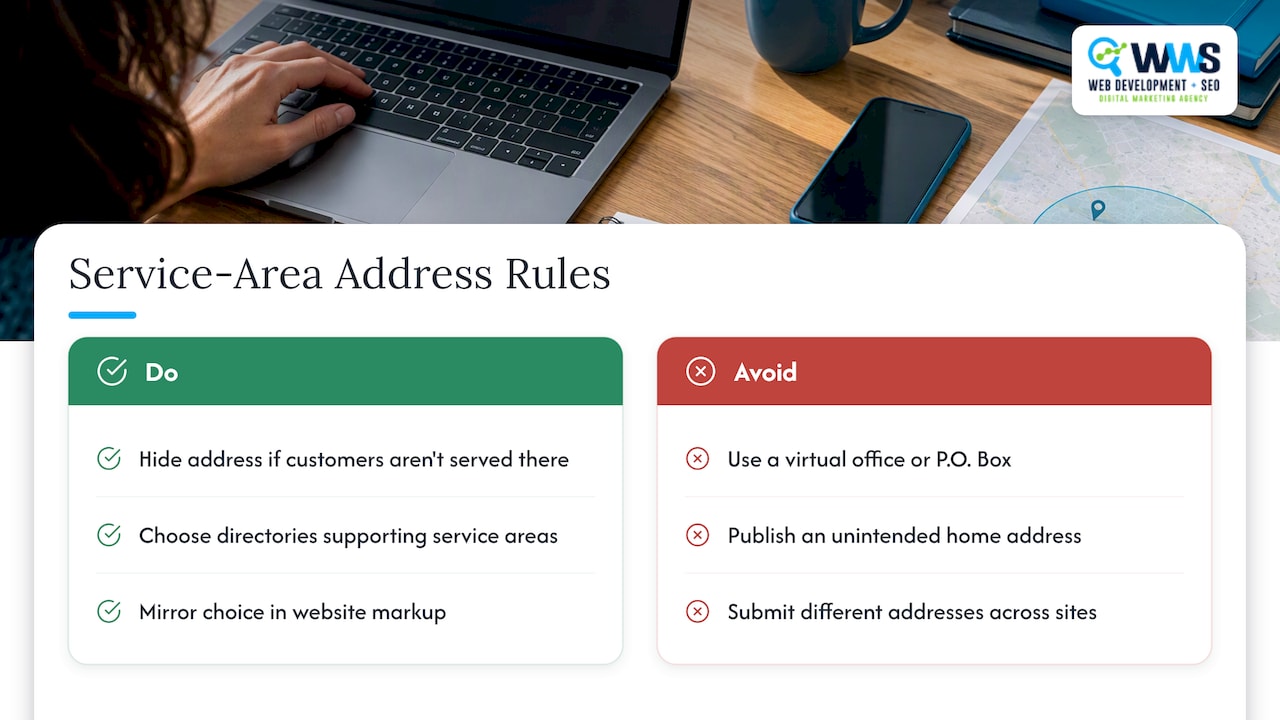
Per the research we reviewed against Google’s guidance, if you do not serve customers at your business address, you should not show it on your profile, and a virtual office or P.O. Box can be grounds for suspension. A Business Profile Community thread about a plumbing company’s repeated verification failures shows the same issue from the owner’s side: a plumber who does not receive customers at the address needs to be set up as a service-area business, with the address hidden.
The citation consequence is simple. Where a directory lets you hide your address and list service areas, do that. Where a directory forces an address, think carefully before publishing a home address you did not intend to make public, and prefer directories that support service-area listings. Never submit one address to some sites and a different one to others. Our guide to local business schema without a storefront shows how to mirror the same service-area choice in your website markup.
Step 3: Audit what already exists
Most businesses older than a year already have citations they never created: old addresses from a prior office, a former owner’s phone number, duplicates created by data brokers. Build a simple spreadsheet and fill it in this order:
- Search Google for your phone number in quotes, then your name plus city, then any old phone numbers or addresses.
- Record each listing: site, URL, whether you control it, and whether the name, address, phone and URL match the master record.
- Mark each row: correct, needs fixing, duplicate, or unclaimed.
- Note which listings carry a link to your website and which point to a generic homepage.
A 30-minute search on the first run usually uncovers a dozen or more listings. Clean up duplicates before you add anything new, because building new listings on top of conflicting ones just multiplies the problem.
Step 4: Fix the data sources before the directories
Hundreds of small directories do not collect your data independently. Many pull it from a handful of upstream providers called data aggregators. Search Engine Journal’s local SEO guidance points to aggregators such as Data Axle and Localeze as the standard way to distribute accurate data to many sites at once, particularly in crowded fields like plumbing and home remodeling where managing hundreds of listings by hand is not realistic.
The practical order of operations:
- Claim and complete your Google Business Profile, which is the foundation for everything else. See our Google Business Profile optimization page for how we approach it.
- Check and correct your record with the major aggregators.
- Claim the main consumer platforms and map apps your customers actually use.
- Only then move to industry and local directories.
If a wrong phone number keeps reappearing after you fix it, an aggregator is usually re-feeding the old record. We cover how to trace it in fixing local data aggregator errors in four steps.
Step 5: Choose quality over quantity
Many guides tell you to submit to 50 or 100 directories. That advice is dated. The more effective approach, as Search Engine Land’s citation guide frames it, is to prioritize authoritative, industry-specific directories over generic low-quality ones. Its examples are Avvo for lawyers and Healthgrades for medical providers.
Here is how that translates to the types of business we serve around Chicago.
| Business type | Priority citation sources | Low priority |
|---|---|---|
| Roofing, windows, remodeling, general contractors | Google Business Profile, Bing Places, Apple Business Connect, Better Business Bureau, home-services marketplaces, trade association and manufacturer certification pages, local chamber of commerce | Generic “submit your site” directories with no moderation |
| HVAC, electrical, plumbing | Google Business Profile, major map apps, licensing and trade association member directories, home-services marketplaces | Out-of-state directories |
| Dentists and med spas | Google Business Profile, healthcare directories such as Healthgrades, professional society finders, insurer provider directories | Directories that charge for a thin listing |
| Restaurants | Google Business Profile, major review and reservation platforms, map apps, local food and city guides | Coupon aggregators |
Add a test to every directory before you commit. Does a real customer in Chicago, Naperville or Schaumburg plausibly use it? Is it moderated? Does it let you choose a service area? If the answer to all three is no, skip it.
Do not forget unstructured citations
A mention in a local news story, a chamber of commerce member page, a sponsor listing for a youth sports team in Elgin or Arlington Heights, or a supplier’s “find an installer” page often carries more real-world trust than another directory. These come from relationships, not submission forms, and they are worth more than most owners assume. Keep a list, and make sure each mention uses your exact NAP.
Step 6: Point citations at the right page
An easy detail to miss: the URL in your citation. According to Ahrefs, for multi-location businesses the URL should lead to a dedicated local landing page for that location, not a generic homepage, which helps avoid diluted signals and reinforces local relevance.
For a single-location business, the homepage is normally fine. For a company with branches in, say, Joliet and Evanston, each listing should link to that branch’s page. Google’s guidance, as summarized in our research, calls for a dedicated page and a separate verified profile per location, with consistent names and categories, and bulk tools for businesses with ten or more locations. We lay out the system in multi-location SEO that scales across cities.
Pair this with markup on the page itself. Google recommends structured data to give search engines clear, machine-readable information, and implementing LocalBusiness markup on a homepage or About page supports your hours, service areas and identity. Use the most specific sub-type available, such as Plumber or Restaurant. Our local SEO schema guide includes JSON-LD you can copy and validate.
Step 7: Build a repeatable maintenance routine
Citation work is not a one-time project. Practitioners quoted by Ahrefs recommend laying a strong foundation and then putting systems in place to automate what you can. A practical schedule:
- Every quarter: rerun your NAP searches and spot-check the top 15 listings.
- Whenever anything changes: a new phone number, a move, a rebrand, new hours or a new service area triggers an immediate update across your master record, website, Google profile, aggregators and key directories, in that order.
- Every year: review your category choices and remove duplicates that data brokers created.
- Continuously: answer reviews and watch for suggested edits to your Google profile.
If you track one number, track the share of audited listings that match your master record. Aim for every priority listing matching exactly.
Mistakes we see most often
- Call-tracking numbers as the main phone number. If you use tracking, keep your real local number as primary in citations and website markup, and use tracking numbers only where you can control and measure them.
- Moving without a cleanup plan. Old addresses survive for years in aggregator feeds.
- Buying citation packages. Bulk submissions to unmoderated sites add little and can leave messy duplicates behind.
- Ignoring Bing, Apple and in-car systems. Not every customer uses Google Maps.
- Treating citations as the whole strategy. They support reviews, a strong profile and a well-built local page. They do not replace them. Our local SEO best practices guide shows how the pieces fit.
Why citations are getting more important for AI search
The same Ahrefs guide notes that citations are increasingly used as data sources for AI models and large language models. We would not overstate this: the research is early and the mechanics are not public. But the practical takeaway is cheap to act on. When search assistants answer “who is the best emergency water damage contractor near me,” they draw on web data about your business, and inconsistent data gives them reasons to skip you.
Our perspective
We handle website development, local SEO and Google Business Profile work in-house for Chicago-area service businesses, so we see the same citation problems repeatedly. Owners rarely have too few listings. They have too many conflicting ones, created over the years by old agencies, directories that scraped their data and a phone number change nobody propagated.
Our view is that citations are plumbing. Nobody wins a customer because of a tidy directory record, but a broken one quietly costs calls. That is why we start with the master record and the aggregators, spend our effort on the handful of platforms customers actually use, and tie the work to a location page that has proper markup and real content. We would rather do 25 listings that match exactly than 250 that nearly do.
The second thing we insist on is ownership. You should hold the logins for every listing that matters, in a shared document, so the work survives a change of agency, staff or phone system.
— Online Marketing Experts
When to hand this to a team
If you run a crew, a clinic or a kitchen, a spreadsheet of 40 listings and a quarterly audit is a lot to keep up. Our Local SEO service covers citation cleanup, Google Business Profile work and local landing pages for businesses across Des Plaines and the greater Chicago area, and everything is done by our own team rather than outsourced. If your site also needs location pages built properly first, start with website design.
FAQ
How many local citations does a business need?
There is no magic number. Start with Google Business Profile, the main aggregators, the major map and review platforms, and the two to five industry directories your customers really use. For most single-location service businesses that is a few dozen listings at most, and accuracy matters more than the total.
Do local citations still help SEO?
Yes, but as a supporting signal. Ahrefs notes that their direct ranking weight has fallen since 2014 while they remain a trust signal. Google’s own ranking factors, relevance, distance and prominence, are where citations fit, mainly under prominence and verification.
What is the best citation format?
The one you wrote in your master record, used identically everywhere. Pick a single format for the business name, street suffix, suite number, phone number and URL, then copy it exactly. If you are a service-area business, apply the hidden-address choice consistently too.
Should I pay for a citation service?
Pay only for work you could not do efficiently yourself, such as aggregator corrections or managing many locations, and ask who holds the logins. Avoid packages sold on listing counts, because volume is not the goal.
Sources
- Structured vs Unstructured Citations for Local SEO, Search Engine Land
- What Is A Local Citation? How They Help SEO, Ahrefs
- Local SEO: The Complete Guide, Ahrefs
- Local SEO strategies for SMBs, Search Engine Journal
- Tips to improve your local ranking on Google, Google Business Profile Help
- Your business information in your Business Profile, Google Business Profile Help
- Business verification repeatedly failing for a plumbing company, Google Business Profile Community
- How to reinstate legitimate profile, Google Business Profile Community