





What Makes the Best Law Firm Website Stand Out
The best law firm website makes it easy for the right client to answer three questions fast: Can this firm handle my issue? Can I trust these lawyers? What should I do next?
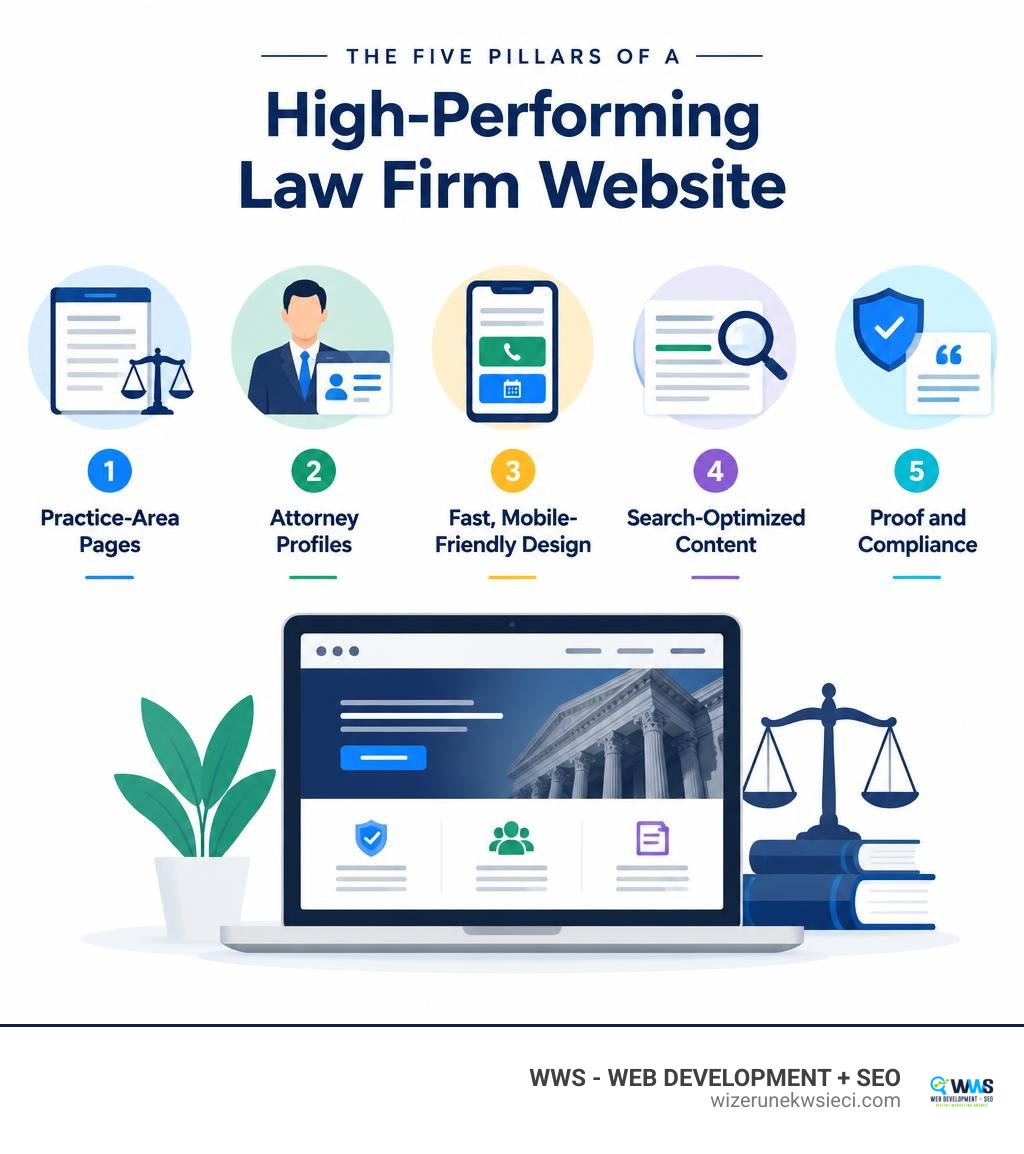
A high-performing legal website needs:
- Clear practice-area pages that explain who the firm helps and how.
- Attorney profiles with real credentials that show experience, admissions, and focus areas.
- Fast, mobile-friendly design with simple navigation and clear ways to call or request a consultation.
- Search-optimized content that helps the firm appear when people search for legal services in its market.
- Proof and compliance through approved testimonials, case results, insights, privacy protections, and required legal disclaimers.
The strongest sites balance authority with usability. They do not bury visitors in firm history or vague claims. Instead, they guide prospective clients, referral partners, recruits, and media contacts toward the information each group needs.
I’m Tomasz Lasota, a digital marketing strategist and founder of Wizerunek w Sieci / WWS — Web Development + SEO, with more than 22 years of experience in web development, SEO, and paid search. I help Chicago-area and U.S. service businesses build the best law firm website strategy around clear messaging, local visibility, and lead generation.
Best law firm website further reading:
Core Features of the Best Law Firm Website Designs
Building a compelling legal digital presence requires combining clean aesthetics with rigorous functional architecture. When potential clients search for legal counsel, they are often navigating stressful, time-sensitive circumstances. An effective layout immediately reassures them through visual clarity, fast loading speeds, and an intuitive hierarchy. At WWS (Wizerunek w Sieci), based in Des Plaines, IL, we work closely with boutique law practices and solo practitioners across Cook County and the greater Chicago area to turn static digital brochures into dynamic client acquisition engines.
To build genuine credibility, a law firm’s platform must move beyond stock imagery and generic copy. The most effective websites utilize custom photography, crisp typographic scales, and responsive design systems that adapt smoothly across desktop monitors, tablets, and smartphones. Elite international practices showcase this balance well; for instance, modern platforms like Leading global law firm | Freshfields utilize multimedia insights and clean layouts to establish institutional authority.
For local attorneys and independent practices across Chicagoland, achieving this standard does not require enterprise-level bloat. Tailored website design allows smaller firms to project substantial market presence while preserving the personal, hands-on touch clients desire.

Accessibility is another core pillar of modern digital design. Law firms must ensure their websites meet Web Content Accessibility Guidelines (WCAG) standards. This includes maintaining high-contrast ratios for readability, structured keyboard navigation for individuals using screen readers, and clear visual alt-text for all media assets. Ensuring accessibility not only expands your audience reach but also reinforces your firm’s professional ethics and commitment to public service.
Structuring Navigation for the Best Law Firm Website User Experience
A law firm website must efficiently direct visitors based on their distinct intents. Potential clients want to know if you can resolve their legal dispute; corporate general counsels evaluate complex regulatory experience; prospective associates review firm culture; and media journalists look for rapid commentary.
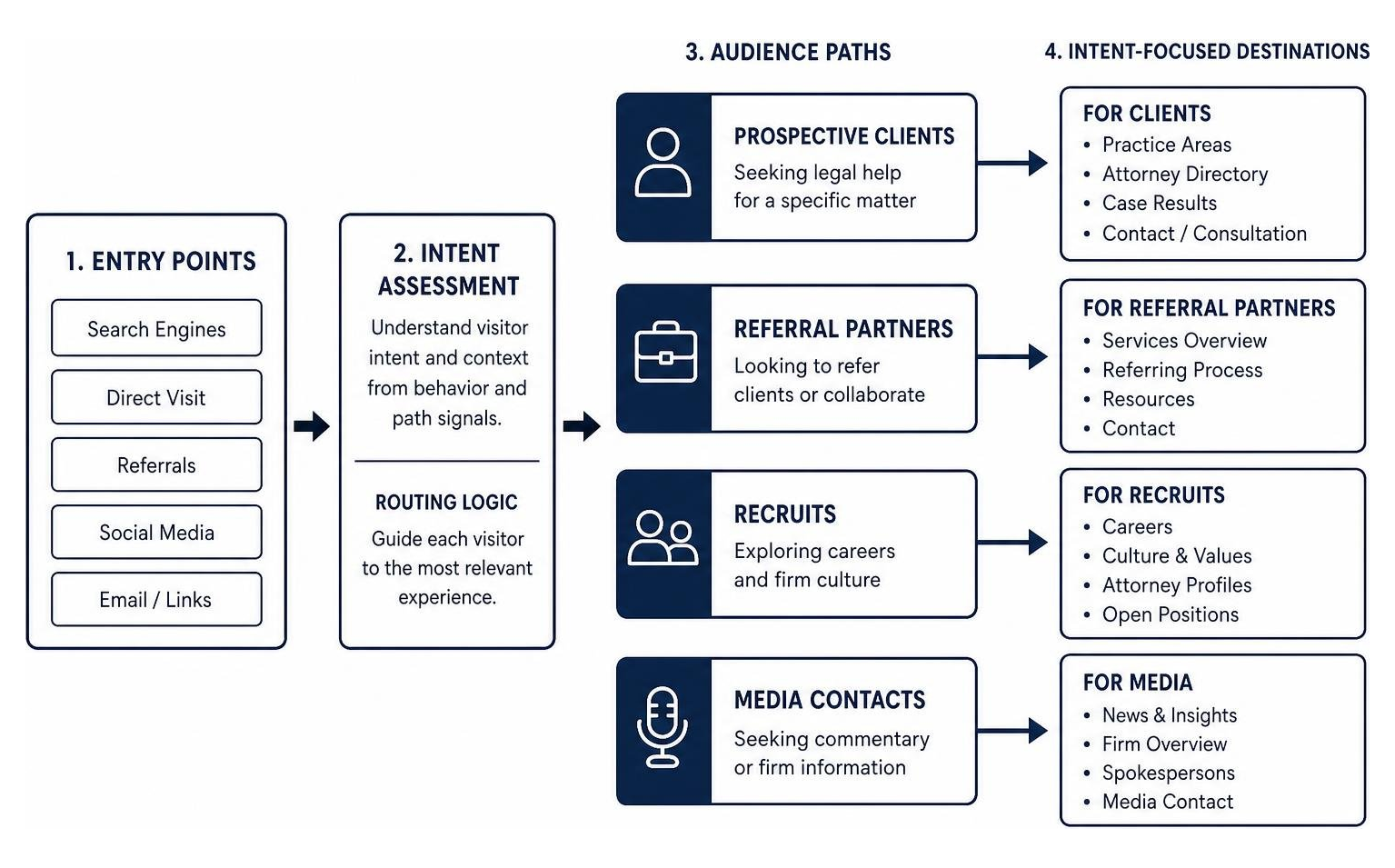
To route these audiences cleanly without cluttering the interface, law firms should implement:
- Practice Area Silos: Clear categorization separating core services (e.g., Commercial Litigation, Estate Planning, Real Estate Closings, Personal Injury) so visitors can locate relevant legal answers immediately.
- Searchable Attorney Directories: Filterable bio archives allowing visitors to sort lawyers by practice focus, bar admissions, office location, and spoken languages.
- Dedicated Resource Centers: Organized sections for recent case commentary, legal updates, client advisories, and multimedia content.
- Direct Engagement Paths: Visible contact points across every subpage to support conversion rate optimization without disrupting the reading experience.
Essential Conversion Elements: Calls-to-Action and Intake Forms
Traffic alone does not sustain a legal practice; qualified consultations and signed retainers do. The journey from a first-time visitor to an active client relies heavily on low-friction conversion pathways.
Every page on your website must feature clear calls-to-action (CTAs). Direct options such as “Schedule a Case Evaluation,” “Call Our Office Directly,” or “Submit a Confidential Inquiry” remove ambiguity. For mobile users browsing during an emergency, click-to-call buttons fixed to the header or mobile screen footer are essential.
Intake forms must balance data collection with user ease. Lengthy forms that ask for unnecessary personal details create friction and cause drop-offs. Asking for basic contact details, a brief summary of the legal issue, and an automated conflict-of-interest screening notice generates higher completion rates. To discover practical methods for turning passive site visitors into active consultations, check out our guide on how to stop bouncing and start buying how to capture leads from your website.
Advanced Search Engine Optimization for Law Firm Websites
A beautifully designed site cannot generate revenue if prospective clients cannot find it on search engines. Search engine optimization (SEO) in the legal sector is among the most competitive digital marketing landscapes in Illinois and across the United States. High-intent legal keywords carry significant search volume, making organic search positioning vital for reducing client acquisition costs.
Achieving top organic rankings requires targeting specific long-tail queries that reflect urgent, high-intent client searches. Instead of aiming solely for generic terms like “Chicago lawyer,” successful firms optimize for precise phrases such as “Cook County commercial lease dispute attorney” or “estate planning lawyer in Arlington Heights IL.” To understand how to pinpoint profitable search phrases for your practice, explore the ultimate guide to choosing website keywords for seo.
Achieving consistent visibility also requires continuous technical maintenance. Identifying broken links, slow server response times, and indexation errors through a routine technical seo audit protects your site from ranking fluctuations and keeps your practice competitive alongside top regional listings, such as those cataloged in The Best Law Firms in Chicago: Rankings – Vault.
Technical SEO Elements That Power the Best Law Firm Website Rankings
Behind every visually appealing website lies a technical framework that search engine crawlers rely on to index and understand content. If crawlers encounter configuration errors, your firm’s rankings will suffer.
Key technical SEO requirements for legal practices include:
- Structured Data (Legal Schema Markup): Implementing
LegalService,Attorney, andPostalAddressstructured data via JSON-LD allows search engines to identify your attorneys, office locations, practice niches, and verified client ratings. - Core Web Vitals Optimization: Google prioritizes sites that load rapidly and display elements without visual shifting. Compressing imagery, streamlining JavaScript, and leveraging modern hosting environments keep load times well under two seconds.
- Crawl Budget and robots.txt Directives: Client portals, internal staging subdomains, and confidential file directories should be restricted via robots.txt or
noindexdirectives, ensuring search engines focus their crawling efforts exclusively on client-facing service pages. If you are preparing to refresh your firm’s digital presence, review our comprehensive roadmap on how to ensure your new website is fully seo enabled.
Local SEO and Practice Area Page Architecture
For consumer-facing and regional commercial law firms, local search positioning is the primary source of online inquiries. When a business owner or individual encounters a legal challenge, their first action is often checking Google’s Local Map Pack.
Dominating local search requires an interconnected approach that ties your physical location to targeted landing pages. Deploying strategic local seo campaigns ensures your practice appears prominently for proximity-based searches across your target municipalities. Each core practice area requires a dedicated, in-depth service page optimized around clear user questions, statutory context, and procedural breakdowns. Learn how to structure these critical conversion assets using our guide to service page seo.
Furthermore, claiming, verifying, and optimizing your Google Business Profile (GBP) creates an active bridge between search results and your intake staff. Implementing routine google business profile optimization—including accurate service categories, updated office hours, high-resolution interior photos, and regular informational posts—signals relevance directly to Google’s local algorithm.
Establishing Trust Through Thought Leadership, Case Results, and Social Proof
Hiring an attorney is a significant financial and personal decision. Prospective clients want clear proof of your capability before initiating contact. A high-performing website presents this social proof clearly, ethically, and persuasively.
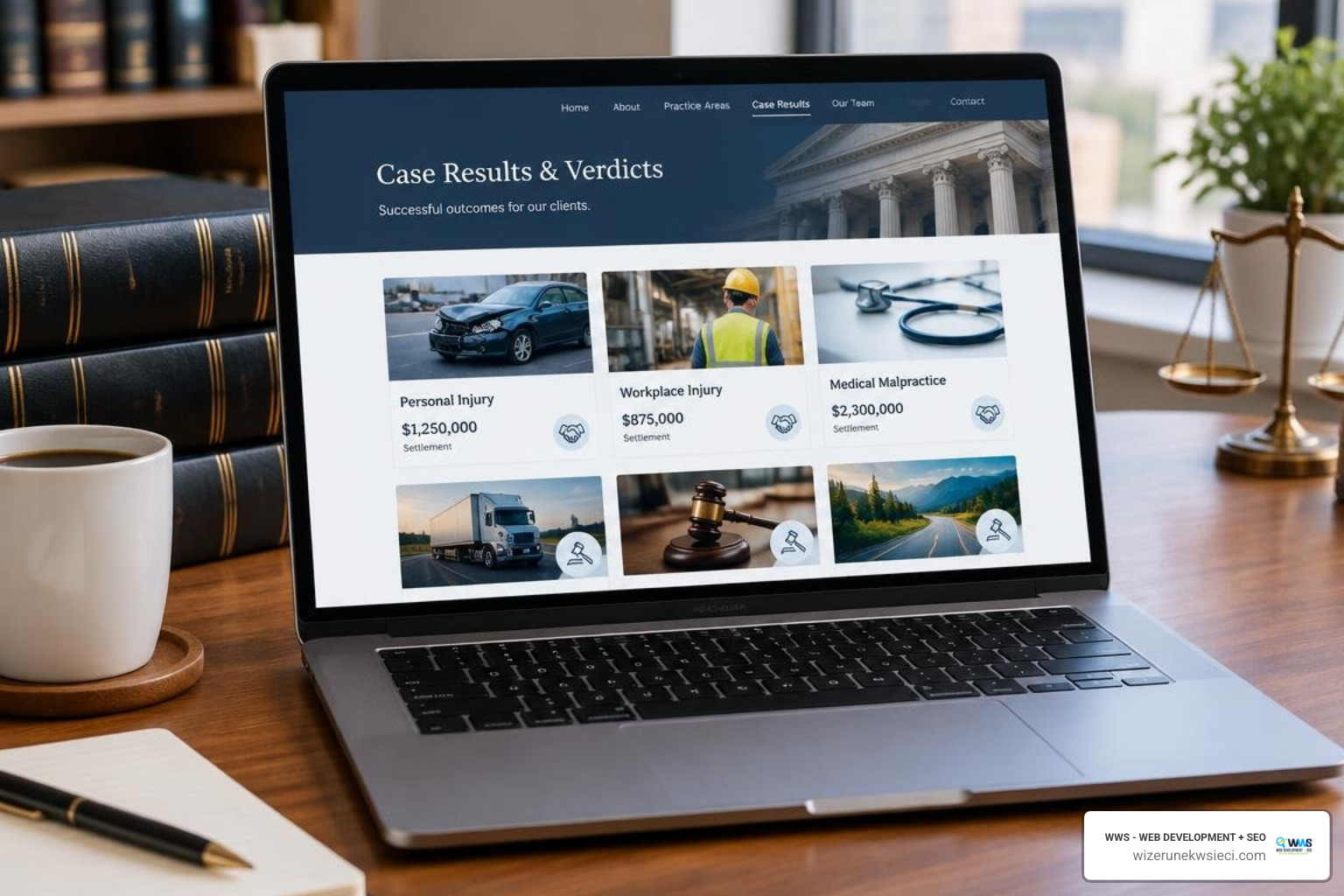
Prominently showcasing trial victories, negotiated settlements, transactional milestones, and pro bono contributions establishes authority. For example, prominent legal organizations like Homepage | Jenner & Block LLP | Law Firm effectively demonstrate their public impact and industry standing by publicizing that 97% of their lawyers perform 50+ hours of pro bono work annually, contributing tens of thousands of service hours alongside notable trial outcomes. Highlighting your firm’s civic engagements, regional awards, and verified client testimonials reassures prospective clients that their legal matters are in capable hands.
Publishing Authoritative Insights, CLEs, and Legal Analysis
Static websites that remain unchanged for years struggle to rank or build authority. Publishing consistent, timely legal commentary demonstrates that your attorneys stay ahead of statutory revisions, appellate court rulings, and shifting regulatory frameworks.
Maintaining an active blog news repository allows your firm to unpack complex legal developments into actionable advice for business owners. For instance, creating analytical articles, downloadable white papers, or hosting continuing legal education (CLE) webinars helps establish individual partners as leading regional authorities in their fields.
Compliance and Ethical Standards in Legal Marketing
Legal marketing is governed by strict state bar ethics rules. Unlike standard consumer businesses, law firms face severe professional penalties if their online messaging is misleading or non-compliant.
When designing and writing copy for a legal website, several compliance rules must be maintained:
- State Bar Advertising Disclaimers: Visible disclaimers stating that website content constitutes attorney advertising, does not create an attorney-client relationship, and that past results do not guarantee future outcomes.
- Regional Marketing Mandates: Keeping pace with evolving state statutes, such as California’s SB37 marketing standards, which impact multi-jurisdictional practices and digital promotional claims.
- Client Confidentiality Protections: Ensuring that contact forms include explicit notices advising users not to submit sensitive, confidential case information prior to the execution of a formal representation agreement.
- Privacy Policy & Data Security: Implementing modern SSL encryption, GDPR/CCPA-compliant privacy statements, and secure data handling procedures for all submitted intake inquiries.
Tailoring Web Architecture: Boutique Practices vs. Multi-Office Global Firms
A solo criminal defense attorney in Des Plaines requires a fundamentally different digital platform than an international corporate law firm operating across multiple continents. Understanding your firm’s scale, target audience, and geographic footprint dictates the website architecture required.
| Feature / Strategy | Boutique & Solo Law Practices | Large & Multi-Office Global Law Firms |
|---|---|---|
| Primary Target Audience | Regional consumers, local business owners, niche commercial clients | Fortune 500 enterprises, general counsels, institutional investors |
| Geographic Targeting | Local municipal focus (e.g., Chicagoland, Cook & Lake Counties) | Multi-state, nationwide, and international multi-jurisdiction reach |
| Site Navigation Model | Lean, direct conversion funnels with minimal sub-menus | Multi-layered directory trees with complex sector cross-referencing |
| SEO Strategy | Local SEO, Google Map Pack dominance, geo-landing pages | Global branded search, corporate thought leadership, multi location seo |
| Conversion Focus | Immediate phone calls, direct intake forms, free consultations | RFPs, corporate lateral recruitment, institutional relationship building |
| Content Scope | Practical guides, local court procedures, consumer legal FAQs | White papers, multinational regulatory trackers, policy podcasts |
Enterprise law firms with extensive reach—such as Akin, an Elite Global Law Firm | Akin, which coordinates more than 1,100 lawyers across 18 offices worldwide—must build scalable CMS infrastructures that cross-link hundreds of practice sectors with multinational regulatory alerts.
Conversely, boutique practices succeed by remaining agile, highly targeted, and deeply connected to their local business communities. At WWS, we bridge this gap for growing practices by delivering enterprise-grade web development and SEO capabilities combined with dedicated, personalized service.
Frequently Asked Questions About Law Firm Web Design
How does a modern law firm website improve lead generation?
A modern legal website improves lead generation by aligning search visibility with seamless conversion design. When prospective clients find your firm via organic search or local map listings, an intuitive layout quickly answers their questions, displays relevant credentials, and provides clear contact options—such as click-to-call buttons and streamlined intake forms—that encourage immediate engagement.
What are the most common technical mistakes on law firm websites?
The most frequent technical mistakes include slow mobile page speeds, missing or misconfigured LegalService schema markup, broken robots.txt files that inadvertently block search engine crawlers, and complicated navigation menus that bury practice area information. Additionally, failing to optimize for local search signals significantly reduces visibility in Google Map Pack results.
How often should a law firm update its website content and design?
Law firms should publish new educational content, case insights, and practice updates at least bi-weekly or monthly to demonstrate active authority to search engines. A complete website redesign is typically recommended every three to four years to keep pace with modern design trends, mobile interface standards, and evolving search engine ranking algorithms. To plan your firm’s digital marketing budget effectively, review our breakdown on website redesign cost.
Conclusion
Establishing a digital presence that commands authority requires more than an attractive homepage. It demands a cohesive strategy that integrates high-speed performance, intuitive user experience, strict ethical compliance, and robust local and organic search engine optimization. When these elements work together, your website shifts from a static business card to a reliable client acquisition platform that consistently brings qualified cases to your firm.
At WWS (Wizerunek w Sieci / WWS — Web Development + SEO), we understand the distinct challenges small and mid-sized law firms face in competitive legal markets. Based in Des Plaines, IL, we proudly serve attorneys, legal practices, and small business owners throughout Chicago, Cook County, the Northwest Suburbs, and across the United States. We also provide bilingual web development and marketing solutions for Polish-American businesses and legal professionals serving the Polonia Chicago community.
Unlike large national agencies that can feel impersonal or solitary freelancers who may lack the full technical resources your practice needs, WWS combines professional agency expertise and resources with personal attention and local knowledge. Our team delivers the strategic insight, technical skill, and dedicated service your practice deserves—treating every client’s business as if it were our own.
Whether you are launching a new boutique practice or upgrading an established firm’s online visibility, contact WWS today for a comprehensive, free website audit. Visit wizerunekwsieci.com to schedule your strategy session.