



What Should Small Businesses Look for When Comparing Local Web Development Agencies?
When you start searching for a partner to build or redesign your company’s website, you will quickly discover that no two agency proposals look identical. One shop might propose an entirely custom-coded solution, another might build exclusively on WordPress page builders, and a third might configure a proprietary hosted platform.
For a small business, choosing the wrong agency model can lead to slow loading speeds, rigid templates that break on mobile screens, or hidden retainers that drain your marketing budget without delivering inbound calls. Finding the right partner means evaluating agencies across three distinct operational archetypes:
- Custom-Coding and Modern Framework Agencies: These teams write clean, semantic code (such as modern server-rendered components, HTML5, and lightweight scripts). They focus heavily on raw performance, high-tier mobile Core Web Vitals, and tailored user flows.
- WordPress and CMS Specialist Agencies: These shops leverage the world’s most widely adopted content management system. However, their execution varies dramatically: some craft clean, lightweight themes or use streamlined builders, while others rely on bloated visual builders and dozens of third-party plugins.
- Hosted Platform and Template Studios: These agencies configure websites on closed, managed platforms. While they offer fast deployment, they often restrict your data portability, source code ownership, and advanced technical SEO customization.
Balancing responsive design across diverse mobile viewports with technical on-page SEO is non-negotiable. More than 60% of local service inquiries originate on a smartphone. A website that merely shrinks desktop elements to fit a smaller screen is not genuinely responsive; it must adapt navigation, touch targets, font scaling, and data payloads specifically for mobile users on local cellular networks.
Choosing a local agency—especially one serving Chicagoland and communities from Des Plaines and Mount Prospect to Naperville and Schaumburg—provides distinct advantages over distant national conglomerates or outsourced platforms. A local team understands your geographic target market, your regional competitors, and the specific search habits of your neighborhood clientele. Furthermore, direct local accountability means you always know who is building and maintaining your digital assets. For a deeper breakdown of selecting a dedicated partner, explore Local Web Design Companies – Your Guide to Finding the Perfect Partner.
Key Criteria: Mobile Usability, Code Quality, and Support
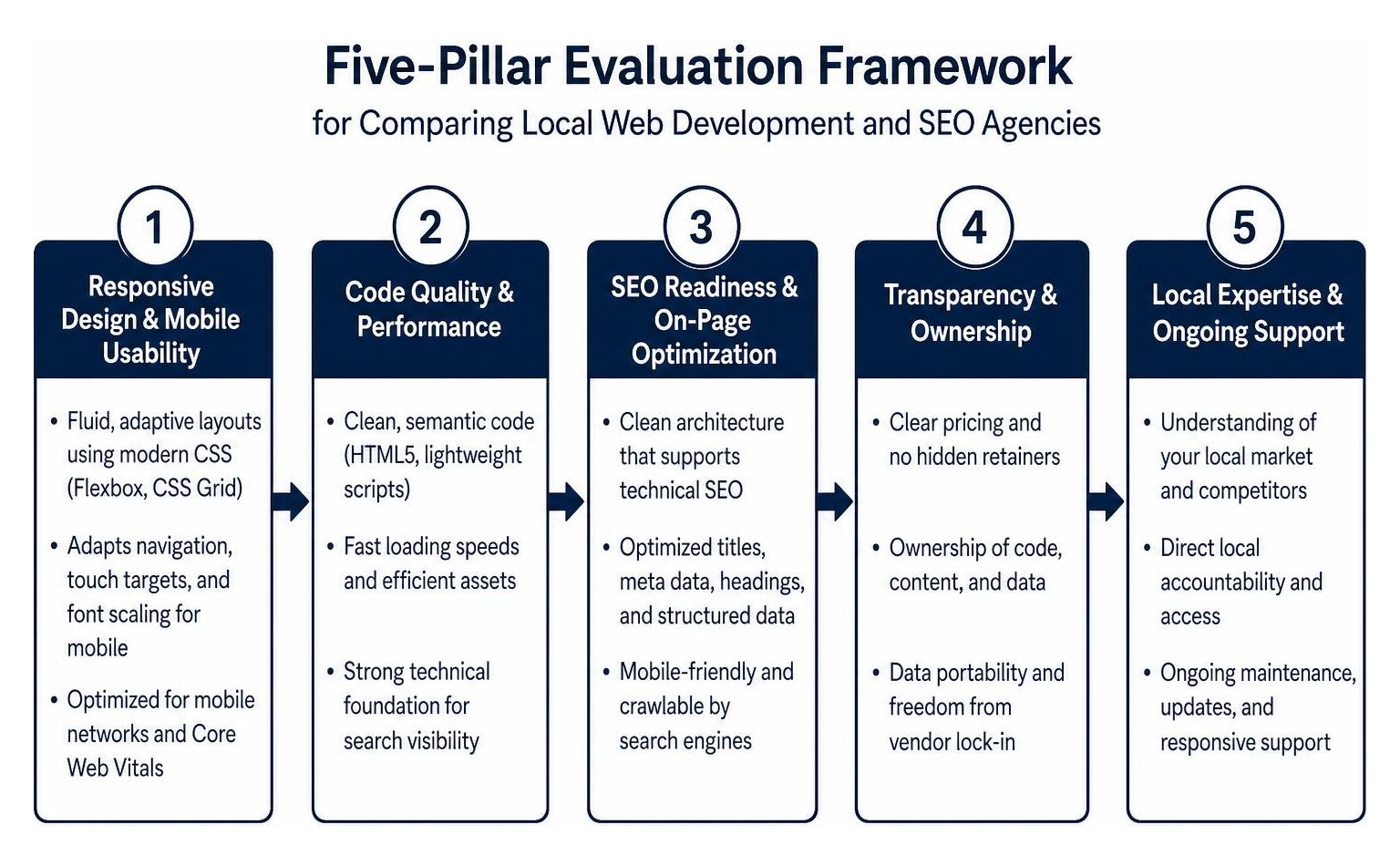
To cut through sales pitches, evaluate prospective agencies against five technical and operational pillars:
- Fluid Responsive Architecture vs. Rigid Canvas Editors: Ensure the agency builds fluid, adaptive layouts using modern CSS standards (such as Flexbox and CSS Grid) rather than absolute positioning. Absolute canvas builders often create two separate, disconnected versions of your site (desktop and mobile), which frequently display broken layouts on tablets, laptops, or foldables.
- Direct Access to Technical Developers: Ask who will actually build your website. Working directly with experienced developers and SEO strategists prevents the miscommunications and delays common when dealing with junior account intermediaries. Discover more about this dynamic in our guide on How a Local Web Designer Can Help Your Business.
- Verifiable Trust Signals and Transparency: Look for established roots, Better Business Bureau (BBB) ratings, verified local reviews, and transparent leadership. An agency with a visible founder and a verified physical address provides the reliability small businesses need.
- Full Ownership of Digital Assets: Ensure your contract explicitly grants you 100% ownership of your domain name, custom design assets, content, and underlying source code without proprietary lock-in.
How Do Different Website Development Approaches and Tech Stacks Compare for SEO and Responsiveness?
The underlying technology an agency uses directly dictates your website’s speed, search engine crawlability, and conversion rates. Search engines prioritize fast, accessible, and semantically structured web pages. If your site code is bogged down by unnecessary scripts, your search rankings and lead flow will suffer.
| Feature / Tech Stack | Modern Hand-Coded / Lightweight Stacks | Lightweight WordPress (e.g., Bricks Builder) | Heavy WordPress (e.g., Elementor / Divi) | Closed Hosted Platforms |
|---|---|---|---|---|
| Mobile Core Web Vitals Pass Rate | Extremely High (95–100%) | High (85–92%) | Low (40–45%) | Moderate to High (75–82%) |
| Average Mobile LCP | Under 2.0s | 2.5s – 3.8s | 4.5s – 18.0s+ | 2.8s – 4.5s |
| Technical SEO Flexibility | Full Control (Raw HTML/Schema) | Full Control via Plugins/Code | Moderate (Plugin Dependent) | Limited to Platform Features |
| Full Code Ownership & Portability | Yes (100% Portable) | Yes (Self-Hosted) | Yes (Self-Hosted) | No (Platform Lock-In) |
| Ongoing Maintenance Overhead | Minimal (Zero Plugin Bloat) | Moderate (Regular Core Updates) | High (Frequent Plugin Conflicts) | Low (Handled by Platform) |
Hand-Coded Frameworks vs. WordPress CMS vs. Hosted Builders
Modern web development emphasizes speed and streamlined code. Hand-coded frameworks and clean semantic HTML generate minimal stylesheet and script payloads, allowing mobile browsers to render pages almost instantaneously.
WordPress remains a major force across the internet, powering approximately 42.2% of all websites globally and 62.8% of detectable CMS sites. However, global web telemetry reveals that only 43.44% to 45% of WordPress sites pass Google’s Core Web Vitals on mobile devices. This gap is largely caused by agencies relying on heavy, drag-and-drop page builders layered with dozens of unoptimized plugins.
Benchmark tests illustrate this performance divide clearly:
- Lightweight modern builders (such as Bricks Builder) score up to 92 on mobile PageSpeed Insights (PSI) on standard servers.
- Legacy visual builders (such as Elementor or Divi) frequently score between 72 and 76 mobile PSI, with unoptimized mobile Largest Contentful Paint (LCP) times stretching from 4.5 seconds to over 18.4 seconds—far exceeding Google’s recommended 2.5-second threshold.
- Hand-coded modern stacks consistently achieve mobile LCP times around 2.0 seconds, ensuring visitors on mobile connections experience immediate page loads.
When evaluating agencies, be cautious of teams selling standalone “AI-generated website” systems. While artificial intelligence is valuable for research, pure AI website generators often produce convoluted, non-semantic HTML structures that impede search engine indexing. Furthermore, industry data shows that AI-generated websites often have a lifespan of just 1 to 2 years before requiring a full rebuild, compared to 3 to 5 years of stable performance for a professionally coded site. High-profile failures in the tech sector, such as Builder.ai entering Chapter 7 bankruptcy and liquidation after raising $450 million, underline the risks of relying on unproven automated builders rather than experienced developers. Learn how solid technical fundamentals prevent low engagement in our article, No More Ghost Towns – The Ultimate Guide to Local Business Website Design.
Conversion-Driven Architecture: Lead Capture and Booking Integration
A fast, responsive site must also turn visitors into paying customers. Local service businesses require clear conversion pathways that guide potential clients directly to contact options, quote requests, or appointments.
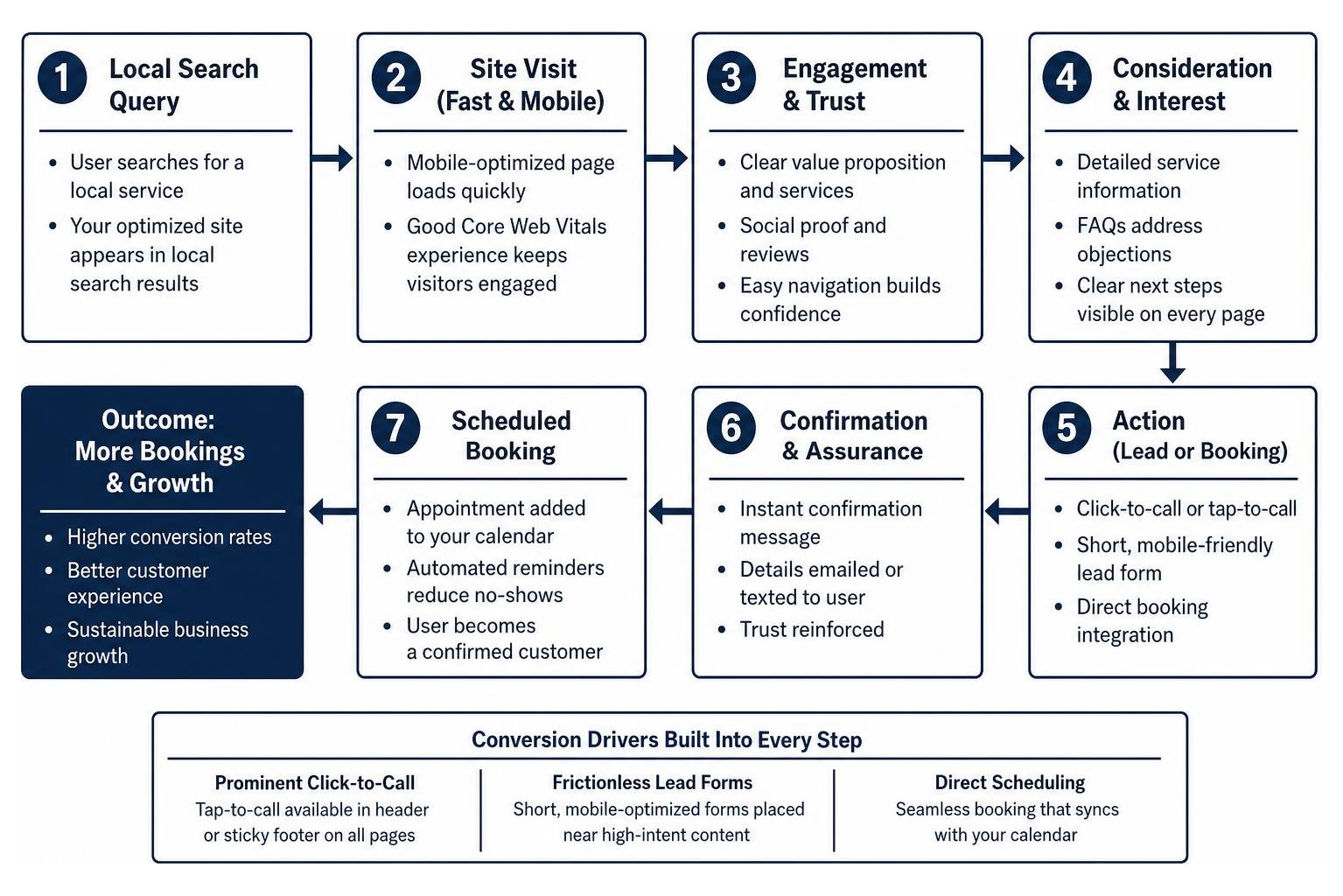
When comparing agencies, ensure their design approach incorporates conversion-focused engineering:
- Prominent, Click-to-Call Functionality: Mobile visitors should be able to tap a phone number from any page header or sticky footer without pinching or zooming.
- Frictionless Lead Forms: Short, mobile-optimized inquiry forms placed strategically near high-intent content increase conversion rates. For strategies on turning traffic into qualified inquiries, review Lead Generation Websites – The X Best Options Compared and our guide on how to Stop Bouncing and Start Buying – How to Capture Leads from Your Website.
- Direct Scheduling Capabilities: If your business relies on appointments—such as medical practices, legal consultations, or home service contractors—the agency should implement secure, seamless Website Booking Integration that syncs directly with your calendar.
What Are the Real Costs and Pricing Models of Hiring a Local Web Agency in 2026?

Web development pricing varies widely depending on technical scope, platform choice, and search optimization depth. In 2026, professional website development for small-to-medium businesses typically falls within the following models:
- Custom Professional Build (Flat-Fee Project): Typically ranges from $3,000 to $15,000. This encompasses custom design, clean responsive coding, on-page SEO integration, conversion path setup, and structured data implementation. You own the website outright upon completion.
- Agency Monthly Retainer Model: Ranges from $500 to $2,500+ per month. Often bundles ongoing local SEO management, conversion rate optimization, Google Business Profile management, and content updates with the initial build spread across a minimum contract term.
- Low-Cost Proprietary Subscriptions: Often marketed at $99 to $200/month. While initial costs appear low, these models charge indefinite rental fees, and you typically lose your website and its accumulated performance history if you cancel the subscription.
Understanding the factors that influence project scope helps ensure you receive an accurate quote. For an in-depth breakdown of these variables, see our guide on Website Redesign Cost.
Uncovering Hidden Fees: Hosting, Add-ons, and Ongoing Maintenance
When reviewing agency proposals, look closely at the recurring line items. Agencies that build on complex plugin ecosystems often leave clients with unexpected ongoing expenses:
- Premium Plugin Licenses: Some WordPress sites require $300 to $1,000 annually in third-party licenses for security, form builders, advanced custom fields, and caching tools.
- Managed Hosting vs. Standard Shared Hosting: High-performance hosting environments cost between $30 and $150 per month, whereas cheap shared hosting ($5/month) often leads to slow response times and failed Core Web Vitals.
- Security Patches and Compatibility Updates: A site built with 30+ plugins requires continuous oversight to avoid security vulnerabilities and software conflicts during routine updates.
A well-architected website minimizes reliance on bloated third-party tools, saving you money and keeping your site secure and stable over the long term.
How Do You Evaluate an Agency’s Technical SEO, Core Web Vitals, and Local Search Capabilities?
Never evaluate a web development agency based solely on portfolio screenshots. Beautiful visual mockups tell you nothing about how quickly the site loads on a mobile phone or whether search engines can parse its code.
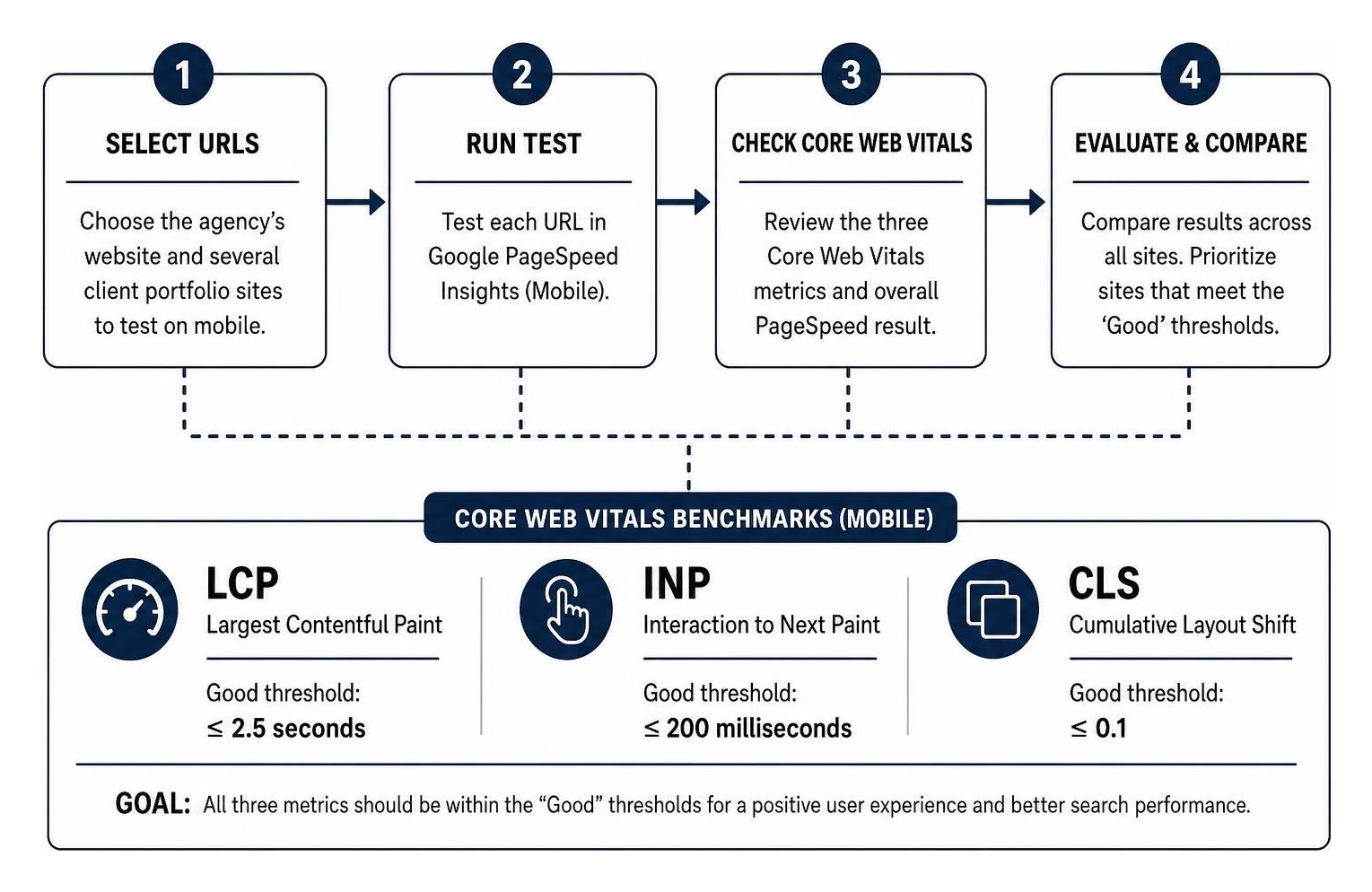
Before hiring an agency, run their own website—and several sites from their client portfolio—through Google PageSpeed Insights on mobile. Look closely at Google’s Core Web Vitals metrics:
- Largest Contentful Paint (LCP): Measures how long it takes for the main visual content to load. Google’s benchmark for a “Good” user experience is 2.5 seconds or less.
- Interaction to Next Paint (INP): Measures page responsiveness to user inputs (clicks and taps). It should remain under 200 milliseconds.
- Cumulative Layout Shift (CLS): Measures visual stability as elements load. The score should be 0.1 or less.
Structured Data, Local Schema, and AI Search Optimization (GEO)
Search engines increasingly use AI-driven overviews and rich snippets to answer local search queries. Your website’s technical architecture must provide clear, machine-readable information through structured JSON-LD schema markup.
There is a critical technical distinction in how agencies implement schema:
- Server-Rendered Schema (Preferred): Embedded directly in the raw HTML delivered by the server. Search engine crawlers read and index your business details, address, operating hours, and service lists instantly without extra rendering steps.
- JavaScript-Injected Schema: Injected into the page dynamically via client-side scripts. Search crawlers must execute JavaScript to discover it, which can cause indexing delays or parsing errors.
A technically sound agency will implement structured data types—including LocalBusiness, Service, FAQPage, and BreadcrumbList—while formatting page content into clear, concise answer blocks. This structure optimizes your business for traditional search rankings as well as AI search engines and Generative Engine Optimization (GEO). Explore how clean code supports organic rankings in our guides on SEO Web Design and Website SEO.
Geographic Targeting: Local Pack Rankings and Multi-Location Architecture
Local visibility depends heavily on your standing in the Google 3-Pack and localized organic search results. A generic, single-page website rarely ranks across multiple surrounding suburbs.
An experienced local web agency will structure your site architecture with dedicated, optimized service and location pages:
- Dedicated Service Pages: Separate pages for every core service you offer rather than bundling everything onto the homepage.
- City-Specific Landing Pages: Custom, unique landing pages for the key municipalities you serve (e.g., Arlington Heights, Elk Grove Village, Glenview, Park Ridge, Naperville, and Chicago).
- Google Business Profile Alignment: Ensuring exact Name, Address, and Phone (NAP) consistency across all landing pages and schema markup to strengthen local trust signals.
For proven geographic growth strategies, review The Ultimate Local SEO Best Practices Guide for Small Businesses, our specific breakdown of Service Area Business SEO, and our playbook for Multi-Location SEO.
Why Is WWS — Web Development + SEO a Proven Local Partner for Small Businesses?
Finding the right balance between large agency technical resources and the attentive service of an independent developer can be challenging. At WWS (Wizerunek w Sieci), founded by Tomasz Lasota and based at 636 S River Rd #218, Des Plaines, IL 60016, we bridge that gap for small and medium-sized businesses.
We provide comprehensive, performance-first digital marketing and development services tailored to help local businesses attract qualified leads and grow revenue:
- High-Performance Website Design: We engineer custom, responsive websites focused on fast mobile load times, clean semantic coding, and intuitive user conversion paths.
- Targeted Local SEO and Global SEO: We build robust site architectures, implement server-rendered structured data, and execute local search strategies detailed in our A Comprehensive Guide to Local SEO for Businesses.
- Comprehensive Growth Services: Beyond web development, our capabilities include high-ROI PPC campaigns (Google Ads and Meta Ads), strategic social media management, graphic design, mobile app development, and automated reputation management.
- Bilingual English & Polish Capabilities: We proudly serve businesses across the entire Chicago metropolitan area, Cook County, Lake County, and nationwide, with deep roots supporting the Polish-American business community (Polonia) in Chicagoland.
- Direct Collaboration & Transparent Pricing: You work directly with experienced professionals who treat your business with genuine care, delivering transparent pricing without hidden fees or surprise maintenance charges.
To see our past work and client feedback, explore our Case Studies and read our verified Client Testimonials. When you are ready to upgrade your online presence, reach out through our Contact page to request a comprehensive, free website audit.
Frequently Asked Questions About Choosing a Local Web Development Agency
How much does a responsive, SEO-optimized small business website cost in 2026?
A professionally designed, custom-built, responsive website for a small business typically ranges between $3,000 and $15,000 as a one-time flat fee. The price depends on the overall page count, the complexity of functionality (such as custom booking systems or advanced lead funnels), and the depth of integrated technical SEO and schema markup. Ongoing monthly local SEO retainers, which cover continuous content optimization, link acquisition, and Google Business Profile management, generally range from $500 to $2,500+ per month.
What is the difference between a custom-coded website and a WordPress builder for SEO?
The primary differences lie in script weight, execution speed, and code cleanliness. Custom-coded or lightweight framework websites load only the exact HTML, CSS, and JavaScript required for that specific page, making it straightforward to pass Google’s Core Web Vitals with mobile LCP times under 2.0 seconds.
WordPress setups utilizing heavy visual page builders often load bulky stylesheets and external script libraries across every page, which can slow down mobile rendering and negatively impact search rankings. However, a properly optimized WordPress build using clean, lightweight builders offers a practical balance for businesses that require frequent, non-technical in-house blog updates.
How do I verify an agency’s technical SEO and mobile performance claims before hiring?
You can verify an agency’s technical capability in four straightforward steps:
- Run Mobile PageSpeed Tests: Paste the agency’s website URL and their portfolio client sites into Google PageSpeed Insights to verify that their mobile Largest Contentful Paint (LCP) is under 2.5 seconds.
- Inspect Structured Data: Run their live URLs through Google’s Rich Results Test tool to ensure they have properly implemented
LocalBusiness,Service, andFAQPageschema markup. - Verify Responsive Layouts: Open their portfolio sites on your smartphone, tablet, and desktop browser to ensure navigation menus, buttons, and text scale cleanly without horizontal scrollbars or overlapping text.
- Check Local Trust and Public Records: Review their verified Google Business Profile reviews, Better Business Bureau standing, and verifiable client references to confirm their track record.