





What Are Local Services Ads and How Do They Work?
Local Services Ads operate differently from standard pay-per-click search campaigns. Instead of bidding on individual keywords and paying whenever someone clicks on an ad copy link, you pay only when an interested customer contacts your business directly through the ad via a phone call, message, or direct booking.
These units occupy the top position on Google Search results, appearing above both traditional paid search ads and organic map pack listings. When a homeowner in Des Plaines or Arlington Heights searches for emergency help, they see your verified badge, aggregate star rating, review count, operating hours, and direct contact options right away.
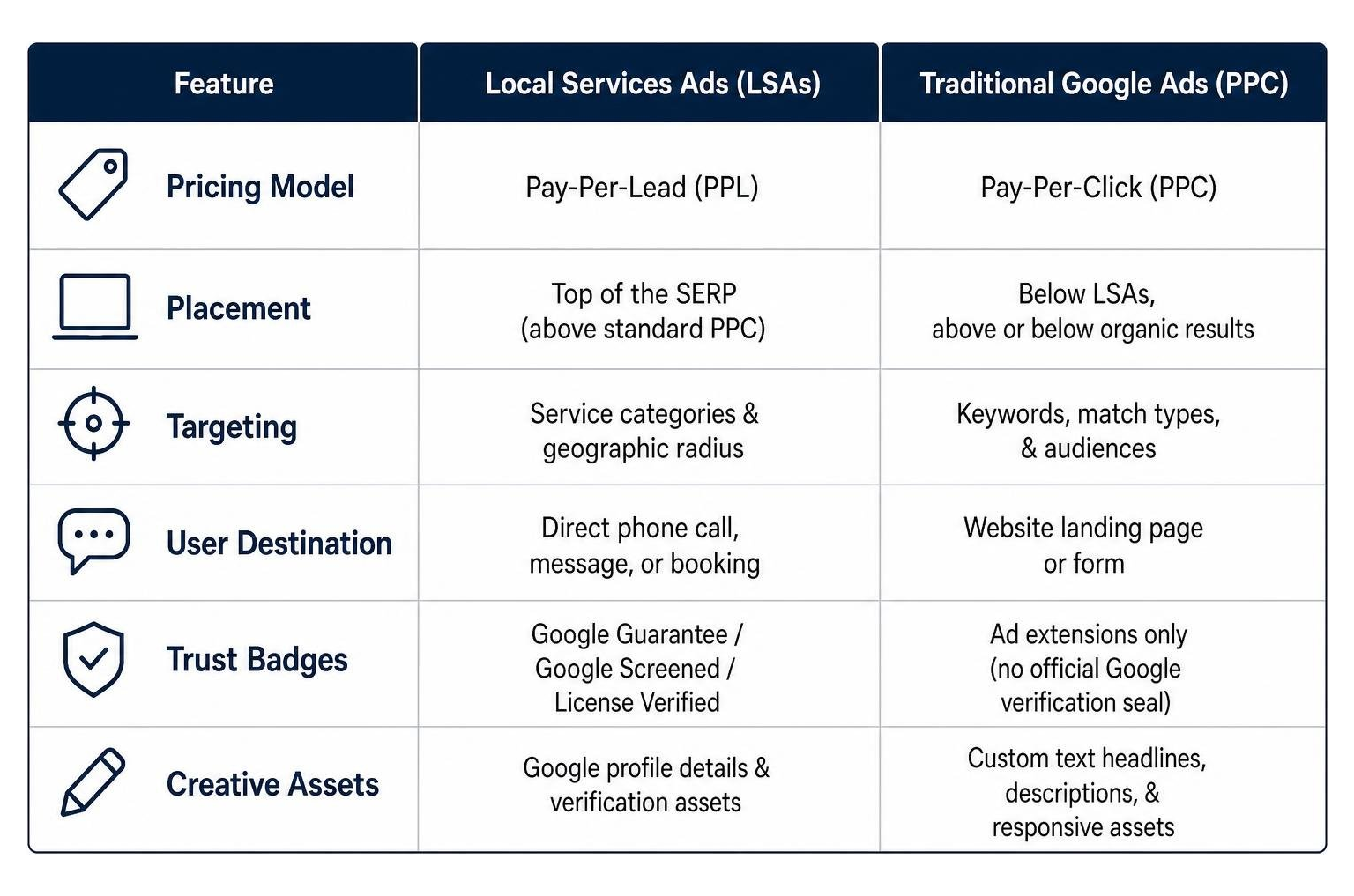
| Feature | Local Services Ads (LSAs) | Traditional Google Ads (PPC) |
|---|---|---|
| Pricing Model | Pay-Per-Lead (PPL) | Pay-Per-Click (PPC) |
| Placement | Top of the SERP (above standard PPC) | Below LSAs, above or below organic results |
| Targeting | Service categories & geographic radius | Keywords, match types, & audiences |
| User Destination | Direct phone call, message, or booking | Website landing page or form |
| Trust Badges | Google Guarantee / Google Screened / License Verified | Ad extensions only (no official Google verification seal) |
| Creative Assets | Google profile details & verification assets | Custom text headlines, descriptions, & responsive assets |
Because searchers connect immediately without landing on an intermediate web page, there is zero click-cost waste from casual browsing. Google details the mechanics behind these profile units in its Local Services Ads overview.
Local visibility is a core pillar of modern digital marketing. When small companies pair verified search units with organic map rankings, they dominate local search results. Understanding how small shops win big with local business ads on Google helps businesses balance organic local SEO with paid search acquisition.
Pay-Per-Lead Economics and Budgeting Structure
The core financial advantage of LSAs is predictability. The average cost per lead across industries is approximately $60, which compares favorably to the broader search PPC benchmark average of $66.69 per lead.
Instead of burning ad spend on accidental clicks or tire-kickers, you pay only when a valid lead reaches out. Google classifies a valid lead as:
- An incoming phone call from a customer seeking a service you offer in your selected area.
- A direct text or booking request submitted through your ad profile.
- A voicemail left by a prospect who reached you through your ad’s tracking phone number.
If a call turns out to be spam, a robocall, an automated sales pitch, or a user looking for a service outside your selected territory, you can dispute the charge within Google’s dashboard for a refund. To calculate your expected returns across search channels, review an essential guide to the Google Ads cost calculator.
Who Is Eligible for Local Services Ads?
Google supports more than 80 service industries and 70 distinct business categories across the United States. While the program originally focused on home repairs, it now serves professional, medical, educational, and personal care providers:
- Home Services: Plumbing, electrical, HVAC, roofing, house cleaning, lawn care, pest control, locksmithing, appliance repair, moving, and general contracting.
- Professional & Business Services: Real estate agents, family lawyers, estate planning attorneys, tax preparers, bookkeepers, and accountants.
- Healthcare & Wellness: Dentists, optometrists, chiropractors, physical therapists, and wellness practitioners.
- Learning & Care Services: Tutors, language instructors, childcare providers, and pet groomers.
- Automotive: Auto repair, mobile mechanics, and towing providers.
Home trade providers in Cook County and Lake County use these direct-contact ads to maintain steady call volume. If you run a trade business, our breakdown on plumbing Google Ads to unclog your lead pipeline demonstrates how direct search placements generate steady inquiries.
Screening Requirements and Trust Badges
Trust is the central deciding factor for local customers hiring someone to work in their home, manage their finances, or handle medical care. To give searchers confidence, Google requires businesses to pass a multi-point verification screening before their ads go live.
Google outlines the full criteria for business verification in its official documentation on how providers qualify for Local Services Ads. The screening steps include:
- Business Entity Verification: Confirming state registry filings and proper business registration.
- Insurance Checks: Submitting active general liability insurance certificates that meet vertical minimums.
- License Verification: Providing active trade, state, or municipal licenses for both the company and individual service professionals.
- Background Checks: Undergoing third-party background screenings for owners and customer-facing staff, conducted by Google’s risk assessment partners.
Meeting these criteria gives service providers access to official Google trust badges, which elevate user confidence. Exploring the ultimate guide to Google Guaranteed ads benefits shows how these trust signals improve conversion rates.
Google Guarantee, Google Screened, and License Badges
Google displays three distinct verification badges depending on industry vertical:
- Google Guarantee (Green Checkmark): Designed for home service businesses (such as electricians, plumbers, and roofers). This badge includes Google’s reimbursement backing (up to $2,000 in lifetime claims in the US) if a customer is unsatisfied with the quality of the work.
- Google Screened: Tailored for white-collar professional services, such as legal, financial planning, real estate, and healthcare practices. It confirms that the provider holds valid licenses and clear background checks, though it does not carry monetary reimbursement.
- License Verified by Google: Applied to specific wellness, beauty, and healthcare sectors where state-level professional licensing is validated directly by Google.
For businesses still completing their full background checks, Google sometimes offers a “pre-badge” ad tier. Pre-badge ads let you generate leads while your paperwork processes, though they appear below fully verified providers on search result pages. For contractors working across Chicagoland, our guide on contractor lead generation through Google Ads explains how verification improves lead quality.
How to Set Up and Launch Local Services Ads
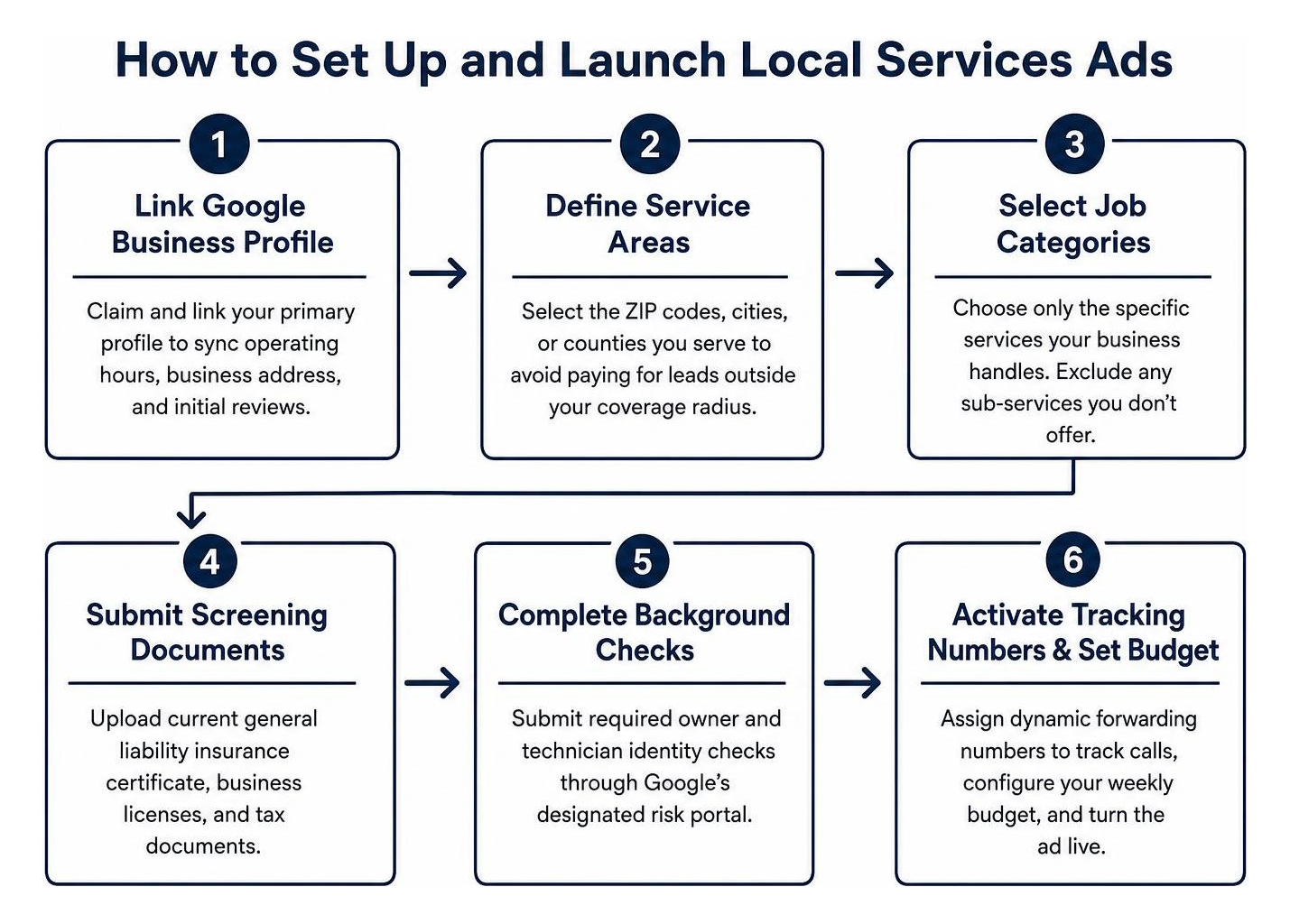
Setting up a campaign requires strict attention to detail during the compliance process. Following a structured launch checklist prevents verification delays:
- Link Google Business Profile: Claim and link your primary profile to synchronize your operating hours, business address, and initial reviews.
- Define Service Areas: Select the precise ZIP codes, cities, or counties you serve (such as Schaumburg, Naperville, Skokie, or Evanston) to prevent paying for leads outside your coverage radius.
- Select Job Categories: Check off only the specific services your business handles. If you are an electrician who does not handle commercial rewiring, exclude that sub-service.
- Submit Screening Documents: Upload your current general liability insurance certificate, business licenses, and tax documents.
- Complete Background Checks: Submit required owner and technician identity checks through Google’s designated risk portal.
- Activate Tracking Numbers & Set Budget: Assign dynamic forwarding numbers to track incoming calls, configure your weekly budget, and turn the ad live.
For a broader view of how local paid campaigns integrate with search strategy, read our quick start guide to Google Ads for local businesses.
The 2026 LSA Migration to Google Ads and Performance Max
Google is completing a major structural transition: migrating Local Services Ads directly into the unified Google Ads engine using the Performance Max framework.
The migration rolls out in three phases starting in August 2026 for primary US service verticals (including plumbing, HVAC, electrical, roofing, and cleaning), expanding across broader categories through late 2026, and concluding non-US migrations in 2027.
This platform update introduces several key changes for advertisers:
- Performance Max Framework: LSAs now leverage Google’s machine-learning infrastructure while retaining top-of-SERP placement and the pay-per-lead payment model.
- Daily Budget Model (30.4 Multiplier): Google is replacing the legacy “Average Weekly Budget” structure with the standard Google Ads daily budget calculation (daily budget × 30.4 days per month).
- Streamlined Reverification: Advertisers no longer need to complete manual annual reverification for insurance and licensing; once verified, information stays active unless your credentials expire or change.
- Unified Campaign Bidding: Legacy vertical-level Target Cost-Per-Lead (tCPL) settings are replaced by campaign-level Target CPA bidding.
Google provides updated setup instructions in its guide to getting started with Local Services Ads.
Adapting Your Campaign Strategy Post-Migration
Transitioning to the unified Google Ads interface gives small business owners centralized reporting across search, map, and lead-generation campaigns.
To maintain steady lead flow after the transition:
- Account for the Learning Phase: Expect a 10- to 14-day performance ramp-up period as Google’s smart-bidding algorithm calibrates to your target service area.
- Synchronize Business Profiles: Ensure your Google Business Profile data (hours, address, phone number) exactly matches your LSA assets to prevent algorithmic visibility penalties.
- Align Budgets with Local Goals: Take advantage of daily budget controls to scale spend up during peak seasonal demand in your local market.
For forward-looking local growth strategies, review our guide on local business marketing strategies for 2026.
Proven Strategies to Optimize Local Ad Visibility and Lead Quality
Securing a top position in LSA units requires more than just bidding. Google’s auction algorithm evaluates multiple operational and profile factors to determine ad rank:

- Proximity to Searcher: How close your registered office or active service radius is to the user entering the search query.
- Review Score & Velocity: A high average star rating (ideally 4.8 or higher) combined with a steady influx of recent, authentic customer reviews.
- Response Speed: How quickly you answer calls and reply to incoming messages. Google tracks answer rates and penalizes slow or unreturned inquiries by lowering your ad visibility.
- Bidding Mode Selection: Choosing between “Maximize Leads” (automated bidding to capture maximum volume within budget) and “Target CPA” (capping the maximum cost you are willing to pay per inquiry).
To capture high-intent inquiries effectively, read our breakdown on capturing search engine marketing leads.
Lead Management and Quality Assurance Workflows
Running a profitable campaign requires disciplined lead tracking. If you pay for inquiries, every call must be handled efficiently.
- Audit Call Recordings: Use the dashboard’s call recording feature to monitor call-handling quality, staff responsiveness, and appointment-setting rates.
- Use Direct Booking Integrations: If your industry supports booking partners, enable direct scheduling so customers can book appointments straight from the search result.
- Enforce the 30-Day Lead Dispute Window: Review your lead log weekly. If you receive an out-of-area lead, a wrong number, or automated spam, submit a dispute within 30 days to receive ad spend credits.
- Connect CRM Systems via Aggregator Feeds: Connect your lead stream directly into your customer management software using Google’s API tools to trigger immediate follow-up notifications.
For professional service providers managing complex sales pipelines, our guide on high-intent lead generation strategies details effective intake processes.
Frequently Asked Questions About Local Lead Generation
How much do local services ads cost compared to standard PPC?
The average cost per lead across US markets is approximately $60, compared to traditional Google Search Ads benchmarks of around $66.69 per lead. Costs vary depending on your industry and competition. Because you pay only for direct customer contacts (calls or messages) rather than landing page clicks, wasted spend is substantially lower.
Can a business run traditional Google Ads and Local Services Ads simultaneously?
Yes. Running both formats allows your business to dominate the top of the search engine results page. Your brand can appear in the LSA banner at the very top, in standard PPC search ads directly below, and in the organic Google Maps pack, capturing maximum search real estate.
What qualifies as a disputable lead under the pay-per-lead model?
You can dispute leads and request credits for:
- Phone calls from areas outside your selected service radius.
- Inquiries for services your business does not provide and has explicitly excluded.
- Automated robocalls, telemarketers, and spam recordings.
- Wrong numbers or callers who did not intend to reach your company.
Conclusion: Scaling Neighborhood Inquiries with Precision Advertising
Google Local Services Ads offer local business owners a direct, verified pathway to acquiring neighborhood customers. By combining the credibility of Google trust badges with a pay-per-lead model, you protect your advertising budget while securing high-intent phone calls and bookings across your service area.
At Wizerunek w Sieci (WWS — Web Development + SEO), headquartered in Des Plaines, IL, we help small and medium-sized businesses across Chicagoland and the United States build profitable online acquisition channels. Founded by Tomasz Lasota, our team bridges the gap between massive, impersonal marketing agencies and solo freelancers. We deliver enterprise-grade digital marketing with personal attention, local market knowledge, and bilingual capabilities serving both the broader American market and the vibrant Polish-American community (Polonia).
Whether you need help navigating local search advertising, optimizing your review strategy, or setting up a complete digital marketing system, we manage your growth with precision. For hands-on help scaling your inquiries, explore our professional management of high-performing paid campaigns or visit wizerunekwsieci.com to request a free audit of your online presence.