


The Practical Guide to Small Business Paid Advertising in 2026
Master PPC management for small business in 2026 with this practical guide covering ad auctions, budgets, and ROI tracking for Chicago-area growth.
 By WWS Team
10 min read

In this article8 sections
- PPC Management for Small Business: Start With the Right Customers
- Fundamentals of PPC Management for Small Business in 2026
- Core Components of High-Performing Paid Campaigns
- Selecting the Best Advertising Platforms for Your Business Goals
- Setting Budgets, Estimating Costs, and Tracking ROI
- Execution Strategies: In-House Setup vs. Agency Partnership
- Frequently Asked Questions About PPC Management
- Conclusion
PPC Management for Small Business: Start With the Right Customers
PPC management for small business owners starts with a clear goal: more qualified calls, leads, or sales, not just more clicks. Choose the service you want to promote, show ads to people likely to need it, set a spending limit, and send each click to a page that makes the next step easy. Track which ads bring in customers, then improve or pause the ones that do not.
Paid ads can put your business in front of potential customers quickly. But results depend on what happens after the click. This guide covers how to choose platforms, manage costs, measure returns, and keep improving your campaigns.
I’m Tomasz Lasota, founder of Wizerunek w Sieci / WWS - Web Development + SEO in Des Plaines, with more than 22 years of experience in digital development and marketing. My work in PPC management for small business owners includes Google Ads and Meta Ads, backed by a personalized approach and support in English and Polish.
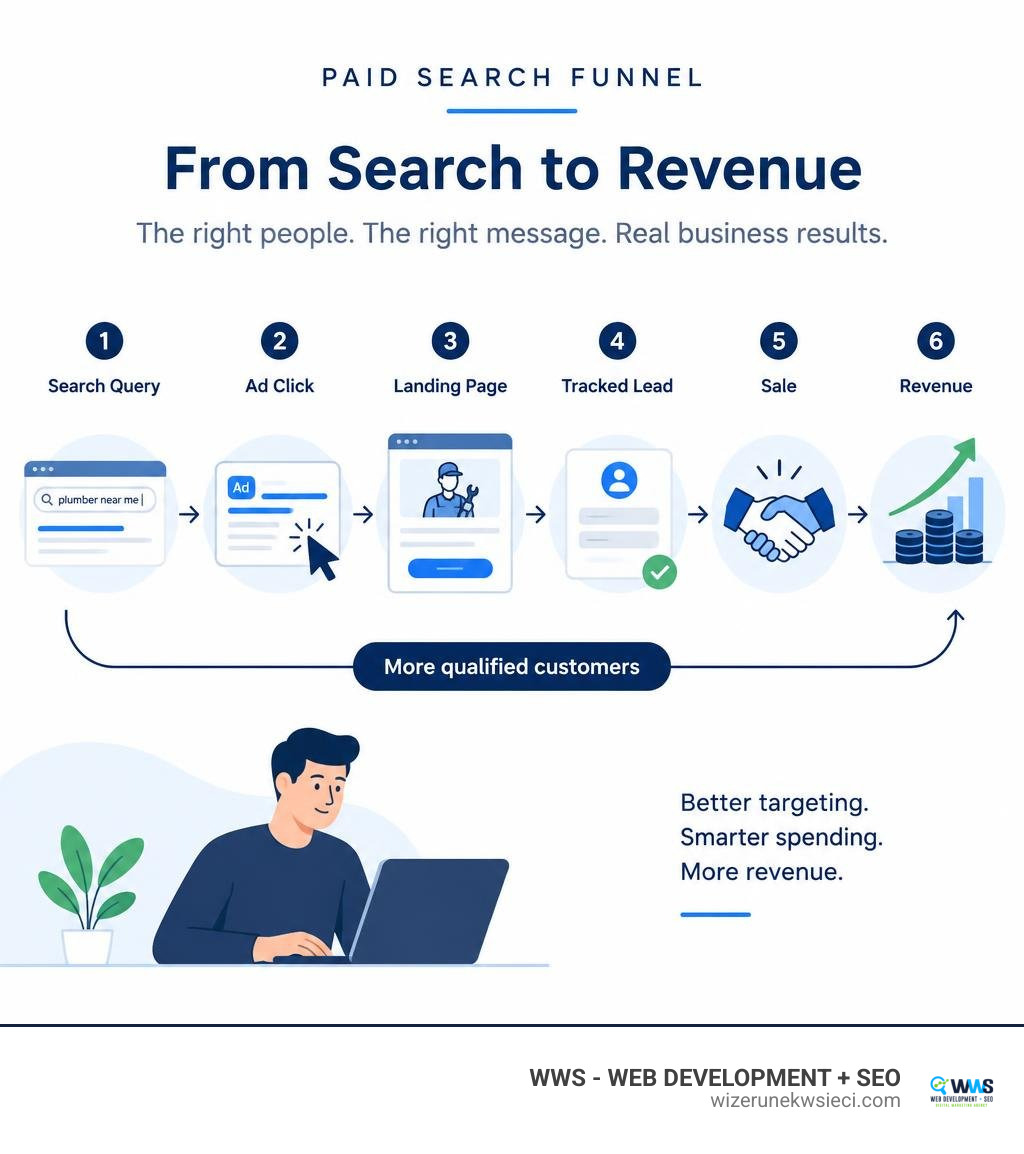
Discover more about PPC management for small business:
Fundamentals of PPC Management for Small Business in 2026
Pay-per-click (PPC) advertising is an online marketing model where advertisers only pay when a user actually clicks on their ad. Unlike traditional advertising where you pay upfront for ad placement regardless of engagement, PPC lets you maintain direct control over your budget, target exact geographic areas, and measure return on ad spend (ROAS) down to the penny.
For small and medium-sized enterprises across the Chicago metropolitan area, Cook County, and nationwide, PPC levels the playing field. Businesses earn an average of $2 in revenue for every $1 spent on Google Ads (a 200% ROAS), making paid advertising one of the most reliable drivers of new client acquisition when managed strategically.
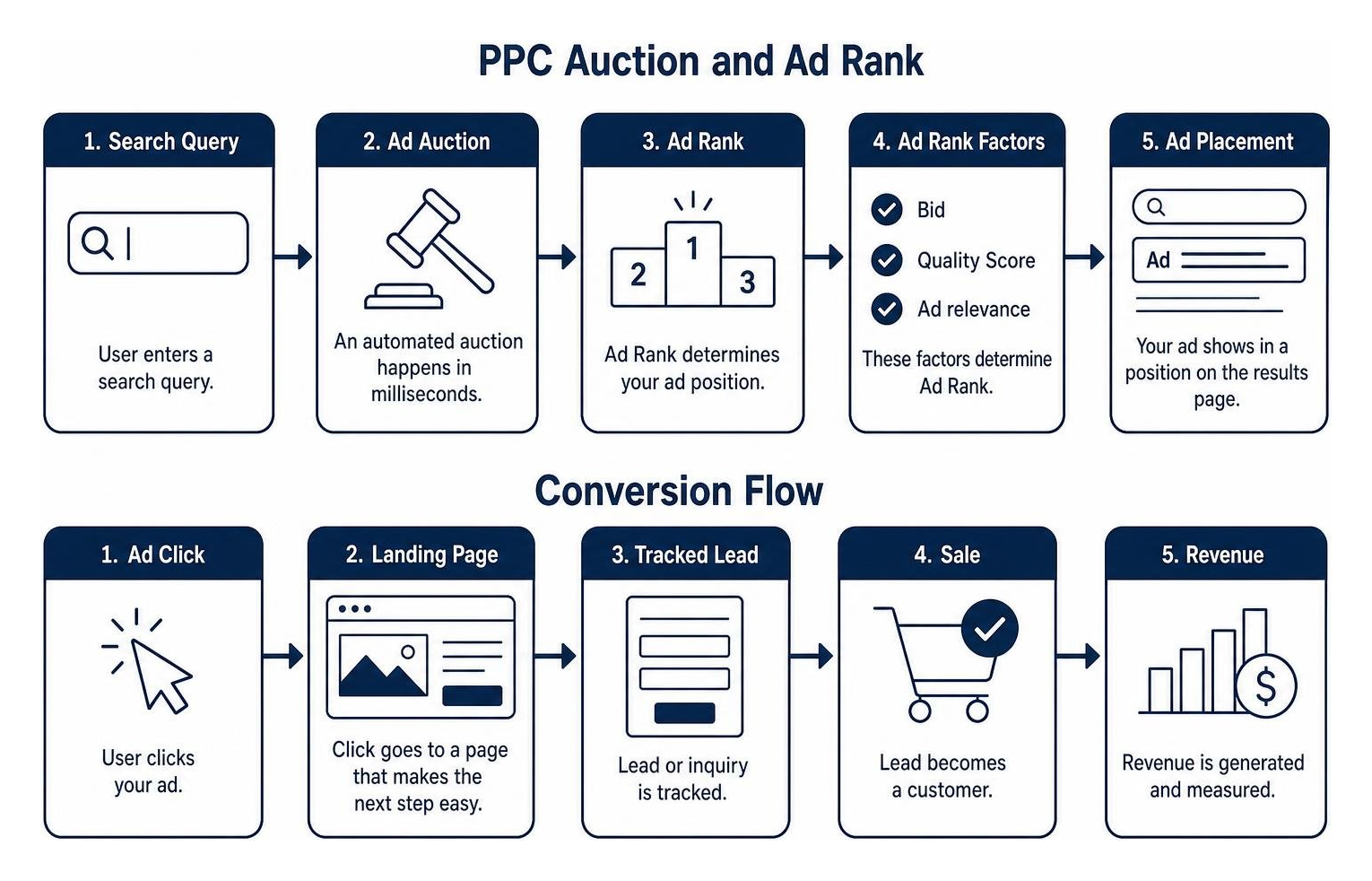
How the Paid Search Auction and Ad Rank Work
Every time a user enters a search query into Google or Microsoft Advertising, an automated auction happens in milliseconds. Ad Rank determines the exact position of your ad on the search results page.
Ad Rank is calculated using several core elements:
- Maximum CPC Bid: The highest dollar amount you are willing to pay for a single click.
- Quality Score: A diagnostic rating assigned to your keywords ranging from 1 to 10, based on three factors:
- Expected Click-Through Rate (CTR): How likely users are to click your ad when shown.
- Ad Relevance: How closely your ad copy matches the searcher’s intent.
- Landing Page Experience: How transparent, fast-loading, mobile-friendly, and relevant your landing page is.
- Ad Assets (Extensions): The additional information included in your ad, such as phone numbers, location pins, and sitelink extensions.
- Auction Context: The searcher’s device, physical location, time of day, and past search behavior.
A higher Quality Score directly lowers what you pay. In fact, improving your Quality Score from 4 to 8 can reduce your cost per click (CPC) by up to 50%, allowing small businesses to outrank larger competitors without outspending them.
PPC vs. Organic Search: Balancing Fast Wins and Long-Term Authority
PPC and search engine optimization (SEO) are complementary strategies that deliver the best results when executed together. PPC delivers immediate visibility, placing your business at the top of search results the moment campaigns launch. Organic SEO builds enduring authority and traffic equity over months.
Understanding why your business needs a real SEO strategy in 2026 allows you to use paid search data - such as high-converting search terms - to guide your long-term content and organic ranking efforts. Furthermore, searchers who click on paid ads are 50% more likely to purchase or book a service than organic visitors because paid search attracts users with urgent, commercial intent.
| Comparison Factor | Pay-Per-Click Advertising (PPC) | Organic Search Engine Optimization (SEO) |
|---|---|---|
| Time to Results | Immediate (hours to days after launch) | Medium-to-long term (3 to 6+ months) |
| Cost Structure | Pay-per-click with flexible daily caps | Strategic investment in technical design & content |
| Audience Intent | High commercial and transactional intent | Broad spectrum (informational to transactional) |
| Traffic Longevity | Pauses when campaign ad spend stops | Compounds over time and continues generating traffic |
| Testing Speed | Fast A/B testing for copy, offers, and pages | Requires iterative indexing and crawling cycles |
Core Components of High-Performing Paid Campaigns

A successful PPC structure avoids clutter and groups themes cleanly. When accounts are disorganized, budgets disperse across irrelevant queries, driving up acquisition costs.
High-Intent Keyword Strategy and Negative Match Precision
Keyword selection must focus on commercial and transactional queries rather than purely informational searches. For example, bidding on “emergency commercial boiler repair Des Plaines” will deliver a much higher lead conversion rate than a broad search like “boiler maintenance tips.”
To capture qualified prospects, you must understand how to capture search engine marketing leads using specific match types:
- Exact Match
[keyword]: Displays your ad only when the search query shares the exact meaning or intent. - Phrase Match
"keyword": Displays your ad when the search query includes the meaning of your phrase, allowing for minor context additions. - Broad Match
keyword: Displays your ad on related variations; best used only alongside strict automated bid targets and heavy negative lists.
Negative Keywords prevent your ads from showing for irrelevant searches that waste capital. If your company provides high-end commercial HVAC services, adding negative keywords such as “free,” “jobs,” “salary,” “DIY,” or “residential parts” ensures your ad budget is reserved strictly for paying clients.
Quality Score Mechanics and Landing Page Relevance
Your ad copy is an invitation, but your landing page makes the sale. Sending paid traffic to a generic homepage often results in high bounce rates and inflated CPCs. Dedicated landing pages must mirror the specific promise, headlines, and keywords presented in your ad copy.
Maximizing conversions requires rigorous conversion rate optimization paired with fast, responsive, and clear website design. Ensure each landing page features:
- A clear, prominent headline addressing the searcher’s problem directly.
- A direct call-to-action (click-to-call phone number, short lead form, or appointment scheduler).
- Trust signals including licensing, local reviews, and business accreditations.
- Rapid page load speeds on mobile networks.
Selecting the Best Advertising Platforms for Your Business Goals
Different ad platforms serve distinct customer intents. Choosing the right channel prevents wasted spend and aligns with your customer acquisition goals.
Google Search, Local Services, and Map Ads for Local Intent
Google remains the primary engine for high-intent search traffic. For service-based companies operating in local suburbs like Schaumburg, Arlington Heights, Glenview, or Evanston, several Google formats deliver outstanding ROI:
- Google Search Ads: Standard text ads appearing at the top of the search engine results page (SERP) when users search for active solutions.
- Google Local Services Ads (LSA): Pay-per-lead ads positioned above standard search ads. Learn how to get qualified neighborhood leads using Google Local Services Ads to connect with nearby customers searching for immediate help.
- Google Maps Search Ads: Promoted pins and top-tier listings in Google Maps that help local shops and providers win nearby high-intent shoppers with Google Maps local search ads.
- Google Guaranteed Program: Builds instant customer confidence through verified trust badges. Explore the ultimate guide to Google Guaranteed ads benefits to understand how verification boosts call volumes.
Paid Social and Multi-Channel Audience Retargeting
While search ads capture existing demand, paid social media platforms like Meta (Facebook & Instagram) generate interest and nurture audiences who may not be actively searching today.
By mastering paid social media ads, small businesses can deploy eye-catching visual carousels, engage specific demographic niches, and run retargeting campaigns. Retargeting places ads in front of previous website visitors who did not convert on their first visit, re-engaging them across social feeds and web properties until they are ready to call.
Setting Budgets, Estimating Costs, and Tracking ROI
Setting a paid media budget requires balancing market competition against your average transaction value and sales conversion rate.
Calculating Realistic Cost-Per-Click and Monthly Ad Spend
On platforms like Google Ads, average CPCs across general industries range from $1 to $2. However, in highly competitive sectors like legal, finance, roofing, or emergency home services, CPCs can easily exceed $30 to $50 per click.
Small businesses typically begin with monthly ad budgets between $500 and $5,000, while companies scaling across competitive metropolitan markets often spend upwards of $10,000 monthly.
To determine the ideal investment for your growth targets, check our guide on estimating ad spend with a Google Ads cost calculator and review strategies for setting profitable Google Ads budgets.
Tracking Conversion Rates, ROAS, and Lead Generation Metrics
Campaign profitability cannot be measured by clicks alone. True success requires measuring bottom-line key performance indicators (KPIs):
- Cost Per Acquisition (CPA) / Cost Per Lead (CPL): Total ad spend divided by the number of completed lead forms or booked calls.
- Conversion Rate (CVR): The percentage of visitors who complete your target action.
- Return on Ad Spend (ROAS): Gross revenue generated by paid ads divided by total ad spend.
- Customer Lifetime Value (LTV): The total revenue a single customer brings over their entire relationship with your business.
Applying proven home services lead generation tactics and establishing methods for capturing leads from website visitors ensures every paid visit contributes to tangible revenue growth.
Execution Strategies: In-House Setup vs. Agency Partnership
Roughly 47% of small business owners execute their marketing campaigns entirely on their own. While managing ads in-house provides complete control, it often pulls owners away from running their daily operations and can lead to costly mistakes.
Evaluating Automation for PPC Management for Small Business
Modern advertising platforms offer numerous automated features, including Smart Bidding (Target CPA, Target ROAS) and Performance Max campaigns. While machine learning algorithms have become powerful, they require high data volumes and human oversight to avoid overspending on broad, low-converting terms. Using third-party optimization tools or checking resources like PPC Management Software for Small Business (2026) | AdFlint can provide additional clarity when reviewing automated workflows and rule-based bidding structures.
When to Outsource PPC Management for Small Business to Specialized Professionals
As your monthly spend grows, the technical complexity of keyword pruning, A/B ad creative testing, conversion tracking verification, and cross-channel retargeting increases. At this stage, partnering with a dedicated agency produces a higher net return than trying to master advertising platforms alone.
| Management Aspect | In-House / Owner Managed | Specialized Agency Partnership (WWS) |
|---|---|---|
| Time Commitment | 5–15 hours weekly taken from business operations | Zero owner time spent on routine technical optimization |
| Technical Expertise | Requires constant self-education on algorithm changes | Experienced specialists applying proven industry methods |
| Cost Structure | Direct ad spend plus cost of trial-and-error | Transparent management fee with optimized ad spend efficiency |
| Account Ownership | Kept in-house | 100% owned by the business owner, retaining all history |
| Landing Page Testing | Often limited to stock templates | Custom coded, GEO-targeted, and conversion-optimized |
Frequently Asked Questions About PPC Management
How much should a small business spend on PPC advertising each month?
Most small businesses see meaningful results by starting with a monthly budget between $1,000 and $3,000 for search ads. This provides sufficient click volume to gather statistically significant performance data, optimize keyword bids, and generate steady inquiries. More competitive industries or businesses serving the wider Chicagoland area may scale past $5,000 to $10,000 monthly as campaign profitability is established.
What is the fastest way to lower cost per click without sacrificing lead quality?
The fastest way to lower CPC while maintaining lead quality is to improve your Quality Score. Refine ad groups into tightly themed keyword clusters (10–15 keywords maximum), draft ad copy that mirrors those keywords precisely, and direct traffic to tailored landing pages. Additionally, regular negative keyword maintenance filters out wasteful clicks, directing your budget only toward qualified prospects.
Can paid advertising work alongside local SEO for service businesses?
Yes. Combining PPC with local SEO creates a comprehensive search presence that dominates page-one search results. By deploying local business marketing tips for 2026, you capture immediate transactional leads through top-of-page Google Ads while simultaneously building long-term local organic visibility in the Google Map Pack.
Conclusion
PPC advertising offers small businesses a direct, measurable path to acquiring high-value customers. By setting strict spending limits, focusing on high-intent keywords, maintaining exceptional Quality Scores, and directing traffic to high-converting landing pages, you can reliably turn clicks into booked clients and sustainable revenue.
At Wizerunek w Sieci (WWS - Web Development + SEO), located in Des Plaines, IL, we combine the technical capabilities and resources of a dedicated digital agency with the personal attention and local market knowledge of a trusted partner. We treat every client’s business with the same care and dedication as our own, proudly supporting American businesses, local entrepreneurs across Cook County and the Chicago suburbs, and the Polish-American community (Polonia Chicago) through bilingual English and Polish management.
Ready to scale your business with custom, data-backed advertising strategies? Explore how our tailored paid campaigns can increase your qualified leads. Call us today at (773) 814-2992 or visit wizerunekwsieci.com to request your free website audit and campaign consultation.
A Des Plaines, IL team helping local service businesses get found, get called and get booked since 2005: local SEO, Google Ads, conversion-focused websites and AI search optimization.
Meet the teamKeep reading
All articles
Performance Max for Local Businesses: How It Works and Fits
Performance Max for local businesses explained: store goals, where ads appear, setup needs, budgets, pay-per-lead rules and how to judge results.
Best Car Wash Website Inspiration: Sleek Designs That Clean Up the Competition
Find the best car wash website inspiration for 2026 - see sleek designs, subscription funnels, and local SEO tips to boost conversions.
SMS Marketing for Contractors: A Practical Playbook
How contractors use text messages to answer leads fast, book estimates, cut no-shows, earn reviews and win repeat jobs, with consent rules and sample texts.