


Turn Home Services Leads Into Booked Jobs
Effective home services lead generation starts with a simple system: show up where local homeowners search, make it easy to call or book, respond fast, and track which sources create real jobs.
- Optimize your Google Business Profile, service pages, and online reviews for local searches.
- Use clear mobile calls to action, such as click-to-call, request an estimate, or book service.
- Generate low-cost demand through referrals, neighborhood partnerships, helpful social posts, and local Facebook groups.
- Track every call, form, appointment, and closed job so you can focus on sources that produce revenue, not just clicks.
The home services market is growing, but more homeowner demand does not automatically mean more booked work. Contractors often lose good prospects through weak local visibility, slow websites, missed calls, unclear forms, and follow-up that arrives too late.
The strongest lead strategy is not one channel or one expensive campaign. It is a repeatable local system that builds trust before contact, captures high-intent prospects, and helps your team prioritize the jobs most likely to close.
I am Tomasz Lasota, a digital marketing strategist and founder of Wizerunek w Sieci / WWS — Web Development + SEO in Des Plaines, Illinois. For more than 22 years, I have helped local businesses improve home services lead generation through practical SEO, conversion-focused websites, paid media, and measurement that connects marketing activity to calls, customers, and revenue.
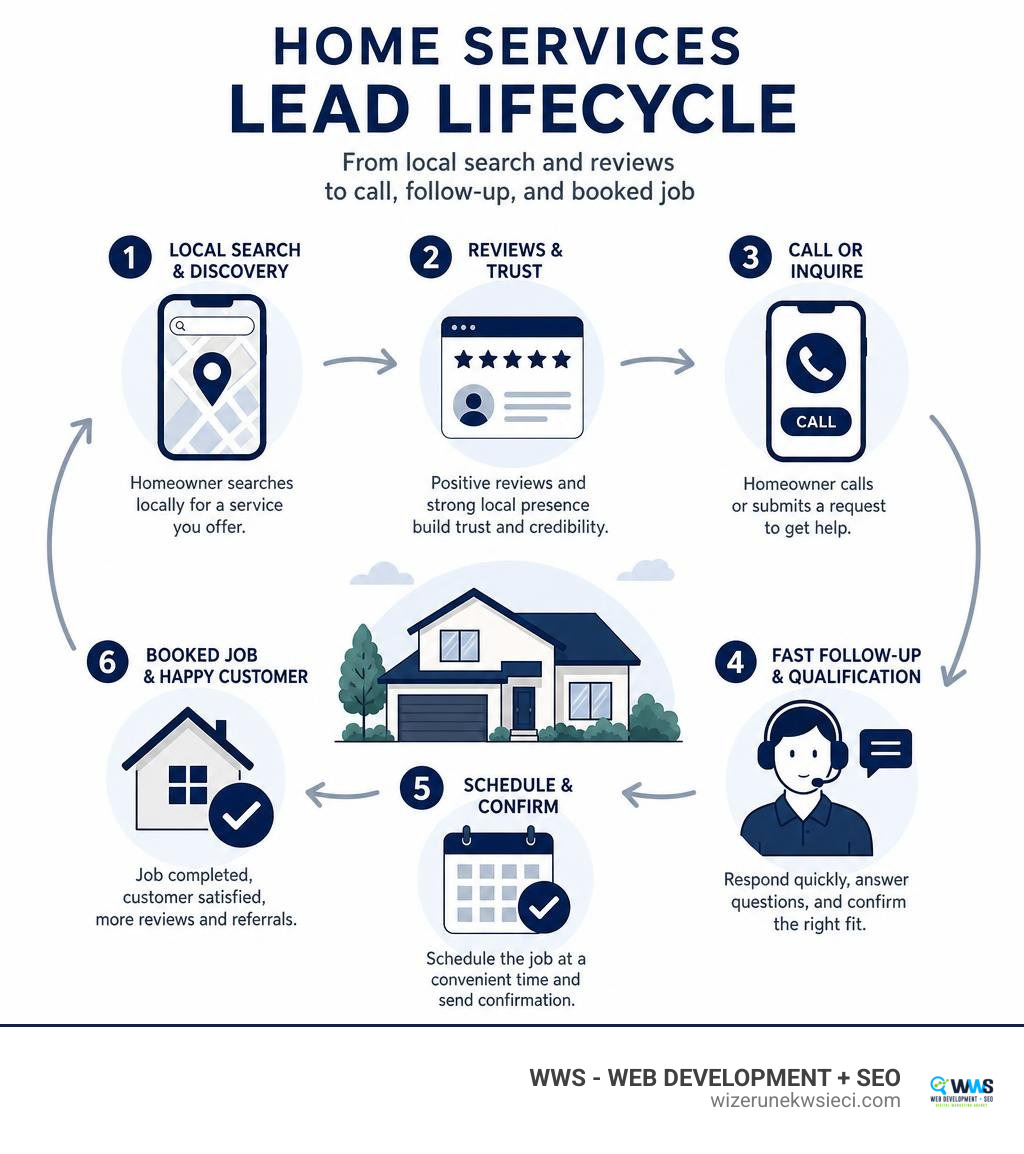
Simple guide to home services lead generation terms:
Foundations of Home Services Lead Generation for Local Contractors
According to market research on home services industry market growth, the global home services sector is projected to expand from $400.3 billion in 2020 to $590.8 billion by 2028. Homeowners are spending more on emergency repairs, routine maintenance, and major renovations. However, capturing this demand efficiently requires a strategic balance across multiple customer acquisition channels.
Relying entirely on paid channels can quickly strain marketing budgets. Home service companies typically pay an average of $53.18 per lead through online search ads, $80.12 per lead through social media ads, and $85.47 per lead through display networks. Because overall customer acquisition costs can range between $25 and $300 per lead depending on the trade, building owned, organic visibility provides lasting stability.
Establishing a multi-channel lead distribution engine enables your company to capture immediate commercial intent while nurturing long-term customer lifetime value. When homeowners encounter urgent issues—such as a burst pipe in Glenview or a malfunctioning furnace in Schaumburg—they search with immediate intent to hire. A balanced marketing foundation ensures your brand captures these urgent inquiries without relying solely on recurring ad spend.
Organic Search and Home Services Lead Generation Strategies
Roughly 77% of consumers across major international markets rely on Google to find local business information, and 87% use the search engine specifically to evaluate local service providers. For home service contractors, organic search visibility centers on ranking prominently in Google’s local 3-pack and map pack results.
Google calculates local search rankings based on three core pillars:
- Relevance: How closely your business profile and website content match what the homeowner is searching for.
- Distance (Proximity): How close your business or verified service area is to the user performing the search.
- Prominence: How established, well-reviewed, and reputable your business appears across the web.
Achieving high visibility requires maintaining consistent Name, Address, and Phone number (NAP) data across all major directories. When listings contain conflicting details, search engines lower ranking confidence; in fact, 62% of consumers state they will avoid a business that displays inaccurate listing information.
Contractors must actively invest in comprehensive Google Business Profile optimization alongside complete local SEO strategies. Google Business Profiles for local service businesses receive an average of 1,009 monthly impressions, with 84% originating from discovery searches by users who do not have a specific company name in mind. By refining service categories, uploading high-resolution job photos, and optimizing geo-targeted service descriptions, contractors can consistently capture discovery search traffic across Cook County and Lake County.
High-Converting Website Architecture and Funnels

Attracting traffic is only half the battle. Your website must be structured to turn visitors into confirmed service appointments. Many contractor websites fail due to slow load speeds, cluttered layouts, and confusing contact options that cause potential customers to leave.
To maximize conversion rates, your website architecture should implement several technical and design best practices:
- Instant Load Speeds: High-performance, clean coding ensures pages render immediately on mobile devices, preventing immediate visitor drop-off.
- Frictionless Mobile Actions: Prominent, sticky click-to-call buttons and short estimate forms allow homeowners to reach out within seconds.
- Structured Service Coverage: Implementing dedicated service area pages and tailored service page SEO allows your business to rank for localized search queries across neighboring municipalities such as Arlington Heights, Mount Prospect, and Des Plaines.
- Conversion-Driven Layouts: Professional custom local landing page design focuses the visitor’s attention on your licenses, customer guarantees, transparent pricing estimates, and direct calls to action.
When your website pairs clear service information with direct booking pathways, you effectively eliminate friction and start capturing website leads at a substantially higher rate.
Organic and Low-Cost Lead Generation Channels
Review Velocity and Automated Reputation Management
Online reviews serve as the primary digital currency for local contractors. Research shows that 87% of consumers read online reviews before contacting a local business, and 79% trust online reviews and testimonials from strangers as much as personal recommendations from friends or family. Furthermore, 90% of consumers who read reviews on Yelp make a purchasing decision within a single week.
Maintaining a continuous stream of authentic customer feedback directly impacts both search rankings and conversion rates. Relying on technicians to manually request reviews often leads to inconsistent results. Establishing automated review workflows via SMS or email immediately following a completed job ensures steady review velocity.
Tools like a free Google reviews app simplify the submission process for clients by sending direct links to your profile. If an unfair or policy-violating review appears, knowing how to legally remove bad Google reviews helps safeguard your company’s online reputation and maintain strong consumer trust across the Northwest Suburbs of Chicago.
Referral Programs and Customer Loyalty Systems
Customer retention and word-of-mouth recommendations represent two of the most cost-effective lead sources available. It costs approximately five times more to attract a new customer than to retain an existing one. Furthermore, referred customers generate a 16% higher customer lifetime value and demonstrate an 18% higher retention rate over time.
While 83% of satisfied homeowners express willingness to refer a home service company, only 29% actually do without a structured incentive system in place.
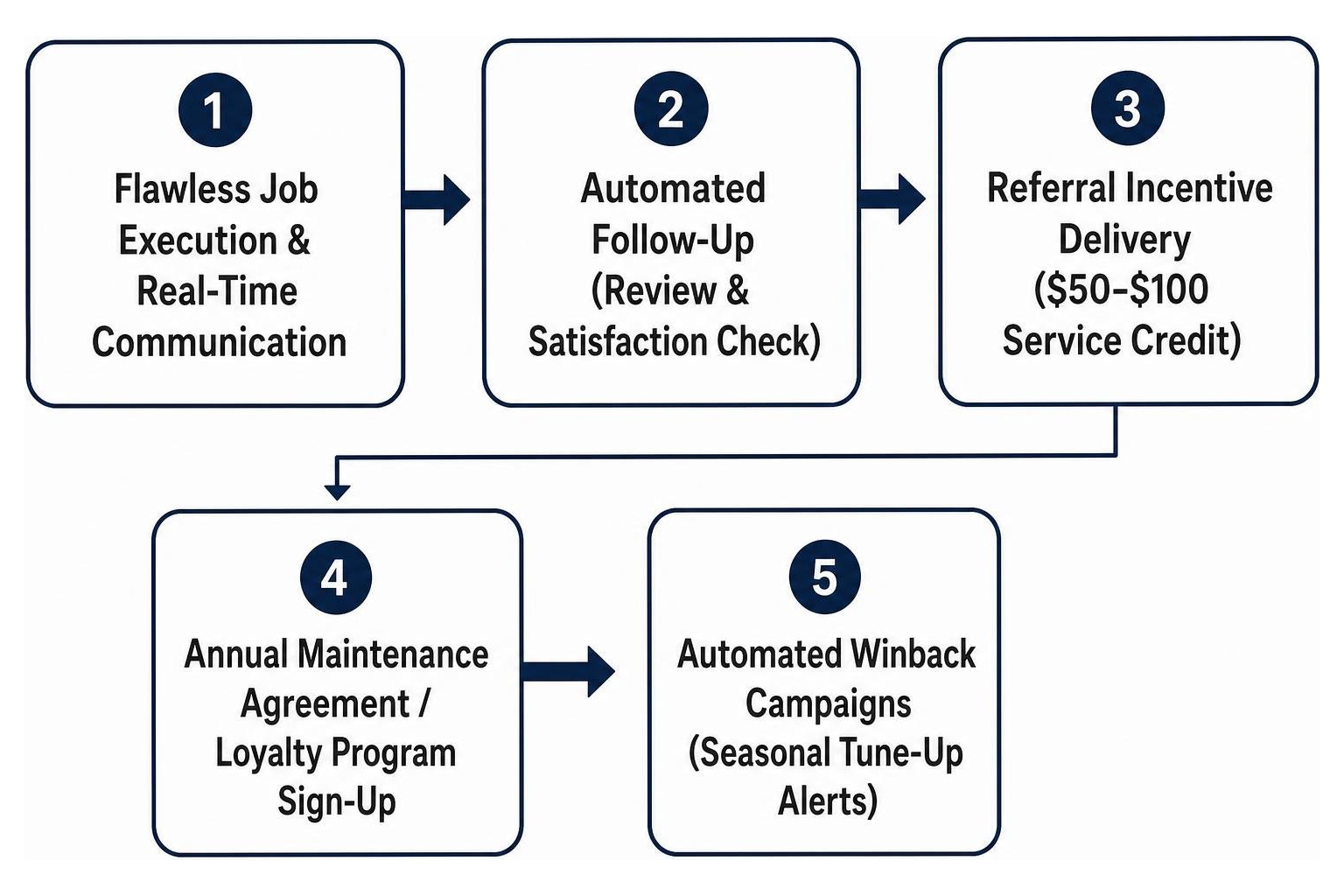
Contractors can establish sustainable referral volume by introducing straightforward loyalty structures:
- Bilateral Referral Credits: Offer a $50 credit toward future maintenance for the referring client and a $50 discount on initial service for the new customer.
- Annual Maintenance Agreements: Provide recurring seasonal tune-ups for HVAC, plumbing, or roofing systems to secure predictable annual revenue.
- Automated Re-Engagement: Deploy a structured winback email campaign to reconnect with past customers prior to peak heating or cooling seasons.
Local Community Engagement, Partnerships, and Social Proof

Establishing non-competing cross-promotional partnerships helps generate high-intent, exclusive referrals. An electrician in Park Ridge can partner with local plumbing contractors, HVAC specialists, and real estate professionals who frequently encounter clients needing electrical panel upgrades during home inspections.
Contractors can also leverage social media channels to establish neighborhood trust. More than 186 million U.S. residents use Facebook (roughly 56% of the population), and 31% of consumers report purchasing from local businesses after viewing social media campaigns.
Active participation in community groups, sponsoring youth athletic leagues across Chicagoland, and sharing practical maintenance tips build brand awareness. When immediate service needs arise, combining community visibility with targeted, high-intent paid social campaigns allows you to capture local demand across specific target ZIP codes.
Shared Lead Marketplaces vs. Owned Digital Assets
Many trade contractors rely heavily on third-party lead aggregators when starting out. While these platforms can supply initial volume, they often create significant operational hurdles over time.
Shared lead platforms frequently distribute the same homeowner request to three to five competing contractors simultaneously. This creates an immediate price-driven race to the bottom, where speed-to-call dictates who gets the estimate, often eroding profit margins. When contractors depend entirely on shared portals, they build no lasting digital equity; the moment they stop paying per inquiry, incoming job opportunities cease entirely.
In contrast, investing in owned digital marketing assets—such as optimized websites, localized landing page frameworks, and organic search equity—creates a defensible marketing foundation that generates exclusive inquiries year after year.
| Acquisition Feature | Shared Lead Marketplaces | Dedicated Lead Generation Services (e.g., LeadGenZilla, RenoLeadz) | Owned Digital Assets (SEO & Custom Web Platforms) |
|---|---|---|---|
| Lead Exclusivity | Shared with 3–5 competitors | 100% Exclusive to your business | 100% Exclusive organic inquiries |
| Pricing Model | Variable cost per shared lead | Performance pay-per-lead or monthly tiers | Fixed asset investment / Long-term ROI |
| Brand Identity | Aggregator brand promoted | Provider landing pages | Your proprietary business brand |
| Long-Term Equity | Zero equity built | Low to moderate equity | High permanent search & brand equity |
| Conversion Rates | 8% – 15% due to price shopping | 20% – 35% on verified inquiries | 30% – 50%+ on direct inbound calls |
| Lead Quality Control | Inconsistent screening | Pre-verified (OTP / database checks) | Natural qualification through web copy |
Contractors seeking scalable growth often utilize specialized pay-per-lead platforms like LeadGenZilla, LeadZik, or RenoLeadz to supplement call volume. However, the most sustainable long-term approach pairs short-term performance channels with owned digital infrastructure. Sourcing intent triggers from municipal building permits or property records via platforms like TradeLead can also provide outbound opportunities, but building owned organic authority remains the gold standard for consistent profitability.
Lead Tracking, Verification, and Quality Scoring
Measuring ROI and Home Services Lead Generation Quality
To scale profitably, contractors must implement structured lead qualification frameworks. Not every incoming phone call or form submission represents a viable project. Utilizing rigorous lead management and verification practices helps filter out low-intent inquiries, incorrect contact information, and service requests outside your operational territory.
Implementing the BANT qualification framework allows office dispatchers and sales teams to score incoming leads efficiently:
- Budget: Does the homeowner’s planned budget align with your company’s minimum service fee or project standards?
- Authority: Is the person requesting service the verified property owner authorized to approve contracts?
- Need: Does the homeowner require a core service your company specializes in, or is it an edge-case repair?
- Timeline: Is the project an immediate emergency, or a flexible project planned months in advance?
Qualifying inbound leads against these criteria ensures that field technicians prioritize high-margin projects, maximizing revenue per billable hour across service territories like Elk Grove Village, Niles, and Palatine.
Call Tracking, CRM Integration, and Revenue Attribution
Calculating precise marketing return on investment requires connecting every dollar spent directly to booked revenue. Tracking total lead counts alone can be misleading; your team must know which specific marketing channels drive profitable jobs.
Deploying Dynamic Number Insertion (DNI) through call analytics platforms like CallRail allows contractors to display unique tracking numbers based on how a visitor discovered the website. Whether a homeowner arrives via local search, Google Ads, or a social media campaign, call tracking software attributes the phone call to the exact source.
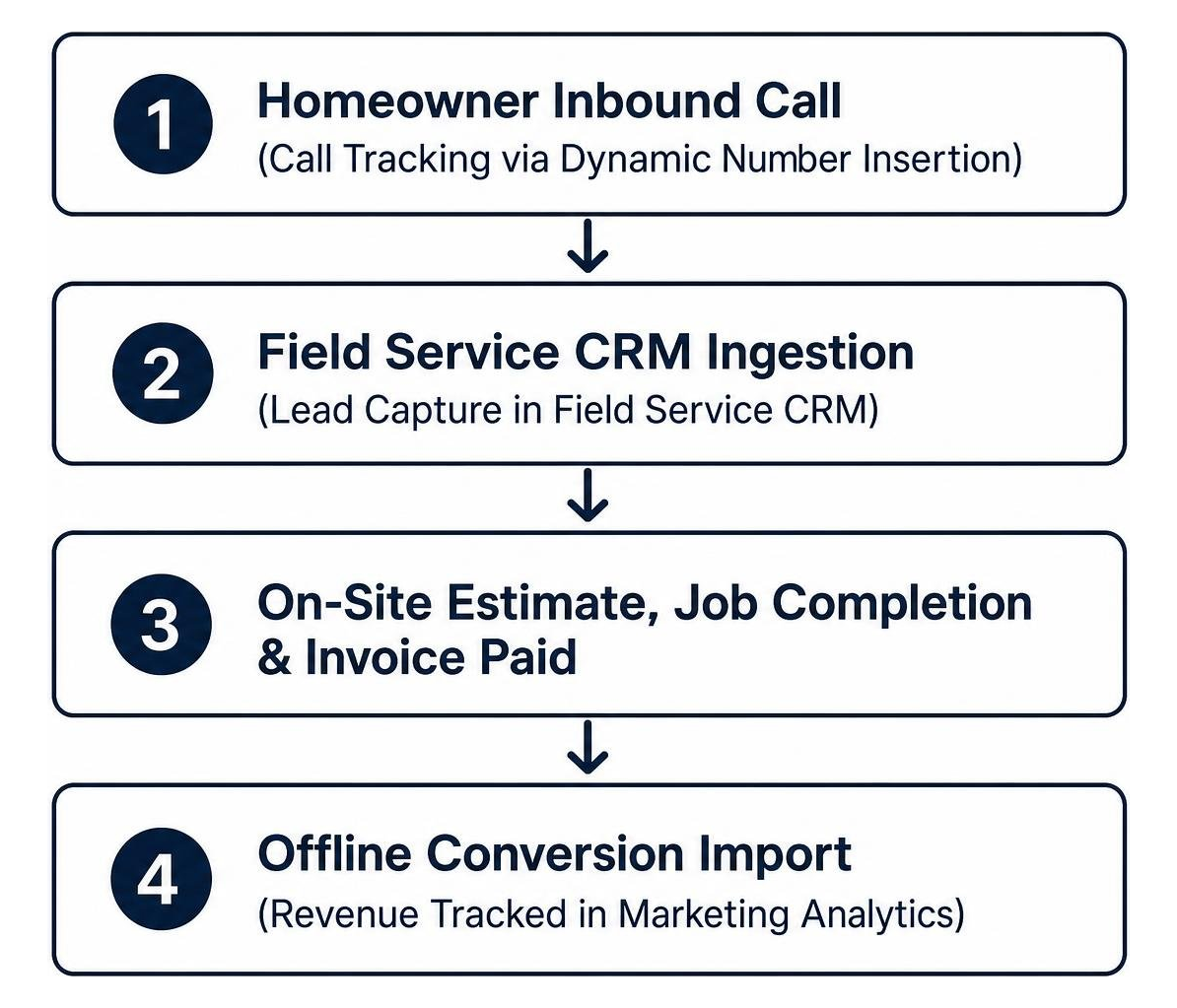
Integrating call tracking data with field management systems like ServiceTitan establishes closed-loop revenue attribution. Analyzing call recordings and transcripts provides valuable insights into customer objections, pricing questions, and dispatch conversion rates. Furthermore, implementing offline conversion import allows your analytics systems to register which digital channels generate signed contracts, enabling more informed marketing budget allocation.
Frequently Asked Questions About Home Services Lead Generation
What is the most effective free lead generation strategy for home services?
The single most effective free strategy is optimizing your Google Business Profile while systematically collecting five-star customer reviews. Because the majority of homeowners search with local intent during maintenance emergencies, ranking in Google’s local 3-pack generates high-intent inbound calls without recurring media spend. Combining this with structured referral requests from satisfied clients creates a consistent stream of zero-cost, exclusive leads.
How do home service businesses calculate lead generation ROI without paid ads?
Contractors can measure organic marketing ROI by tracking four core metrics within their CRM and call analytics software:
- Organic Lead Volume: The total number of verified calls and form submissions generated through organic search and directory profiles.
- Booking & Close Rate: The percentage of organic inquiries that convert into dispatched estimates and paid invoices.
- Customer Acquisition Cost (CAC): Total investments in website maintenance, SEO management, and review tools divided by the number of acquired organic customers.
- Customer Lifetime Value (CLV): The total cumulative revenue an organic client produces over their relationship with your company, including recurring service contracts and referrals.
When organic revenue significantly exceeds the overhead cost of website and search optimization, your organic marketing engine operates with positive ROI.
How quickly should a contractor follow up with inbound service leads?
Inbound web inquiries should be contacted within five minutes or less. Research demonstrates that responding within five minutes increases lead conversion odds dramatically compared to waiting thirty minutes or longer. Implementing automated SMS appointment reminders and direct website booking integration ensures homeowners receive instant confirmation, preventing them from calling a competing contractor.
Conclusion
Building a sustainable home services business requires moving away from unpredictable lead sources and establishing an owned, predictable customer acquisition engine. When you combine local search prominence, high-converting website design, active reputation management, and closed-loop call attribution, your business secures consistent booking volume regardless of broader market fluctuations.
At Wizerunek w Sieci / WWS — Web Development + SEO, we help small and mid-sized contractors across the Chicago metropolitan area build high-performing digital marketing assets that drive tangible business growth. Our team combines agency-level technical capabilities with personalized, local service, bilingual support in English and Polish, and a proven track record helping local businesses get more customers online. We proudly serve the Polish-American community (Polonia Chicago) and businesses throughout Illinois and across the United States.
To discover how tailored website SEO and performance marketing strategies can turn your online clicks into profitable booked jobs, contact WWS today for a free website audit.
- Office: 636 S River Rd #218, Des Plaines, IL 60016
- Website: wizerunekwsieci.com